Your student has spent years working toward a Service Academy appointment or ROTC scholarship. Then a DQ code arrives for back pain they had during football season two years ago. The condition resolved. They returned to varsity sports. And DoDMERB still issued a DoDMERB back pain disqualification.
This is one of the most common situations families contact us about. Back pain is a DQ condition, but the standard is specific. Seven defined criteria determine whether a history of back pain actually meets the threshold. Knowing exactly which criteria apply is the difference between a panic spiral and a plan.
One applicant we worked with received a DQ code for back pain from a wrestling injury in sophomore year. He had no pain at the time of his DoDMERB exam and was playing varsity lacrosse. His waiver was approved after his family submitted an MRI showing full resolution, a return-to-activity note from his orthopedic surgeon, and a letter from his lacrosse coach confirming he had played a full season without symptoms. — DoDMERB Qualified case file
Key Takeaways
- Back pain in the last 24 months triggers a DQ under DoDI 6130.03 when it meets any of seven criteria — such as requiring medication for more than 6 weeks, lasting more than 6 weeks with treatment beyond self-care, requiring interventional procedures, or limiting a physically active lifestyle. A single brief episode treated with rest does not automatically disqualify.
- Lumbar disc pathology (herniation, bulge, protrusion, extrusion) is disqualifying if associated with symptoms, treatment, or activity limitations in the last 24 months, or with any history of recurrent symptoms
- Spondylolysis and spondylolisthesis carry a "history of" standard. A past diagnosis triggers a DQ regardless of whether the applicant is currently asymptomatic and playing sports.
- A DQ is not a final denial: waivers are commonly granted for back pain, disc conditions, and spondy cases with the right documentation; spinal fusion carries the most limited waiver prospects
- Waiver reviewers focus on imaging chronology, frequency of care, medications used, and documented return to strenuous activity. They do not rely solely on how the applicant feels at the time of the exam.
The 7 Back Pain Triggers DoDMERB Actually Uses
Under DoDI 6130.03, back pain is not disqualifying because it was severe. It is disqualifying because of what was done about it, or how it presented, within the last 24 months. This distinction matters enormously for families who assume a single sports injury will not be flagged.
The standard addresses any back condition in the last 24 months that meets at least one of seven specific criteria. Meeting even one is sufficient for a DQ code.
"History of any condition, in the last 24 months, or any recurrence, including but not limited to the spine or sacroiliac joints, with or without objective signs, if: (1) It prevented the individual from successfully following a physically active avocation in civilian life, or was associated with local or radicular pain, muscular spasms, postural deformities, or limitation in motion; (2) It required external support; (3) It required frequent treatment or limitation of activities of daily living or a physically active lifestyle; or (4) It required the applicant to use medication for more than 6 weeks. (5) It caused one or more episodes of back pain lasting greater than 6 weeks requiring treatment other than self-care. (6) It involved surgery to the spine or spinal cord, other than a single-level lumbar or thoracic diskectomy, meeting the criteria in Paragraph 6.16.i. (7) It required interventional procedures, including, but not limited to, spinal injections, nerve blocks, or radio ablation procedures." — DoDI 6130.03, Section 6.16.b
| Trigger | What It Means |
|---|---|
| 1. Activity limitation or associated symptoms | The condition prevented a physically active avocation, or was associated with local or radicular pain, muscular spasms, postural deformities, or limitation in motion |
| 2. External support | Required a brace, corset, or other external support device |
| 3. Frequent treatment or lifestyle limitation | Required frequent medical treatment, or limited activities of daily living or a physically active lifestyle |
| 4. Prolonged medication | Required the applicant to use medication for more than 6 weeks |
| 5. Extended back pain | One or more episodes of back pain lasting more than 6 weeks requiring treatment beyond self-care |
| 6. Spine surgery | Surgery to the spine or spinal cord, other than a qualifying single-level diskectomy |
| 7. Interventional procedures | Spinal injections, nerve blocks, radio ablation, or similar interventional procedures |
Not every applicant who reports a back pain history will receive a DQ. When an applicant positively endorses back pain on the medical history form, DoDMERB sends a back pain supplemental questionnaire. That questionnaire gathers detail on frequency, treatment, medications, and functional impact, aligned precisely to these seven triggers. Completing it accurately determines whether a DQ code is issued at all.
Lumbar Disc Pathology: Herniations, Bulges, and the 24-Month Rule
A disc bulge found incidentally on an MRI two years ago, with no symptoms and no treatment, is a very different case from a disc herniation that sent your student to physical therapy last spring. DoDI 6130.03 covers all four forms of lumbar disc pathology under the same standard, but the DQ threshold turns on symptoms, treatment, and activity limitations, not the imaging finding alone.
The intervertebral discs between each vertebra act as shock absorbers and contribute to spinal stability. Damage ranges in severity: a bulge (disc material pushes outward but remains intact), a herniation (material breaks through the disc wall), a protrusion (herniation contained by the outer layer), or an extrusion (material escapes the outer layer entirely). All four types fall under the same DQ criterion.
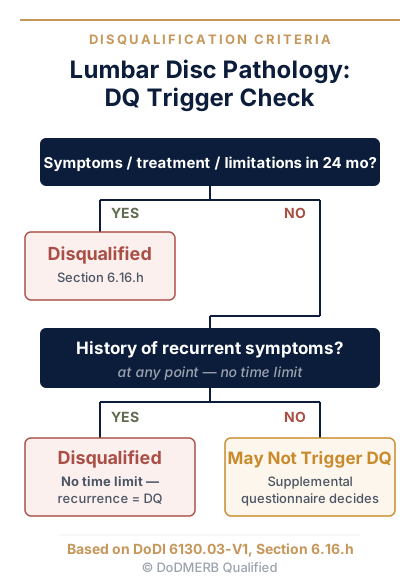
"History of lumbar disc pathology, including, but not limited to, bulges, herniations, protrusions, and extrusions associated with symptoms, treatment, or limitations of activities of daily living or a physically active lifestyle, in the last 24 months or any history of recurrent symptoms." — DoDI 6130.03, Section 6.16.h
The DQ threshold has two paths. First: symptoms, treatment, or limitations of activities of daily living or a physically active lifestyle associated with the disc pathology within the last 24 months. Second: any history of recurrent symptoms associated with the disc pathology, with no time limitation.
Surgery for a herniated disc is addressed separately under Section 6.16.i. All surgery to correct herniated nucleus pulposus is disqualifying, with one narrow exception: a single-level lumbar or thoracic diskectomy that is currently asymptomatic with full resumption of unrestricted activity for at least 12 months. Any other disc surgery — including multi-level procedures, cervical diskectomy, or any diskectomy with residual symptoms — requires a waiver. Spinal fusion is addressed separately under Section 6.16.d and is disqualifying regardless of timing or symptoms.
For disc cases that meet DQ criteria, the waiver authority also looks at whether the applicant has returned to demanding physical activity since resolution. A physician clearance note explicitly stating return to full, unrestricted activity is foundational to this case.
Spondylolysis and Spondylolisthesis: Why Past History Still Disqualifies
Your child was diagnosed with spondylolysis two years ago. She rested, completed physical therapy, received clearance from her orthopedic surgeon, and returned to gymnastics. She has had no pain since. DoDMERB still issued a disqualification. This is not an error. It is how the standard works.
Spondylolysis is a stress fracture of the PARS interarticularis, the thinnest and weakest part of the vertebra. It connects the vertebral body to the facet joint. Athletes who place repeated stress on the lower back are most susceptible: gymnasts, football linemen, and weightlifters see this injury most often. A common presentation is back pain that worsens with activity and eases with rest, sometimes with radiation into one leg.
Spondylolisthesis develops when the fracture allows the vertebra to slip forward relative to the vertebra below it. Slippage is assessed as a percentage of the vertebral width. Less than 25% slippage with no evidence of progression is the most favorable picture for waiver consideration. Greater than 50% slippage is generally not waivered by military accession authorities.
The regulatory language is straightforward. Unlike Section 6.16.b, which applies a 24-month time window, spondylolysis and spondylolisthesis use a "history of" standard with no time limitation:
"History of spondylolysis or spondylolisthesis, congenital or acquired." — DoDI 6130.03, Section 6.16.k
Any documented history of either condition — whether diagnosed last year or in middle school — triggers a DQ. There is no distinction between the two conditions in the regulatory text and no symptom window. This makes the waiver package the critical path: imaging showing a healed fracture with no active stress reaction, surgeon clearance, and documented return to demanding activity are what the waiver authority evaluates.

The waiver authority's review focuses on two questions. First: is there evidence of full healing? The most recent imaging study should show a healed PARS fracture with no active stress reaction. An unhealed fracture or ongoing stress reaction significantly reduces waiver prospects. Second: what is the recurrence risk? Clinical notes, slippage percentage on imaging, and documented return to sport all factor into this assessment.
Evidence of physical activity since resolution strengthens the waiver case. A coach letter confirming a full season of participation, race results, or documentation of varsity play in a back-loading sport all support the argument that recurrence risk is low. Return to sport does not erase the diagnosis, but it gives the reviewer data to work with.
What the Waiver Authority Reviews for Every Spine Case
DoDMERB does not decide your student's waiver. It issues the disqualification code. Each commissioning source, whether a Service Academy or an ROTC program, has its own independent waiver authority that reviews the medical file without any involvement from DoDMERB. Understanding what that reviewer is actually assessing changes how families prepare.
The waiver authority is conducting a risk assessment. The core questions are: How severe was this condition? How likely is it to recur during intense military training? Can this person function reliably in a field environment without predictable breakdown or need for special accommodation?
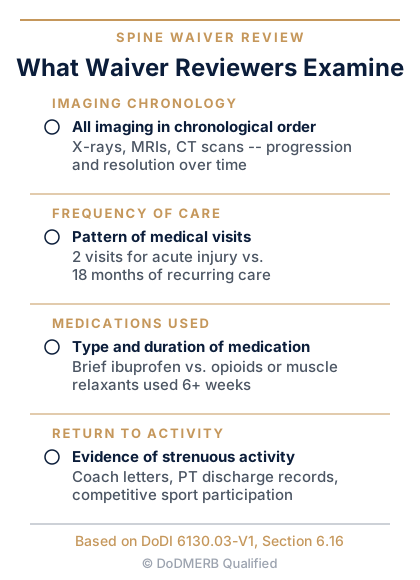
For all spine cases, reviewers examine the following:
Imaging studies in chronological order. X-rays, MRIs, and CT scans taken over time tell the story of the condition's progression and resolution far better than a single recent scan. For disc conditions, the MRI shows the type and extent of pathology and whether adjacent structures were involved. For spondylolysis, imaging reveals whether the PARS fracture is active or healed.
Frequency of medical care. Two physician visits for an acute injury followed by full resolution is very different from a recurring need for care over 18 months. Reviewers look for patterns across the whole clinical course, not just the most recent entry.
Medications used and duration. A brief course of ibuprofen signals a different severity level than prescription muscle relaxants or opioid analgesics. Duration matters: medication required for more than six weeks for a spine condition is a specific flag in the regulatory language.
Evidence of return to strenuous activity. Coach letters, PT discharge records, and documentation of actual participation in demanding sport since resolution complete the picture. This is where families who have evidence of competitive sport participation hold an advantage.
Related: For a complete list of DoDMERB disqualification codes related to spine conditions, see the DoDMERB DQ Codes Lookup Tool.
DoDMERB Qualified
Not sure what your student's spine DQ means for their application timeline?
Our team reviews your student's specific medical history against each commissioning source's waiver standards and helps families identify the documentation most likely to support a successful waiver review.
The Documentation Checklist: What to Gather Before the Remedial Letter
Waiting for DoDMERB's remedial request to start gathering records adds three to six weeks to an already compressed timeline. The records the waiver authority needs are the same records your student's physicians already have. Starting the process now means a faster response and a shorter gap in the review cycle.
When DoDMERB issues a remedial request after a spine-related DQ code, the letter will specify which records to upload through the DMACS 2.0 portal. Having those records organized and ready before the request arrives reduces the window between DQ and waiver submission significantly.
All Spine Conditions
- All imaging study reports in chronological order: x-rays, MRIs, CT scans related to the spine condition
- Physician clinical notes from the first visit through the most recent follow-up
- Return-to-full-activity clearance letter from the treating physician, explicitly stating unrestricted activity is permitted
- Physical therapy records including discharge date and documented functional outcome
- Documentation of strenuous physical activity since resolution: coach letters, race results, or records of return to demanding sport
If Surgery Was Involved
- Operative report with the name of the procedure and structures treated
- Post-operative visit notes from all follow-up appointments through final clearance
- Final orthopedic exam documentation confirming full range of motion, no laxity, and no residual symptoms
The DMACS 2.0 portal is where families upload remedial records. Contact your DoDMERB case manager for upload guidance specific to your DQ code. Organized, labeled files upload faster and give the reviewer a cleaner record to assess.
Related: For the full overview of DoDMERB disqualifications and waiver paths, see DoDMERB Disqualifications: Common Conditions and Waiver Paths.
Frequently Asked Questions
My student had back pain from a football injury two years ago and rested for a week. Is that disqualifying?
Probably not. A single brief episode managed with rest and OTC medication that did not prevent a physically active lifestyle, require medication for more than 6 weeks, involve treatment beyond self-care for more than 6 weeks, or require external support does not meet the seven criteria in DoDI 6130.03 Section 6.16.b. The back pain supplemental questionnaire will ask about these specifics. Complete it accurately.
Does DoDMERB focus on the diagnosis or on current function?
Both. Specific diagnoses, including any history of spondylolysis or spondylolisthesis, trigger a DQ regardless of current function. Current function then shapes the waiver review: how severe was the condition and how likely is it to recur? The diagnosis predicts risk; documented recovery informs the reviewer's assessment.
My student's disc herniation was treated more than two years ago and they have no current symptoms. Are they still DQ'd?
Not necessarily. DoDI 6130.03 Section 6.16.h requires symptoms, treatment, or activity limitations within the last 24 months, or any history of recurrent symptoms. An applicant whose disc condition resolved completely more than 24 months ago, with no recurrent symptoms and no ongoing treatment, may not meet the DQ criteria. The supplemental questionnaire surfaces the relevant details.
My student plays varsity lacrosse after recovering from spondylolysis. Why is the history still disqualifying?
The standard in Section 6.16.k is a "history of" standard. Any documented history of spondylolysis or spondylolisthesis, congenital or acquired, triggers a DQ regardless of current symptoms or timeline. Return to sport helps the waiver case but does not eliminate the DQ or the review requirement.
Is spinal fusion ever waiverable?
Spinal fusion carries the most limited waiver prospects among all spine conditions in DoDI 6130.03. It appears as a DQ trigger in multiple subsections of Section 6.16, including correction of curvature and disc surgery. Applicants in this situation should speak directly with the medical authority at their specific commissioning source.
What is the DoDMERB back pain supplemental questionnaire?
DoDMERB sends this questionnaire to applicants who positively endorse a back pain history on the medical history form. It gathers detail on frequency, duration, treatment, medications, and functional impact, aligned to the seven criteria in Section 6.16.b. Completing it accurately determines whether a DQ code is issued. Do not minimize or omit relevant history on this form.
Does the timing of a DQ matter differently for Academy applicants versus ROTC scholarship recipients?
Yes. Service Academy applicants generally need to resolve medical qualification by approximately April 15 of their entry year. ROTC scholarship recipients have until approximately December of their college freshman year. Families with complex spine cases may find the ROTC pathway gives more time to gather documentation and support a waiver submission before the deadline becomes critical.