Your student-athlete has been cleared to play after every concussion. The team doctor signed off. The school trainer confirmed it. None of that matters to DoDMERB.
A concussion history DoDMERB evaluation does not automatically disqualify your child. But the number of concussions, the timing, and how they were documented determine everything.
"Our son had two concussions. We submitted a pediatrician letter confirming he had been symptom-free for a year and a half and was cleared for all activities. The waiver came through within days of his Naval Academy acceptance." — Parent of USNA appointee
This guide covers the four DoDI 6130.03 criteria that trigger concussion-related disqualification, the episode-count thresholds most families do not know exist, and the documentation strategy that wins waivers. This applies to service academy and ROTC applicants.
Key Takeaways
- Three or more lifetime concussions is an automatic DQ with no time limit and no severity requirement (DoDI 6130.03, Section 6.26.j)
- Two concussions within any 12-month period is independently disqualifying, even with full symptom resolution
- Post-concussion syndrome lasting more than one month is a separate DQ, even with only one concussion (Section 6.26.k)
- Being "cleared to play" by a sports medicine doctor does not equal DoDMERB qualification
- Post-concussion headaches can trigger a second, independent DQ under the headache criteria (Section 6.26.e)
How DoDMERB Evaluates Concussion History: The Four DQ Pathways
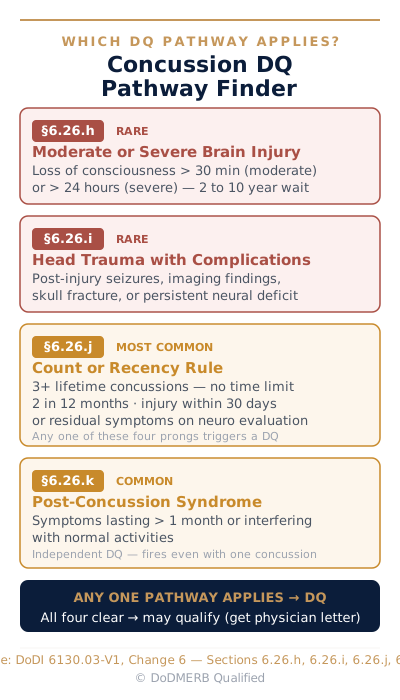
DoDMERB does not have a single "concussion disqualification." It has four separate regulatory criteria, and triggering any one independently disqualifies your child.
Section 6.26.h: Moderate or Severe Brain Injury
"History of moderate or severe brain injury." — DoDI 6130.03, Section 6.26.h
Moderate means loss of consciousness greater than 30 minutes and up to 24 hours. Severe means loss of consciousness exceeding 24 hours. The history alone disqualifies. Moderate TBI carries a 2-year clearance window; severe TBI requires 5 to 10 years.
Section 6.26.i: Head Trauma with Complications
"History of head trauma if associated with: (1) Post-traumatic seizure(s) occurring more than 30 minutes after injury; (2) Persistent motor, sensory, vestibular, visual, or any other focal neurological deficit; (3) Persistent impairment of cognitive function; (4) Persistent alteration of personality or behavior; (5) Cerebral traumatic findings, including, but not limited to, epidural, subdural, subarachnoid, or intracerebral hematoma on neurological imaging; (6) Associated abscess or meningitis; (7) Cerebrospinal fluid rhinorrhea or otorrhea persisting more than 7 days; (8) Penetrating head trauma, including radiographic evidence of retained foreign body or bony fragments secondary to the trauma, or operative procedure in the brain; or (9) Any basilar or depressed skull fracture." — DoDI 6130.03, Section 6.26.i
A football concussion with normal imaging and no lasting deficits would not fall under 6.26.i. This section covers rare but serious cases.
Section 6.26.j: Mild Brain Injury by Count and Recency
"History of mild brain injury if: (1) The injury occurred within the last month; (2) Neurological evaluation shows residual symptoms, dysfunction or activity limitations, or complications; (3) Two episodes of mild brain injury occurred with or without loss of consciousness within the last 12 months; or (4) Three or more episodes of mild brain injury." — DoDI 6130.03, Section 6.26.j
The most common pathway for student athletes. Any one of four prongs disqualifies:
- Injury within the last month
- Neurological evaluation shows residual symptoms, dysfunction or activity limitations, or complications
- Two episodes within the last 12 months (with or without loss of consciousness)
- Three or more episodes (no time limit)
One concussion within 30 days equals a DQ. Three lifetime concussions with zero current symptoms equals a DQ.
Section 6.26.k: Post-Concussion Syndrome
"History of persistent post-concussive symptoms that interfere with normal activities or have duration of more than 1 month. Symptoms include, but are not limited to, headache, vomiting, disorientation, spatial disequilibrium, impaired memory, poor mental concentration, shortened attention span, dizziness, or altered sleep patterns." — DoDI 6130.03, Section 6.26.k
If post-concussion symptoms lasted more than one month or interfered with normal activities, this fires as a separate DQ, independent of the concussion count.
The Four Concussion DQ Pathways
| DoDI Section | What Triggers It | Who It Affects | Waiver Difficulty |
|---|---|---|---|
| §6.26.h | Moderate/severe brain injury | LOC >30 min to 24 hrs (moderate); >24 hrs (severe) | Hard (2-10 year wait) |
| §6.26.i | Head trauma + complications | Post-injury seizures, imaging findings, persistent deficits | Hard (prove resolution) |
| §6.26.j | Count/recency (3+ lifetime, 2 in 12 months, recent, residual) | Most student athletes | Moderate (documentation-dependent) |
| §6.26.k | Post-concussion symptoms >1 month | Lingering headaches, dizziness, sleep issues | Moderate (prove resolution) |
Related: Migraine and Military Disqualification
After this section, you should know which of the four DQ pathways applies to your child's specific concussion history.
The Concussion Count Rules: What One, Two, or Three Concussions Means for Your Child
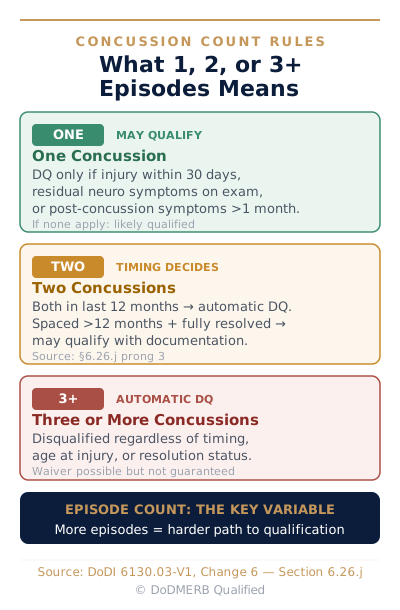
One concussion can disqualify your child. Three concussions will disqualify your child. The difference is timing, and the regulation draws hard lines.
One Concussion: Usually Qualifies, with Two Exceptions
A single lifetime mild brain injury does not automatically disqualify.
Exception 1 (Section 6.26.j, prong 1): The concussion occurred within the last 30 days. Air Force Academy data shows return-to-play averaged 29.4 days, so an applicant cleared by sports medicine could still be within the DoDMERB window.
Exception 2 (Section 6.26.j, prong 2): A neurological evaluation shows any residual symptoms, dysfunction, or activity limitations.
If the concussion was recent, delay the exam until 30 or more days post-injury.
Two Concussions: Timing Is Everything
Two lifetime concussions are not automatically disqualifying if they occurred more than 12 months apart and neither is within the last month. Two concussions within any 12-month period (Section 6.26.j, prong 3) is an automatic DQ regardless of current symptom status.
Research consistently shows that a prior concussion significantly increases the risk of a subsequent concussion. This is the deployment-readiness rationale DoDMERB applies.
Three or More Concussions: The Hard Line
Section 6.26.j, prong 4: three or more episodes of mild brain injury equals a DQ with no time limit.
It does not matter if they happened at ages 8, 12, and 16. It does not matter if all symptoms fully resolved. The regulation draws a categorical line. Waivers are technically possible but require comprehensive neuropsychological testing (ImPACT, ANAM), a neurologist evaluation, and compelling evidence of full cognitive function.
After this section, you should know your child's exact episode count, whether timing creates a DQ trigger, and what action to take before the exam.
Post-Concussion Syndrome: The Hidden DQ That Catches Families Off Guard
Your child had one concussion. It resolved. They are back to normal. But if post-concussion symptoms lasted more than one month, DoDMERB has a separate disqualification for that. This catches families who focused only on the concussion count.
What Section 6.26.k Actually Says
"History of persistent post-concussive symptoms that interfere with normal activities or have duration of more than 1 month." — DoDI 6130.03, Section 6.26.k
The regulation's symptom list is not exhaustive. Fifteen percent of service academy cadets with a concussion history had symptoms lasting more than one month. This is not rare.
How PCS Stacks on Top of Section 6.26.j
Post-concussion syndrome is an independent DQ. It fires even if your child had only one concussion and is outside the 30-day window.
Consider this scenario: one concussion, six months ago, headaches lasted six weeks. That is a DQ under Section 6.26.k even though Section 6.26.j prong 1 (recency) is clear.
What "Resolved" Means for PCS Waiver Purposes
All symptoms must be fully resolved and documented as such. Neuropsychological testing (ImPACT, ANAM) provides objective evidence of cognitive recovery. The longer the symptom-free period, the better the waiver case.
After this section, you should understand whether post-concussion syndrome applies to your child's case and what documentation proves resolution.
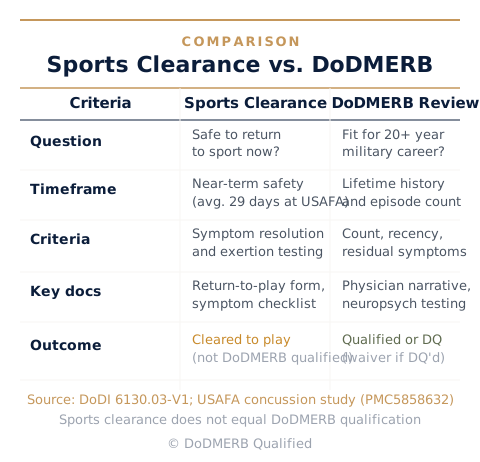
Why "Cleared to Play" Does Not Mean DoDMERB Qualified
Your child's sports medicine doctor cleared them to play. That clearance means nothing to DoDMERB. Return-to-play protocols and military medical standards evaluate different risks on different timelines.
What Return-to-Play Actually Evaluates
Sports clearance answers one question: "Is this athlete safe to return to this sport right now?" The evaluation uses symptom resolution and graduated exertion testing. At the Air Force Academy, average return-to-play was 29.4 days. This is a near-term athletic safety assessment, not a career fitness determination.
What DoDMERB Actually Evaluates
DoDMERB answers a fundamentally different question: "Is this applicant medically fit for a 20-plus year military career that includes combat environments, austere conditions, and limited medical access?"
DoDMERB applies lifetime episode counts, recurrence risk assessment (research shows prior concussion significantly increases subsequent concussion risk), and persistent symptom screening. A concussion history DoDMERB review looks at the full picture, not just current fitness.
What This Means for Your Family
Get a separate, DoDMERB-focused physician letter that addresses the regulatory criteria directly. The sports clearance letter can supplement but cannot replace documentation that speaks to the DoDI standards.
After this section, you should understand why sports clearance documentation alone is insufficient and what additional documentation DoDMERB requires.
What DoDMERB Reviews: Records, DQ Codes, and the AMI Process
The concussion itself is not what disqualifies your child. The medical record describing it is. DoDMERB reviewers make decisions based on documentation, and a poorly worded record from years ago can be more damaging than the original injury.
How Concussion History Enters the DoDMERB Process
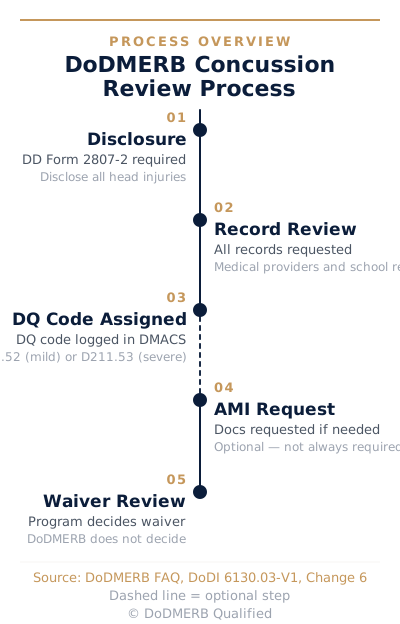
The DD Form 2807-2 medical history questionnaire includes head injury questions. Any "yes" answer triggers review. DoDMERB then pulls records from disclosed providers.
Research at service academies found that 51% of documented concussions were delayed reports. Undisclosed history surfaces through school records, sports physicals, or emergency visits. Full disclosure paired with strong documentation is the foundation of every successful concussion history DoDMERB case.
DQ Codes for Concussion History
D211.52 corresponds to mild brain injury (Section 6.26.j). D211.53 covers significant head trauma (Sections 6.26.h and 6.26.i). D211.40 and D211.50 are headache codes triggered when post-concussion headaches meet Section 6.26.e. An applicant can receive multiple DQ codes from a single concussion history.
The AMI Request: Additional Medical Information
If records are ambiguous, DoDMERB issues an AMI requesting specific documentation. An AMI is not a DQ. It is a request for clarification. Respond promptly with only the requested information.
An old record showing "symptoms still constant" is more damaging than the underlying injury. If the record is outdated, the AMI response must include a current neurologist evaluation that overrides the stale language.
Related: Seizure History and Military Service
After this section, you should understand what records DoDMERB reviews, what DQ codes apply to concussion history, and how to handle an AMI request.
Building Your Concussion Waiver Strategy: Documentation That Works
A concussion DQ is not a rejection. It is the start of a documentation exercise, and the families who approach it with the right strategy get waivers.
Step 1: Gather All Original Concussion Records
Collect emergency department reports, sports medicine evaluations, school nurse incident reports, and pediatrician visit notes. Include every documented concussion. DoDMERB will cross-reference school and sports records.
Step 2: Get a Current Physician Narrative Letter
This is the single most important document. The letter must include concussion dates, current symptom-free status, duration symptom-free, and clearance for all physical and cognitive activity. Use DoDI language: "no residual symptoms, dysfunction, or activity limitations."
Step 3: Neurologist Evaluation and Neuropsych Testing (If Needed)
A neurologist evaluation is required if residual symptoms were ever documented, if post-concussion syndrome was diagnosed, or if the applicant has three or more concussions. ImPACT is the standard tool in sports concussion evaluation. ANAM is the military's own cognitive testing tool.
Step 4: Understand Who Decides Your Waiver
DoDMERB assigns DQ codes but does not grant waivers. Each commissioning program has independent waiver authority. Army ROTC and Navy ROTC national scholarship holders are automatically considered for waivers.
Step 5: Apply to Multiple Programs
Different waiver authorities means different approval rates. An applicant DQ'd and denied by one program can be waived by another.
Step 6: Timing the Exam
If the concussion was recent (less than 30 days), delay the exam. If the injury was a moderate TBI, wait 2 years. If it was a severe TBI, wait 5 to 10 years.
Concussion Waiver Documentation Checklist
- All original concussion records (ER, sports medicine, school nurse, pediatrician)
- Current physician narrative letter (symptom-free status, duration, full activity clearance)
- Neurologist evaluation (if residual symptoms ever documented or 3+ concussions)
- Neuropsychological testing results, ImPACT or ANAM (if neurologist referral)
- Sports medicine return-to-play documentation (supplemental, not primary)
- Academic records showing normal cognitive function post-injury
After this section, you should have a step-by-step documentation plan and know exactly which records to gather for your child's waiver packet.
DoDMERB Qualified
Worried about how your child's concussion history will affect their DoDMERB evaluation?
Our team helps families build the documentation strategy that wins concussion waivers. Talk to LTC Kirkland about your child's case.
Concussion Waiver Difficulty by Scenario: Where Your Child Stands
Not all concussion histories are equal in DoDMERB's eyes. The table below maps common scenarios to their regulatory triggers and expected outcomes.
| Scenario | DoDI Criteria Triggered | DQ Likely? | Waiver Difficulty | Key Action |
|---|---|---|---|---|
| 1 concussion, >30 days ago, no residual symptoms | None (if truly clear) | No | N/A, may qualify outright | Get physician letter confirming resolution |
| 1 concussion, <30 days ago | §6.26.j prong 1 | Yes | Easy. Delay exam | Reschedule to 30+ days post-injury |
| 1 concussion, PCS >1 month | §6.26.k | Yes | Moderate | Neurologist letter + neuropsych testing |
| 2 concussions, >12 months apart, resolved | §6.26.j (may not trigger) | Possible | Moderate | Physician narrative + duration symptom-free |
| 2 concussions within 12 months | §6.26.j prong 3 | Yes | Moderate-Hard | Neurologist eval + resolution evidence |
| 3+ concussions, fully resolved | §6.26.j prong 4 | Yes | Hard | Neuropsych testing + multi-program strategy |
| Moderate/severe TBI | §6.26.h | Yes | Hard, time-gated | Wait 2-10 years + neurological workup |
| Any concussion + headaches meeting §6.26.e | §6.26.j/k + §6.26.e | Yes (double DQ) | Hard | Address both DQs separately |
Most single-concussion athletes with full resolution qualify or receive a waiver readily. Difficulty steepens with episode count and symptom persistence.
After this section, you should be able to identify your child's specific scenario and understand the expected difficulty level.
The Bottom Line
A concussion history does not end your child's path to a service academy or ROTC scholarship.
Clear path: Single concussion, more than 30 days ago, no residual symptoms. Get a physician letter and proceed.
Waiver needed, strong odds: Two concussions spaced apart, or resolved post-concussion syndrome. Physician narrative letter and neurologist evaluation build the case.
Waiver needed, harder path: Three or more concussions, moderate/severe TBI, or persistent symptoms. Neuropsychological testing, multi-program strategy, and professional guidance give your child the best chance.
The families who succeed build the right documentation before the exam, not after the DQ letter. If your family needs guidance, talk to LTC Kirkland.
Frequently Asked Questions
Will one concussion disqualify me from DoDMERB?
Not automatically. A single concussion disqualifies only if it occurred within the last 30 days, if residual symptoms are present, or if post-concussion syndrome lasted more than one month. Most single-concussion applicants qualify or receive waivers.
How many concussions automatically disqualify you from military service?
Three or more lifetime concussions is an automatic DQ under Section 6.26.j, with no time limit. Two concussions within any 12-month period is also independently disqualifying.
Does post-concussion syndrome disqualify you from DoDMERB?
Yes. Persistent post-concussion symptoms lasting more than one month or interfering with normal activities is an independent DQ under Section 6.26.k, regardless of how many concussions your child has had.
Does being cleared to play sports mean I will pass DoDMERB?
No. Sports medicine clearance evaluates short-term athletic safety. DoDMERB evaluates fitness for a 20-plus year military career. A sports-cleared athlete with three lifetime concussions is still DQ'd under Section 6.26.j.
Can you get a waiver for concussion history at a service academy?
Yes. Waivers are granted for concussion-related DQs, especially for one or two concussions with documented full resolution. The commissioning program, not DoDMERB, makes the waiver decision.
What documentation do I need for a DoDMERB concussion waiver?
A current physician narrative letter is the most important document. It should state the number of concussions, dates, symptom-free status, duration symptom-free, and clearance for all activity. Neuropsychological testing may be needed for three or more concussions.
Who decides DoDMERB waivers, DoDMERB or the academy?
The commissioning program decides. DoDMERB only assigns DQ codes. Each program has independent waiver authority with different risk tolerances. Applying to multiple programs maximizes your child's chances.
How long should I wait after a concussion before taking the DoDMERB exam?
At least 30 days for a mild concussion, as Section 6.26.j prong 1 disqualifies any injury within the last month. Two years for moderate TBI. Five to ten years for severe TBI.
Can post-concussion headaches cause a separate DoDMERB disqualification?
Yes. If post-concussion headaches caused missed school or activities more than twice in 12 months, required prescription medication more than twice, or involved preventive medication, they trigger an independent DQ under Section 6.26.e. Both the concussion DQ and the headache DQ must be addressed separately.
What neuropsychological tests does DoDMERB use for concussion evaluation?
ImPACT (Immediate Post-Concussion Assessment and Cognitive Testing) is the most common in sports settings. ANAM (Automated Neuropsychological Assessment Metrics) is the military's standard tool. A neurologist narrative letter interpreting results is typically required alongside test scores.
The appearance of U.S. Department of Defense (DoD) visual information does not imply or constitute DoD endorsement.