Many families arrive at the waiver stage having already done a spirometry — and they expect that a normal result closes the chapter. It doesn't. A clean spirometry reading tells waiver authorities that your student's lungs function normally at rest. What it doesn't tell them is how those airways respond under provocation. That gap is exactly what the DoDMERB methacholine challenge test is designed to fill.
Understanding why this test exists, what the numbers mean, and what a waiver authority needs to see from the results is the difference between a well-prepared case and one that stalls for months waiting on missing documentation.
Key Takeaways
- Under DoDI 6130.03 Section 6.10.e, any use of asthma-type medications or symptoms of airway hyperresponsiveness after the 13th birthday is disqualifying — regardless of current health status.
- A normal spirometry is necessary but often not sufficient for a waiver. Waiver authorities want objective provocation testing when the history is unclear.
- A positive methacholine challenge is defined as an FEV1 drop of 20% or more from baseline. A normal result is a PC20 greater than 16 mg/mL.
- The most favorable waiver profile combines a remote asthma history, normal spirometry, normal methacholine challenge, several years off asthma medications, and current participation in high-intensity athletics.
- ROTC scholarship recipients have until approximately December of their freshman year to resolve medical qualification — giving significantly more time to gather specialist testing than the Academy April 15 deadline.
What DoDI 6130.03 Actually Says About Asthma — The Age-13 Standard
The question families ask us most often is: "My student hasn't used an inhaler in years. Why is this even an issue?"
The answer is in the regulatory text. Section 6.10.e of DoDI 6130.03 reads:
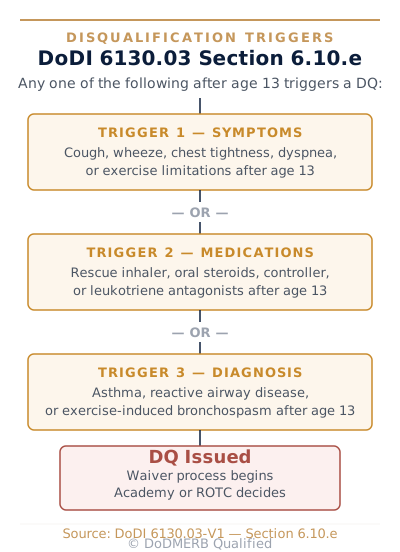
History of airway hyper responsiveness including asthma, reactive airway disease, exercise-induced bronchospasm or asthmatic bronchitis, after the 13th birthday. (1) Symptoms suggestive of airway hyper responsiveness include, but are not limited to, cough, wheeze, chest tightness, dyspnea, or functional exercise limitations after the 13th birthday. (2) History of prescription or use of medication (including, but not limited to, inhaled or oral corticosteroids, leukotriene receptor antagonists, or any beta agonists) for airway hyperresponsiveness after the 13th birthday.
Three separate triggers can produce a disqualification under this section. A diagnosis of asthma is one of them. But symptoms — even without a formal diagnosis — are also disqualifying. And medication use after the 13th birthday, including an as-needed rescue inhaler, is disqualifying on its own.
That last point trips families up more than any other. A single rescue inhaler prescribed at 16 for wheezing during a tough week of baseball practice meets the literal standard for disqualification. The student may feel completely fine today. The medical record still shows medication use after age 13. The DQ will be issued.
Here is what matters most for families at this stage: a disqualification is not a denial. It is the step that initiates the waiver process. The standard describes what triggers a DQ review. The waiver process is where the clinical context, the timeline, and the objective testing determine the actual outcome.
Three Tests DoDMERB Uses to Evaluate Airway Hyperresponsiveness
Not every applicant with an asthma history needs a methacholine challenge. The testing usually follows a ladder.
The first rung is baseline spirometry. This is the foundational pulmonary function test. Two measurements matter most. FEV1 is the maximum volume of air a person can blow out in one second of a forced, fast breath. FVC is the total amount of air that same person can forcefully exhale after taking the deepest breath possible. The ratio of FEV1 to FVC tells clinicians whether there is airflow obstruction.
The second rung is pre-and-post bronchodilator spirometry. The patient takes a bronchodilator (a medication that relaxes the airways) and spirometry is repeated. If baseline lung function is normal and does not change significantly after the bronchodilator, that result suggests there is no active, reversible obstruction. For many applicants with older, mild histories, this combination is sufficient.
The third rung — and the one waiver authorities are most interested in for borderline cases — is the methacholine challenge. The reason it gets requested even when resting spirometry looks fine is sensitivity. Resting spirometry measures how the airways perform at baseline. It does not test whether the airways are still hyperresponsive to triggers. An applicant could have normal FEV1 on a quiet Tuesday morning and still have airways that overreact under the conditions of military training: cold air, dust, sustained exertion, stress.
The methacholine challenge is the test that answers the question waiver authorities actually need answered: does this applicant's airway still behave like an asthmatic airway?
Related: For a full breakdown of how DoDMERB waiver decisions work after a disqualification is issued, see DoDMERB Remedial vs. Disqualification: What Each Status Actually Means.
How the Methacholine Challenge Test Works — Step by Step
The methacholine challenge test is a controlled provocation test run in a clinical pulmonology setting.
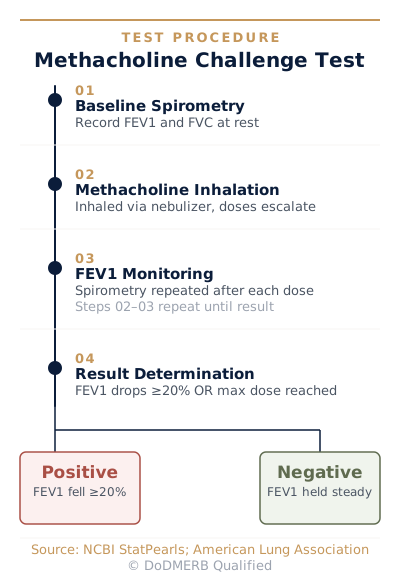
Before the test begins, the patient completes baseline spirometry to establish reference FEV1 and FVC values. Preparation matters: most protocols require stopping short-acting bronchodilators (rescue inhalers) several hours before the test and avoiding caffeine for at least four hours. Long-acting medications may require a longer hold period — the ordering provider will specify.
During the test, the patient inhales progressively higher doses of methacholine via nebulizer. Methacholine is a cholinergic agent that directly stimulates the smooth muscle receptors lining the airways, causing them to contract. In a person without airway hyperresponsiveness, the airways tolerate these doses without significant narrowing. In a person whose airways are still hyperresponsive, the smooth muscle overreacts and constricts.
After each dose, spirometry is repeated and FEV1 is measured. The test continues up the dose ladder until one of two things happens: FEV1 drops 20% or more from the baseline value, or the maximum dose is reached without that threshold being crossed.
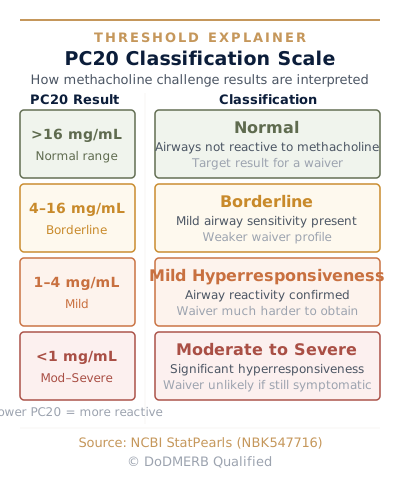
A drop of 20% or more is a positive result. The clinical measure used to characterize severity is the PC20, the concentration of methacholine required to produce that 20% drop. The lower the PC20, the more reactive the airways.
| PC20 Value | Interpretation |
|---|---|
| Greater than 16 mg/mL | Normal — airway hyperresponsiveness not present |
| 4.0–16 mg/mL | Borderline |
| 1.0–4.0 mg/mL | Mild hyperresponsiveness |
| Less than 1.0 mg/mL | Moderate to severe hyperresponsiveness |
A result above 16 mg/mL carries strong negative predictive value for asthma. It means the airways did not react even at high provocation doses. That is the result waiver authorities want to see.
One important caveat: false positives can occur. COPD, chronic bronchitis, allergic rhinitis, and recent respiratory infections can all produce elevated airway reactivity without true asthma. If your student tests positive but the clinical picture does not fit active asthma, that context belongs in the record package the waiver authority reviews.
The test is not appropriate for everyone. Applicants with FEV1 below 60% of predicted, recent heart events, or uncontrolled hypertension would not be candidates. A pulmonologist orders and oversees the test.
DoDMERB Qualified
Not sure whether your student needs a methacholine challenge test?
Our team can help organize current spirometry and clinical records. DoDMERB or the waiver authority will request a methacholine challenge if needed.
What a Normal Methacholine Challenge Means for Your Waiver Case
A normal result does not automatically grant a waiver. What it does is anchor the strongest possible waiver profile.
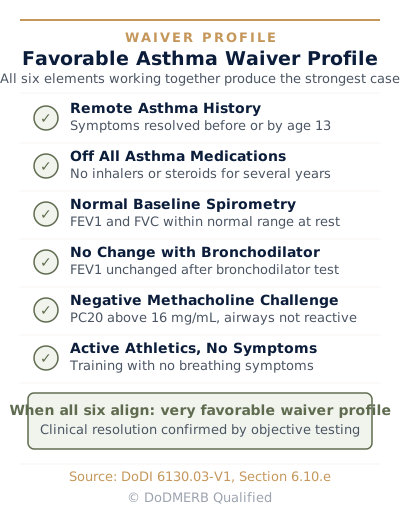
The waiver profile that consistently earns approval has six elements working together. The asthma history is remote. The last medication use was several years ago. Baseline spirometry is normal. Pre-and-post bronchodilator spirometry shows no significant change. The methacholine challenge is negative (PC20 above 16 mg/mL). And the applicant is currently competing in high-intensity athletics with no symptoms.
When all six of those elements are present, the objective evidence supports a clear picture: this applicant may have had airway hyperresponsiveness years ago, but the airways no longer behave that way. That is the picture waiver authorities are trying to construct from the documentation you provide.
The methacholine challenge is important precisely because it addresses the gap in the other tests. A student who stopped using an inhaler two years ago, runs cross-country, and has normal resting spirometry could theoretically still have subclinical airway hyperresponsiveness that only shows up under provocation. The challenge test rules that out. It converts a clinical argument ("seems fine") into an objective finding ("airways tested normal under provocation").
What waiver authorities cannot act on is the absence of documentation. A student who is genuinely fine but has no recent pulmonary function testing is a harder case to argue than a student with two years of clean objective data.
What an Abnormal Result Means — And Why Honesty Matters More Than the Outcome
A positive methacholine challenge means the airways are still hyperresponsive. That is a clinically significant finding, and waiver authorities will treat it that way.
A waiver is still theoretically possible for an applicant with a positive challenge result, but the threshold rises substantially. If the applicant is also still using inhalers, has had steroid bursts in the past year, or has exercise-limiting symptoms, the clinical picture is one of active or poorly controlled asthma. That is the profile that is, in the words of the physicians who review these cases, "much tougher, if not impossible" to waive.
The important point for families in this situation is not to try to engineer a clean result. Stopping necessary medications in the weeks before a test is dangerous. A student who genuinely needs a rescue inhaler can have an uncontrolled episode during training, during a physical exam, or during any high-exertion event. Beyond the safety issue, it does not work. Pharmacy logs go back years. A DoDMERB physician reviewer who sees that an inhaler was prescribed at 16, 17, and 18 — and that prescriptions abruptly stopped six weeks before the exam — has the same information as if the medications had been disclosed.
The path forward for an applicant with a currently positive challenge is straightforward even if it is not quick. Treat the condition properly under a physician's supervision. Allow genuine resolution to occur over time. When the condition is truly stable, when medications are no longer needed, and when objective testing confirms it — that is when the case becomes winnable. The waiver process is designed to reward genuine clinical resolution, not a temporarily suppressed prescription record.
Bronchitis Inhalers vs. Asthma — How DoDMERB Tells the Difference
One of the most common sources of anxiety in this category is the student whose medical record shows inhaler use — but the diagnosis was bronchitis, not asthma.
DoDMERB physicians understand the clinical reality here. Prescribing a short-course inhaler for bronchitis is standard of care. When an upper respiratory infection causes airway inflammation and wheezing, a physician prescribing albuterol is not diagnosing asthma. They are treating a transient symptom. If the medical record shows bronchitis as the diagnosis and the inhaler was prescribed for a short period as part of that treatment, DoDMERB will see it for what it is. The records will probably have bronchitis as the diagnosis, and treatment consisted of an inhaler and other medications — perhaps antibiotics. That scenario is not a DQ for asthma.
The picture changes when the pattern repeats. If a teenager presents multiple times over several years with cough, wheezing, and shortness of breath, receives a diagnosis of bronchitis each time, and requires an inhaler and a steroid course each visit — that pattern is itself evidence of airway hyperresponsiveness, regardless of what diagnosis appears on the encounter note.
The airways are responding to pathogens by constricting significantly enough to require bronchodilators and systemic steroids. That meets the functional definition of airway hyperresponsiveness under Section 6.10.e. A DQ can be issued even without the word "asthma" in any record.
For families in this situation, the key is making sure the primary clinical records tell the complete story. A summary note is not sufficient. The encounter records, the prescription history, and any pulmonology consultations all go into what a waiver authority reads.
How to Build Your Record Package Before a Remedial Arrives
The most effective thing a family can do right now — before any Remedial is issued — is organize the records so they are ready to upload the day one arrives.
DoDMERB issues Remedials through DMACS 2.0 requesting specific documents. The turnaround time available to respond is not long. Families who have already gathered their records move through this stage significantly faster than those who are searching for records at the same time they are trying to respond to a formal request.
For an asthma-related case, the records worth having organized include:
Medical History
- Primary care records showing all encounters with asthma, wheezing, or respiratory symptoms from age 13 forward
- Any pulmonology or allergy consultation notes
- Hospital or urgent care records for any asthma-related visit
Testing Reports
- Spirometry reports (dated, with FEV1 and FVC values)
- Pre-and-post bronchodilator spirometry, if done
- Methacholine challenge test report, if done (include the full printout with PC20 value)
Medication History
- Pharmacy log obtained directly from each pharmacy showing all prescriptions from age 13 forward with dates, medications, and quantities
Provider Statements
- A note from the treating physician or pulmonologist summarizing current status, date of last use, and any restrictions
A summary note from a physician is helpful as context, but primary records are what DoDMERB and waiver authorities actually read. Do not submit patient-portal printouts unless the remedial request expressly allows them. Obtain actual clinical records from the provider's office.
One final note on timing: ROTC scholarship recipients have until approximately December of their freshman year to complete medical qualification. If your student's asthma history is complex and the objective testing is not yet done, the ROTC pathway may provide enough additional runway to gather the documentation that makes the strongest case. Academy applicants face an April 15 deadline for the entry year and should not wait to initiate the process.
Frequently Asked Questions
Does every applicant with an asthma history need a methacholine challenge test?
No. The methacholine challenge is typically requested when there is a borderline or uncertain history — for example, an applicant who had symptoms or medication use after age 13 but claims full resolution. If baseline spirometry and pre-and-post bronchodilator testing are clearly normal and the history is remote, some waiver cases proceed without it. But when the history is ambiguous, waiver authorities routinely request it.
My student's spirometry was completely normal. Does that mean the methacholine challenge will be normal too?
Not necessarily. Resting spirometry measures airway function at baseline. The methacholine challenge measures how airways respond to provocation. Some applicants with normal resting spirometry still show airway hyperresponsiveness on the challenge test. That is why waiver authorities request both.
What if my student is still on a daily controller medication?
Ongoing controller medication use is evidence of active airway hyperresponsiveness under DoDI 6130.03. The waiver case is much harder to build while a student remains on daily asthma medication. The appropriate path is continued medical treatment until the physician determines the medication is no longer needed — not stopping medication early to clean up the record.
Can an applicant with a positive methacholine challenge still receive a waiver?
It depends on the service and the overall clinical picture. A mildly positive result in an applicant who otherwise has a remote history, no current symptoms, and no current medications is a different case than a highly positive result in someone still using daily controller medications. Waivers have been granted in borderline positive cases, but the bar is substantially higher than for a negative result.
How far in advance should the methacholine challenge be completed before the DoDMERB exam?
Start with current pre/post-bronchodilator spirometry and complete clinical records. DoDMERB or the waiver authority will request a methacholine challenge if it needs one. Do not obtain the challenge proactively before that request.
Does it matter which service your student is applying to?
The DQ standard under DoDI 6130.03 is the same across all services. What varies is each service's willingness to waive specific cases. Some services have historically been more flexible on resolved childhood asthma cases than others. That variability is handled at the waiver authority level, not at DoDMERB.
My student had one episode of wheezing at age 15 during a bad cold. Are they going to get DQ'd?
Possibly flagged for additional information — not automatically disqualified. DoDMERB physicians know that wheezing is a common symptom of respiratory infection and not only asthma. A single episode during an infection, treated with a short-course inhaler, documented as bronchitis — that is a different clinical picture than ongoing airway hyperresponsiveness. The encounter records tell the story. See the section above on bronchitis inhalers for more detail.
The Bottom Line
The methacholine challenge test exists to answer one clinical question: are these airways still hyperresponsive?
For applicants with a remote asthma history who are currently healthy, performing at a high athletic level, and have been off asthma medications for several years, a normal challenge result is the strongest piece of objective evidence available to support a waiver. It converts a "maybe resolved" history into documented clinical resolution.
For applicants whose airways are still reactive, the test reflects a medical reality that cannot be papered over. The right response is to continue treatment under a physician's supervision, allow genuine resolution to occur, and return to the process when the objective data supports it.
At DoDMERB Qualified, we work with families whose students have complex pulmonary histories — including cases where objective testing has already been completed and the record package needs to be organized for the waiver authority. DoDMERB Consulting engagements start at $800.
Contact us about DoDMERB Consulting →
The appearance of U.S. Department of Defense (DoD) visual information does not imply or constitute DoD endorsement.