Most DoDMERB exam appointments are over in under 15 minutes. No blood draw. No urine sample. No invasive procedures. The physical exam itself is one of the least stressful parts of the entire commissioning process.
DoDMERB processes roughly 45,000 medical examinations every year for service academy, ROTC, and military commissioning program applicants. Despite that volume, almost no publicly available resource describes what actually happens inside the exam room. Parents and applicants are left guessing, and the anxiety fills in the blanks with worst-case scenarios.
This guide covers every detail. What tests are performed. What paperwork to bring. How the eye exam differs from the physical. And what happens after you walk out.
Whether your student is applying through ROTC or a service academy, the DoDMERB medical examination follows the same standardized process. Two separate appointments (physical and eye exam), two online portals, and a handful of forms lead to one of three outcomes: Qualified, Disqualified, or Remedial.
This guide covers the officer commissioning track only. For case-specific guidance, contact DoDMERB Qualified directly.
Key Takeaways
- Two separate appointments are required: a physical exam (~15 minutes) and an optometry exam at a different facility
- No blood draw or urine sample is collected at routine DoDMERB physicals
- Contact lenses must be removed days or even months before the eye exam, depending on lens type
- Parents help with the medical history questionnaire but do NOT enter the exam room
- Three possible outcomes after the exam: Qualified, Disqualified, or Remedial
- ~20% of candidates receive a DQ, but many obtain waivers from their commissioning program
This guide reflects DoDI 6130.03-V1, Change 6 (February 3, 2026) and current DMACS 2.0/DoDMETS portal procedures. DoDMERB updates medical standards periodically. Confirm current requirements through DMACS or contact DoDMERB Qualified for the latest guidance.
What Happens During the DoDMERB Physical Exam
The DoDMERB physical exam is closer to a school sports physical than the military boot-camp screening most families imagine. A contracted provider runs through a short series of checks, reviews your medical history, and completes the clinical paperwork. Most appointments wrap up in under 15 minutes.
Vitals and Measurements
The provider records your height (standing and sitting, to the nearest quarter inch), weight, resting pulse, and blood pressure. If systolic exceeds 140 or diastolic exceeds 90, the provider repeats the measurement.
Avoid caffeine for 24 hours and strenuous exercise for 48 hours before your appointment. Not official requirements, but they help ensure accurate readings.
Audiometric Hearing Test
The examiner tests hearing at six frequencies in both ears (500, 1000, 2000, 3000, 4000, and 6000 Hz), recording your threshold in decibels.
DoDI 6130.03 sets the disqualification standard:
"Current hearing threshold level in either ear that exceeds: (1) Twenty-five decibels (dB) averaged at 500, 1000, and 2000 cycles per second; (2) Thirty dB at 500, 1000, or 2000 cycles per second; (3) Thirty-five dB at 3000 cycles per second; (4) Forty-five dB at 4000 cycles per second; or (5) No standard for 6000 cycles per second." — DoDI 6130.03-V1, Section 6.6.b
Hearing aid use and unexplained asymmetric hearing loss (a difference of 30 or more dB between ears at 500, 1000, or 2000 Hz) are also disqualifying.
The Reading Aloud Test (RAT)
The applicant stands erect, faces the examiner from across the room, and reads a specific passage aloud. This tests speech clarity and articulation.
The passage, known as the "grandfather passage," reads:
"You wished to know all about my grandfather. Well, he is nearly 93 years old; he dresses himself in an ancient black frock coat, usually minus several buttons; yet he still thinks as swiftly as ever. A long flowing beard clings to his chin giving those who observe him a pronounced feeling of the utmost respect. When he speaks, his voice is just a bit cracked and quivers a trifle. Twice each day he plays skillfully and with zest upon our small organ. Except in winter when the ooze of snow or ice is present, he slowly takes a short walk each day."
Pause on any word and the examiner says "What's that?", requiring a restart from the first sentence. No limit on retries. Scored RAT-PASS or RAT-FAIL.
Medical History Review
The provider reviews your printed DD Form 2807 during the appointment. Every "Yes" answer will be discussed, and the provider may ask for supporting documentation.
Thorough written explanations at this stage prevent Remedial requests later.
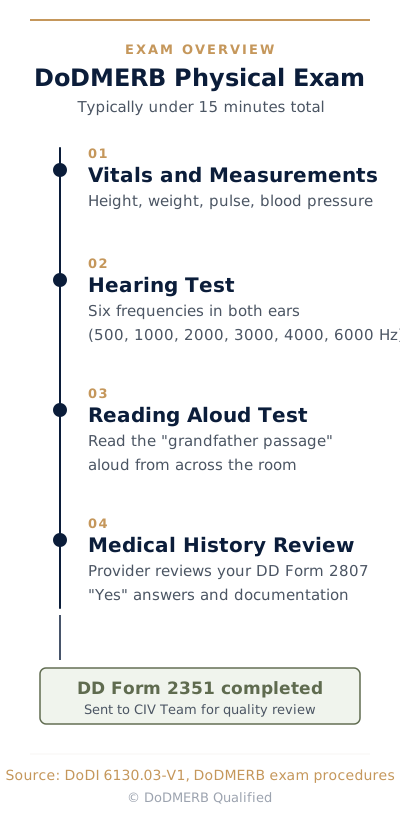
After this step, the provider completes DD Form 2808 and sends it to the CIV Team for quality review.
What Happens During the DoDMERB Eye Exam
The DoDMERB eye exam is a separate appointment from the physical, and for contact lens wearers, it requires advance planning that can span weeks or months. The optometrist performs a full battery of tests across visual acuity, refraction, color vision, and depth perception.
Contact Lens Removal Requirements
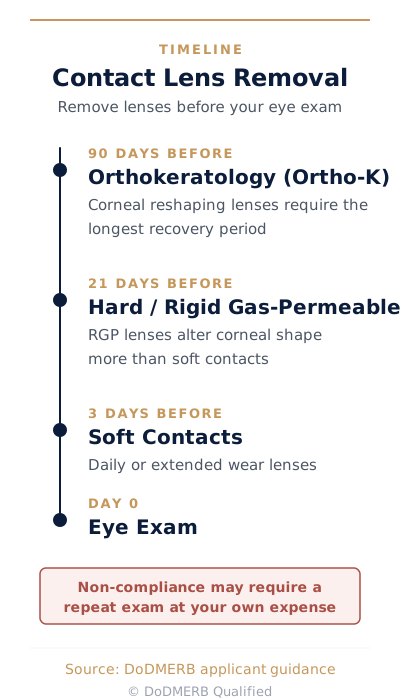
Your corneas must return to their natural shape before the eye exam can produce accurate results. The required removal timeline depends on your lens type:
- Soft contacts: remove at least 3 days before the exam
- Hard or rigid gas-permeable contacts: remove at least 21 days before
- Orthokeratology (ortho-K) lenses: remove at least 90 days before
Vision Tests Performed
The optometrist tests distant and near visual acuity (corrected and uncorrected) in both eyes. A manifest refraction determines your sphere, cylinder, and axis measurements per eye.
Bring your glasses. The provider tests both uncorrected and corrected vision.
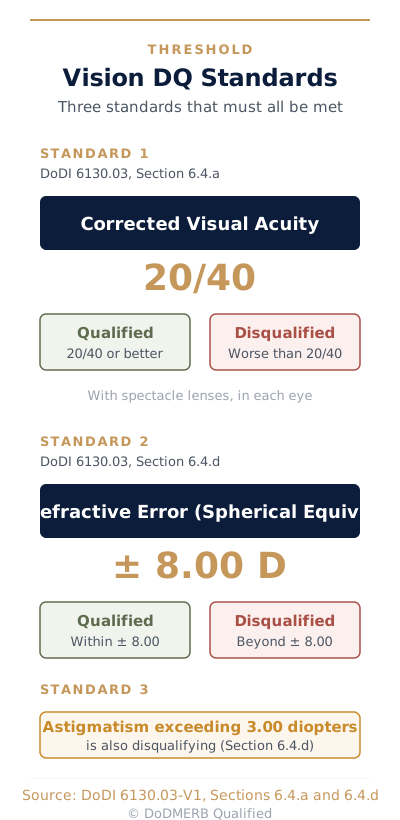
DoDI 6130.03 sets the disqualification standards:
"Current distant visual acuity of any degree that does not correct with spectacle lenses to at least 20/40 in each eye."
"Current refractive error (hyperopia, myopia, astigmatism) in excess of -8.00 or +8.00 diopters spherical equivalent or astigmatism in excess of 3.00 diopters."
Color Vision, Depth Perception, and Specialty Tests
The examiner administers the PIP (Pseudo-Isochromatic Plate) 14-plate test for color vision; identifying 10 of 14 plates is passing (Army and Navy). Army applicants who fail the PIP get a vivid red/green backup screen; the Navy treats a failed PIP as a disqualification and may request computer-based testing. The Air Force and Marine Corps have no color-vision accession standard.
Depth perception testing uses VTA-ND/OVT/AFVT, DPA-V, or TITMUS/Stereo Fly. The provider also performs a cover test for heterophoria/tropia, checks ocular motility with a red lens test, and measures near point of convergence.
LASIK and Refractive Surgery
Applicants who have had LASIK, PRK, or other corneal refractive surgery must be at least 180 days post-procedure at the time of the exam. Pre-surgical refractive error must not have exceeded +/- 8.00 diopters spherical equivalent or 3.00 diopters of astigmatism, and post-surgical refraction must be stable with no ongoing complications or medications.
Related reading: What is DoDMERB? covers the broader process from application trigger to final determination.
After this step, both exams are complete. DoDMERB will not process your case until both the physical and eye exam results arrive.
What to Bring to Your DoDMERB Appointments
Showing up without the right paperwork can stall your entire DoDMERB timeline. Applicants who arrive missing forms risk delays or repeat visits. Print and pack this list before your appointment.
Physical Exam Checklist
Eye Exam Checklist
- Glasses (if you wear corrective lenses)
- Government-issued photo ID
- Contact lenses removed per the timeline above (soft: 3 days, hard: 21 days, ortho-K: 90 days)
After this step, you have your paperwork packed. Confirm your appointment time in DoDMETS before heading out.
The Medical History Questionnaire (DD Form 2807)
The medical history questionnaire is where most DoDMERB complications begin, not the exam room. How your student answers 100+ yes/no questions about their entire medical history determines whether the process moves smoothly or triggers weeks of follow-up documentation requests.
What the Questionnaire Covers
The DD Form 2807 asks about every medical condition from birth to present: surgeries, injuries, allergies, mental health history, hospitalizations, medications, vision history, hearing issues, and more. Every "Yes" answer requires a written explanation.
Even fully resolved conditions must be disclosed. DoDI 6130.03, Section 6.1.a states:
"Unless otherwise stipulated, the conditions listed in this section are those that do not meet the standard by virtue of current diagnosis, or for which the candidate has a verified past medical history."
A childhood condition that resolved years ago still requires a "Yes" and an explanation.
Complete It With a Parent
DoDMERB strongly recommends completing the questionnaire with a parent present. The questions span your student's entire life, and parents typically know the childhood medical history better than the applicant does. Ear tubes at age two, an ER visit at age five, allergy testing at age eight. These details matter.
However, parents do NOT enter the exam room. The applicant meets with the provider alone. This is the beginning of your student's transition to military independence.
Strategy: Be Honest, Be Thorough
Review your student's complete health records before answering. Self-identify issues based on actual documentation, not vague memory. A "Yes" does not automatically disqualify. It prompts a follow-up review.
Approximately 20% of candidates receive a disqualification, but many of those candidates obtain waivers from their commissioning program. Answer thoroughly and have supporting documentation ready.
DoDMERB Qualified
Planning for the DoDMERB exam? Avoid these 5 common mistakes.
Free guide covering why hiding conditions backfires, when to get specialist evaluations done, and other errors that cost families waivers.
DoDMERB Qualified
Not sure how to approach your student's medical history?
We help families identify documentation gaps and prepare thorough, honest responses before the DoDMERB questionnaire locks your answers.
After this step, print DD Form 2807 and DD Form 2808 from DMACS, single-sided, and bring them to your physical exam appointment.
Scheduling Your Exams: DMACS 2.0 vs. DoDMETS
Two portals, two organizations, two different purposes, and confusing them is one of the most common DoDMERB mistakes. One system handles your medical history and status. The other handles scheduling. They do not share logins or data.
DMACS 2.0
DMACS 2.0 (ready2serve.dmacs.health.mil) is the official DoD system managed by DoDMERB. Complete your medical history questionnaire, print DD Forms 2807 and 2808, track qualification status, and upload Remedial documents here. PDF uploads are capped at 15MB per file.
DoDMETS
DoDMETS (dodmets.com) is the contractor scheduling system managed by the CIV Team. You use it only to schedule your physical and eye exam appointments at assigned contracted facilities.
After you complete your medical history in DMACS, the CIV Team will contact you up to four times over 45 days to help you schedule. Their phone number is (215) 587-9600.
Here is a side-by-side comparison:
| DMACS 2.0 | DoDMETS | |
|---|---|---|
| URL | ready2serve.dmacs.health.mil | dodmets.com |
| Managed by | DoDMERB (DoD) | CIV Team (contractor) |
| Purpose | Medical history, status tracking, document uploads | Scheduling exams only |
| What to do there | Complete questionnaire, print forms, check results, upload Remedial docs | Schedule physical and eye exam appointments |
The No-Show Rule
Missing an appointment without at least 24 hours' notice triggers a "No Show" designation. DoDMERB cancels your exam authorization and will not reauthorize for at least 45 days.
To reschedule: cancel in DoDMETS, call your assigned provider, and call the CIV Team at (215) 587-9600. All three steps are required.
Scheduling Tips
Take the first available appointment. Scheduling can take up to 30 days, and delays compound quickly. Your physical and eye exam may be at different facilities. Exams at contracted providers are free; private providers cost out-of-pocket. Exams are valid for two years.
Related reading: DoDMERB Process breaks down the full 13-step process from application to determination.
After this step, you have both appointments scheduled. Plan your contact lens removal timeline backward from your eye exam date.
After the Exam: Results, Timelines, and Next Steps
The exam is the easy part. The waiting is what gets families. After both appointments are complete, your results enter a multi-week pipeline before you see a determination in DMACS.
Results Timeline
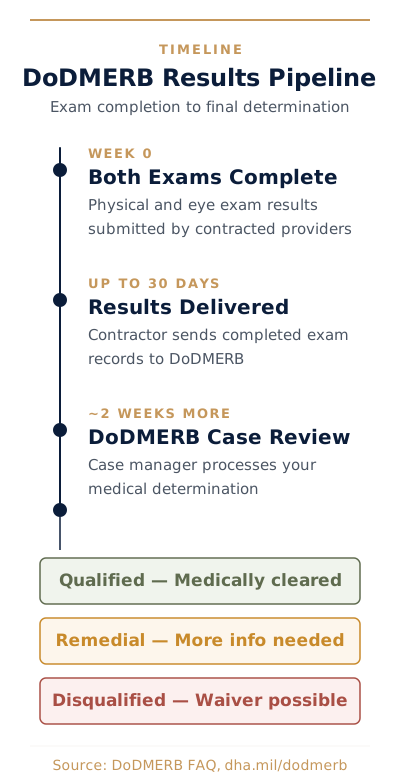
The contracted facility has up to 30 days to deliver completed exam results to DoDMERB. Once received, DoDMERB case managers typically process a determination within approximately two weeks.
From exam completion to determination: expect 6 to 8 weeks. From initial application trigger to final decision: 2 to 4 months. If a waiver is needed, add several more months depending on the commissioning program.
Three Possible Outcomes
Qualified means your student meets all DoDI 6130.03 medical standards and is cleared to proceed with the commissioning process.
Disqualified (DQ) means one or more conditions do not meet the standard. This is not the end. Approximately 20% of candidates receive a DQ, and many obtain waivers. The commissioning program decides whether to grant one.
Remedial means DoDMERB needs more information before making a determination. Log into DMACS and check "Additional Actions Required" for specific document requests.
📋 Policy: Waivers are granted by the commissioning program (ROTC detachment, service academy), NOT by DoDMERB. DoDMERB only makes the medical determination against DoDI 6130.03 standards. The waiver decision belongs to the program your student is applying to.
If You Receive a Remedial
Upload all requested documents at once through DMACS. Submitting everything simultaneously avoids sequential follow-up requests that add weeks to your timeline.
Documents must be actual provider notes, not patient portal printouts. PDFs are capped at 15MB per file. If you need to mail hard copies, the address is: DoDMERB, 8034 Edgerton Drive, Suite 132, USAFA, CO 80840.
DoDMERB staff typically respond to voicemails within two business days. The helpdesk email is dha.ncr.dod-merb.mbx.helpdesk@health.mil.
After this step, you either have your qualification status or know exactly what additional documentation to submit.
Parent's Guide: Your Role Before, During, and After the Exam
Your student walks into the exam room alone, but the most important preparation happens with you at the kitchen table. The DoDMERB process tests more than physical fitness. It tests organization, honesty, and follow-through. Your role shifts at each stage.
Before the Exam
Help your student complete the DMACS medical history questionnaire. The questions cover birth to present, and you know the childhood history. Ear tubes, tonsillectomies, allergy testing, ER visits, broken bones.
Review your student's medical records together so every "Yes" answer has a thorough written explanation. Keep records organized at home in case DoDMERB issues a Remedial request later. If your student wears contact lenses, calculate the removal timeline backward from the eye exam date.
Day of the Exam
Drive your student to the appointment. You wait outside. Only the applicant enters the exam room. This is standard policy, not a suggestion.
After the Exam
Monitor DMACS for status updates. Results can take 6 to 8 weeks. If a Remedial arrives, help your student gather and organize the requested medical documentation. If a DQ is issued, research the waiver process with the specific commissioning program.
Help your student respond calmly and thoroughly. Rushed or incomplete responses create delays that compound against application deadlines.
The appearance of U.S. Department of Defense (DoD) visual information does not imply or constitute DoD endorsement.
Frequently Asked Questions About the DoDMERB Exam
What actually happens during the DoDMERB physical exam?
Vitals, hearing test, Reading Aloud Test, and medical history review. Typically under 15 minutes. No blood draw or urine sample.
Can my parent come into the exam room?
No. Parents help with the questionnaire beforehand, but only the applicant enters the exam room.
Do I need to remove contacts before the eye exam?
Yes. Soft contacts: 3 days before. Hard or rigid gas-permeable: 21 days. Ortho-K: 90 days. Failure to comply may require a repeat exam at personal cost.
Can I keep wearing ortho-K lenses as a cadet or midshipman?
Plan on not relying on them. Ortho-K can't be used in the field or on deployment, and it isn't allowed during initial cadet or midshipman training — if you need vision correction then, you'll be issued standard military-issue glasses. Once in garrison there's no rule against wearing them at night, but no on-base or on-post optometry clinic fits or supports ortho-K, so if a lens is damaged or something goes wrong, you're on your own to go off-base for a replacement. For those reasons, ortho-K generally isn't a dependable long-term vision plan at a service academy.
Is there a blood draw or urine test?
Routine DoDMERB physicals do not include blood draws or urine tests. DoDMERB performs no urinalysis at all; unlike the enlisted MEPS process, any urinary-system history comes from what you self-report on the medical history questionnaire, not from a lab test at the exam.
How long does the entire DoDMERB process take?
Exam to determination: 6 to 8 weeks. Full process from application to decision: 2 to 4 months. Waivers add several more months.
What is the Reading Aloud Test?
You stand across the room and read the "grandfather passage" aloud. Pause on any word and the examiner says "What's that?" requiring a full restart. Practice beforehand.
What happens if I get a Remedial?
Log into DMACS, check "Additional Actions Required," and upload all requested documents at once as PDFs (max 15MB per file). Use actual provider notes, not portal printouts.
What forms do I need to bring?
Printed DD Form 2807 and DD Form 2808 (both single-sided), photo ID, glasses if applicable, and a list of current medications with dosages.
What if I miss my appointment?
A no-show without 24-hour notice triggers a 45-day lockout. Cancel through DoDMETS and call your provider and the CIV Team at (215) 587-9600.
Does a DQ mean I cannot get into ROTC or a service academy?
Not necessarily. About 20% of candidates receive a DQ, and many obtain waivers. The commissioning program makes the waiver decision. Thorough medical documentation is the strongest factor.