Your daughter has spent years building an application for a service academy or ROTC scholarship, and now a line on her medical history reads "polycystic ovarian syndrome." PCOS is one of the most common endocrine conditions in young women, and a diagnosis on the DoDMERB paperwork tends to set off an immediate worry that the military path is closed.
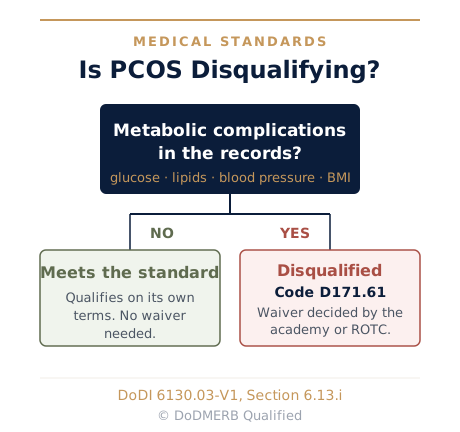
It usually is not. Under Department of Defense standards, PCOS is disqualifying in one specific situation, and meets the standard in another. The difference is not the diagnosis. It is whether the condition comes with metabolic complications.
That single distinction decides almost every PCOS case. This guide explains the exact standard, what counts as a metabolic complication, where medication like metformin fits, how the menstrual side of PCOS is scored, and what documentation actually moves a case forward.
DoDMERB certifies medical eligibility for every Academy and ROTC applicant, but it does not decide waivers. That authority belongs to the commissioning source. Knowing how the standard reads is the first step in presenting an accurate medical picture.
Key Takeaways
- PCOS is disqualifying under DoDI 6130.03 only when there is evidence of metabolic complications. Without them, it meets the standard.
- The disqualification code is D171.61, "Polycystic ovarian syndrome with metabolic complications."
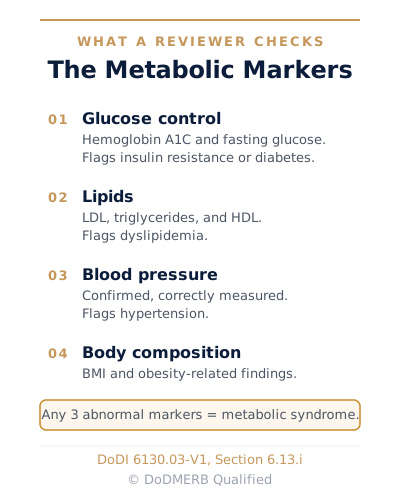
- "Metabolic complications" means insulin resistance or glucose abnormalities, abnormal lipids, high blood pressure, and obesity-related findings, judged against National Heart, Lung, and Blood Institute and American Heart Association guidelines.
- Metformin is not named anywhere in the standard and is not a disqualifier by itself. What matters is why it was prescribed. Metformin for diabetes is weighed very differently from metformin used preventively with normal labs.
- The labs that decide these cases are hemoglobin A1C, fasting blood glucose, a lipid panel, blood pressure, and BMI.
- Whether PCOS is disqualifying comes down to the metabolic workup, not the diagnosis. Most cases turn on proving the metabolic picture is normal or controlled.
📋 Current as of February 2026: This guide reflects DoDI 6130.03-V1, Change 6, dated February 3, 2026, the standard DoDMERB applies to Academy and ROTC applicants.
What the DoDMERB Standard Actually Says
PCOS appears in the female genital system section of the medical standards, and the wording is narrow on purpose. The regulation does not list PCOS as a flat disqualifier. It carves out an exception, and the exception is where most applicants land.
The verbatim text of DoDI 6130.03-V1, paragraph 6.13.i, reads:
"Polycystic ovarian syndrome unless no evidence of metabolic complications as specified by National Heart, Lung, and Blood Institute and American Heart Association Guidelines." — DoDI 6130.03-V1, Section 6.13.i
Read the sentence carefully. PCOS does not meet the standard unless there is no evidence of metabolic complications. Flip it around and the meaning is clear. If the metabolic workup is clean, the condition meets the standard on its own terms.
The diagnosis is not the trigger
A reviewer is not reacting to the letters P-C-O-S. The concern is a documented pattern of metabolic problems that could progress during a military career or become hard to manage in an austere environment. When those problems are absent, the label alone does not carry the case into disqualification.
Where the D171.61 code comes from
When DoDMERB does apply a disqualification for PCOS, it uses code D171.61, "Polycystic ovarian syndrome with metabolic complications." The code name itself tells you the boundary. It is reserved for cases where metabolic complications are present. If you have received this code, the reviewer saw evidence of one or more of those complications in your records, and the path forward is showing that evidence is controlled, resolved, or was misread.
After this section, you should understand that PCOS is only a disqualifying condition when metabolic complications are documented, and that DQ code D171.61 signals exactly that finding.
What Counts as a Metabolic Complication
"Metabolic complications" is not a vague clinical impression. It maps to specific numbers a reviewer can check. The standard points to National Heart, Lung, and Blood Institute and American Heart Association guidelines, which is the same framework physicians use to define metabolic syndrome and cardiovascular risk.
In practice, a reviewer looks for four things.
Glucose and insulin resistance
The most common metabolic complication of PCOS is insulin resistance, which is why glucose control is the first thing a reviewer examines. Hemoglobin A1C reflects long-term glucose control, and fasting blood glucose captures the current picture. A history of diabetes is separately disqualifying under the endocrine standards, and unresolved prediabetes within the last 24 months does not meet the standard either. A clean A1C and normal fasting glucose remove the single biggest concern.
Abnormal lipids
Dyslipidemia is a recognized metabolic complication. Reviewers look at the lipid panel for elevated LDL, high triglycerides, and low HDL. A normal lipid profile is a strong data point in a PCOS file.
High blood pressure
Hypertension is part of the metabolic-syndrome definition. Blood pressure that is confirmed in the normal range, measured correctly, counts in your favor. Elevated readings invite a closer look at overall cardiovascular risk.
Weight and body composition
Obesity-related findings tie the picture together, so BMI is part of the assessment. Body composition is not itself the disqualifier, but combined with abnormal glucose, lipids, or blood pressure, it can push a case from a normal variant into metabolic complications.
After this section, you should know the exact markers a reviewer checks: A1C, fasting glucose, lipid panel, blood pressure, and BMI.
Is PCOS Waiverable? It Depends on the Whole Picture
When PCOS is disqualified, the question shifts from "is it a DQ" to "is it waiverable," and the honest answer is that it depends on the total metabolic picture. Two applicants can carry the same diagnosis and sit at opposite ends of the waiver spectrum.
On one end is the applicant with mild hormonal symptoms, regular follow-up, no insulin resistance, normal lipids, normal blood pressure, and normal function. This picture is favorable, and in many cases it should not have been disqualified at all once the labs are in.
On the other end is the applicant with documented insulin resistance, obesity-related complications, ongoing endocrinology management, and functional limitations. This is the harder case, and it requires clear evidence that the complications are controlled.
DoDMERB does not decide your waiver
This is the point families miss most often. DoDMERB determines whether you meet the medical standard. It does not grant waivers. If you are disqualified, the waiver decision belongs to your commissioning source.
| Path | Who initiates the waiver | Who decides |
|---|---|---|
| Service Academy | The academy admissions office | The academy's surgeon and waiver authority |
| ROTC scholarship | Your detachment or cadre | The service's ROTC medical waiver authority |
You cannot request a waiver directly from DoDMERB. The commissioning source decides whether to pursue one, which is why staying competitive on every other part of your application matters. A waiver authority weighs the whole person, and a strong candidate is one the academy or detachment wants to fight for.
DoDMERB Qualified
Not sure whether your student's PCOS will read as a normal variant or a metabolic complication?
We review the actual labs and records against the standard, identify what the reviewer will see, and help you build a cleaner medical picture before it reaches waiver review.
After this section, you should know that the waiver decision rests with the academy or ROTC authority, not DoDMERB, and that the outcome tracks your metabolic markers.
The Metformin Question
Metformin is the single most common source of confusion in PCOS cases, so it deserves a direct answer. Metformin is not named anywhere in DoDI 6130.03, and taking it is not a disqualifier by itself. No line in the standard says "current use of metformin does not meet the standard."
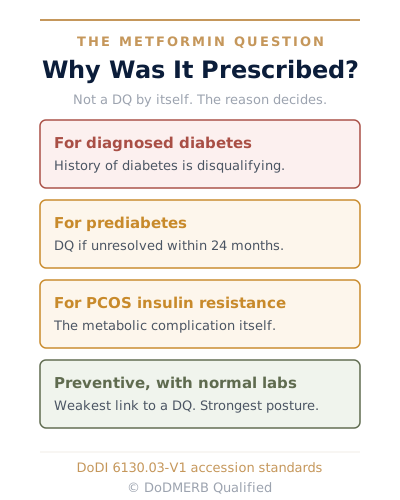
What a reviewer does is work backward from the prescription to the reason for it. The medication is a signpost pointing at a diagnosis, and the diagnosis is what the standard actually addresses. The same pill can sit in four very different cases.
Metformin for diagnosed diabetes
This is the hard end. A history of diabetes mellitus is disqualifying under the endocrine standards, and metformin prescribed to treat diabetes points straight at that condition. When metformin is managing actual diabetes, the underlying diagnosis, not the drug, is the barrier.
Metformin for prediabetes
Unresolved prediabetes within the last 24 months does not meet the standard. If metformin was started for prediabetes, the reviewer wants to see whether the prediabetes has resolved, with current A1C and fasting glucose to prove it.
Metformin for PCOS insulin resistance
Here the medication itself signals a metabolic complication. If metformin was prescribed because of insulin resistance tied to PCOS, that insulin resistance is exactly the kind of complication paragraph 6.13.i is written around. The case then turns on whether the resistance is controlled and the glucose numbers are normal.
Metformin as a preventive measure
This is the most favorable version. Some applicants are placed on metformin preventively, often because of family history, while their own blood sugar, insulin, and cholesterol are normal. When the labs are clean and there is no diagnosis of diabetes, prediabetes, or documented insulin resistance, the medication carries far less weight, and the door to qualification or a waiver is more open.
A note on birth control
Oral contraceptives are viewed differently from metformin. They are ordinary management for PCOS, commonly used to regulate cycles, and they do not carry the same metabolic signal. Using birth control to manage PCOS is not treated as evidence of a metabolic complication.
After this section, you should understand that metformin is judged by the reason behind it, and that documenting that reason plus normal labs is the core of a metformin PCOS case.
How the Menstrual Side of PCOS Is Evaluated
Many PCOS cases do not surface under the PCOS line at all. They surface through irregular cycles. Because irregular or infrequent periods are a hallmark of PCOS, the same records that mention the diagnosis often trigger the menstrual criteria in the standard, which sit in the same section.
The standard flags menstrual patterns when they suggest something medically significant, current, and affecting function. The specific triggers include:
- Irregular menses more than twice in the previous six months when cycles were fewer than 21 days apart, or associated with anemia.
- Oligomenorrhea of fewer than four cycles in the previous six months, unless it results from intentional hormonal suppression such as birth control or an IUD.
- Menstrual symptoms that caused more than one day of missed school or work in the previous six months.
Notice the oligomenorrhea carve-out. Infrequent cycles are not counted against you when they are the result of intentional hormonal suppression. That is directly relevant to PCOS applicants who use hormonal management to regulate their cycles.
"Resolved through lifestyle changes"
A common and favorable PCOS trajectory is a young woman whose irregular cycles have normalized through weight management, diet, and exercise, with no medication and no metabolic complications. The important word for a reviewer is current. A history of irregular periods that have since resolved, with recent records showing regular cycles and normal labs, is a very different file from one showing active irregularity, anemia, or missed school.
After this section, you should recognize that PCOS is often evaluated through the menstrual criteria, and that current, resolved cycles supported by recent records are what a reviewer needs to see.
What Strong Documentation Looks Like
PCOS cases are won or lost on documentation, and the pattern is consistent: primary records that prove the current metabolic picture is clean or controlled. Do not submit patient-portal printouts or screenshots unless the remedial request expressly allows them. Obtain the actual clinical notes and lab reports from the provider's office.
Gather these proactively, so they are ready when the request comes.
Specialist and clinical records
- Endocrinology or gynecology notes stating the diagnosis, current status, and that the condition is stable and not functionally limiting
- A current provider assessment confirming there are no metabolic complications, or that any complications are controlled
Laboratory results
- Recent hemoglobin A1C
- Fasting blood glucose
- Lipid panel
- Documented blood pressure readings and BMI
Medication and menstrual history
- The reason any medication, especially metformin, was prescribed, plus current status
- Recent cycle history showing the current pattern
- Any evidence that irregular cycles have resolved
Personal statement
- A concise statement describing the diagnosis, current management, and present function, in the applicant's own words
A brief principle guides all of this. Submit what is requested, keep the file focused, and let the labs tell the story. A clean, well-organized package that proves normal metabolic markers is more persuasive than a thick stack of loosely related records.
Full disclosure is not optional. Every applicant signs medical paperwork as a future officer, and integrity in that paperwork matters as much as the medical facts. Disclose the diagnosis, then let accurate, well-documented records carry the case.
After this section, you should have a concrete checklist of the records that demonstrate a normal or controlled metabolic picture.
The Bottom Line
PCOS is not an automatic end to a military commissioning path. The standard disqualifies it only when metabolic complications are present, and the code that captures that, D171.61, is reserved for exactly that finding. For the majority of applicants whose glucose, lipids, blood pressure, and weight are normal, the condition meets the standard on its own terms.
The work is in the proof. Clean labs, current specialist notes, a clear explanation of any medication, and a resolved cycle history are what turn a diagnosis into a qualified case. Where a waiver is needed, the decision belongs to the academy or ROTC authority, and a competitive, well-documented applicant is the one they choose to support.
If you want a clear read on where your student's PCOS falls, we can help. At DoDMERB Qualified, we review the actual records against the standard, identify the real question a reviewer will ask, and help you build a cleaner medical picture. Our DoDMERB Consulting engagement starts at $800, with a follow-on option for complex cases.
Contact us about DoDMERB Consulting to get started, or if your student also needs full application coaching, DoDMERB Qualified works alongside the Academy and ROTC coaching teams at gainserviceacademyadmission.com.
Frequently Asked Questions
Is PCOS an automatic DoDMERB disqualification?
No. Under DoDI 6130.03, PCOS is disqualifying only when there is evidence of metabolic complications. If your metabolic workup is normal, with clean glucose, lipids, and blood pressure, the condition meets the standard. Disclosing PCOS may prompt a request for labs to confirm the picture is clean.
Does taking metformin disqualify me?
No. Metformin is not named in the standard and is not a disqualifier by itself. A reviewer looks at why it was prescribed. Metformin for diabetes points at a disqualifying diagnosis, while metformin used preventively alongside normal labs carries much less weight.
Are birth control pills a problem for a PCOS case?
No. Oral contraceptives are considered ordinary management for PCOS and do not signal a metabolic complication. Using hormonal management to regulate cycles also falls under the intentional-suppression carve-out in the menstrual criteria.
What labs will DoDMERB or the waiver authority want to see?
Typically hemoglobin A1C, fasting blood glucose, a lipid panel, blood pressure readings, and BMI. These markers show whether insulin resistance, glucose abnormalities, dyslipidemia, or hypertension are present. Recent results are more persuasive than older ones.
What is DoDMERB code D171.61?
D171.61 is the disqualification code for "polycystic ovarian syndrome with metabolic complications." Receiving it means the reviewer found evidence of metabolic complications in your records. It does not end your candidacy. Many conditions flagged under it are addressed through the waiver process.
Does PCOS need a waiver, or can it just meet the standard?
Both are possible. If there are no metabolic complications, PCOS can meet the standard without a waiver. If complications are documented, the condition is disqualified and a waiver, initiated by your commissioning source, becomes the path forward.
Who requests a PCOS waiver?
Your commissioning source. For a service academy, the admissions office initiates the request and the academy's surgeon decides. For ROTC, your detachment handles it and the service's ROTC medical authority decides. You cannot request a waiver directly from DoDMERB.
Can I still attend a service academy with PCOS?
Yes. Applicants with PCOS earn appointments regularly, most often because their metabolic markers are normal or well-controlled and their records prove it. A PCOS diagnosis is common and, on its own, does not close the door to a military career.