Roughly one in five cadets and midshipmen at U.S. service academies entered with a medical waiver on file. That number surprises most parents. It should also reassure you.
The DoDMERB waiver process is the mechanism that turns a medical disqualification into a second chance. Here is the critical distinction most families miss: DoDMERB does not decide waivers. DoDMERB evaluates medical fitness and issues disqualifications. The commissioning program, whether an academy, ROTC detachment, or scholarship board, decides whether to grant a waiver.
Each year, approximately 6,000 of 30,000 applicants receive a DoDMERB disqualification. That is roughly 20 percent. A disqualification does not end your student's candidacy. It starts a separate process.
A disqualification means DoDMERB found a condition listed among its 593 possible codes under DoDI 6130.03, Volume 1. The file then moves to the commissioning program's medical authority, which reviews the case through a different lens than DoDMERB used.
This article walks through every stage of the DoDMERB waiver process: what happens after a DQ, who decides, what strengthens the package, realistic timelines, approval rate data, and what to do if a waiver is denied.
Key Takeaways
- DoDMERB does not decide waivers. The commissioning program (academy, ROTC, scholarship board) makes that call independently
- Roughly 20% of applicants receive a DoDMERB disqualification, and waivers are commonly granted
- Each service's Surgeon General evaluates independently. A denial from one program does not affect another
- ROTC scholarship files are auto-forwarded for waiver review. Academy files are only forwarded if the candidate is competitive
- Approval rates vary dramatically by condition: shoulder injuries at ~84%, eczema at ~26%
- The single most impactful waiver document is a fitness-for-duty letter from your student's treating physician
What Happens After a DoDMERB Disqualification
Most parents assume a disqualification means the end. It does not. A DQ triggers a separate review track that operates on its own timeline, with its own decision-makers, and its own standards.
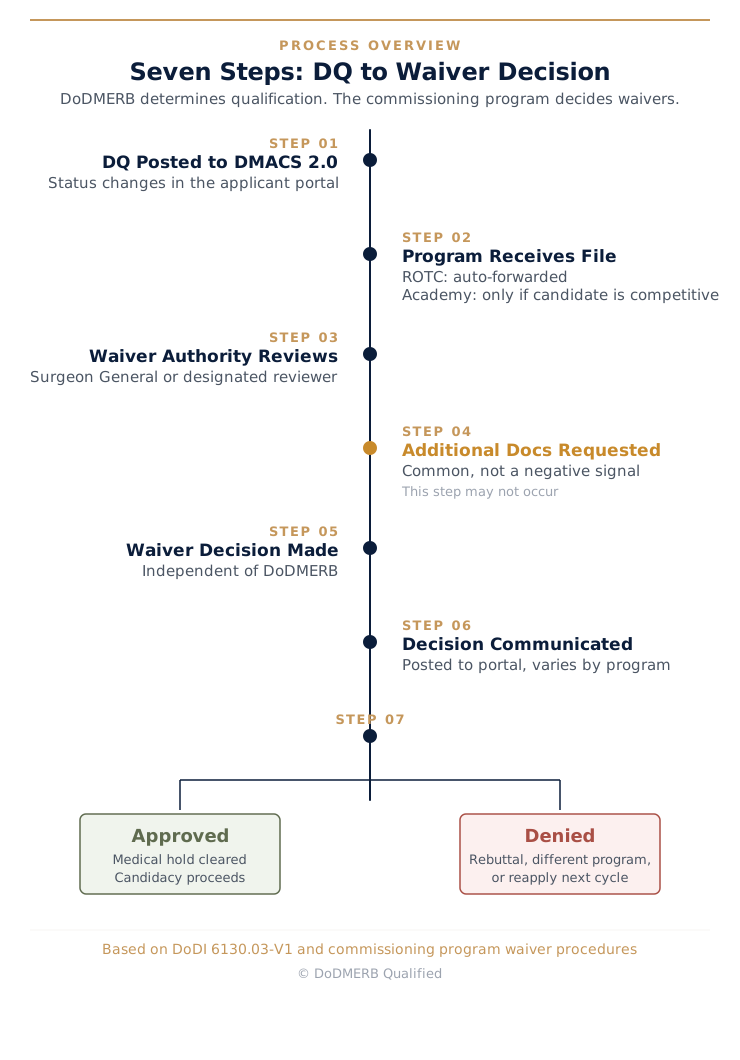
Step 1: DoDMERB Posts the Disqualification
Your student's status changes in the DMACS 2.0 portal. The disqualification code references a specific condition under DoDI 6130.03, Volume 1. This is a medical determination, not an admissions decision.
Step 2: The Commissioning Program Receives the File
DoDMERB forwards the complete medical file to the relevant program's waiver authority. For ROTC programs, this happens automatically. For academies, it does not. Academy admissions offices decide which candidates are competitive enough to warrant waiver consideration.
Step 3: The Waiver Authority Reviews the Case
A Surgeon General's office or designated medical reviewer evaluates the condition against the program's standards. They may request additional documentation through a remedial action, which is different from a disqualification.
Step 4: Additional Documentation May Be Requested
If the reviewing authority needs more information, a remedial request goes back through DoDMERB. This is common and not a negative signal. Respond promptly with exactly what is asked for.
Step 5: The Waiver Decision Is Made
The waiver authority grants or denies the waiver based on the complete file. This decision is independent of DoDMERB.
Step 6: The Decision Is Communicated
Results post to the portal and may be communicated through the admissions office or ROTC detachment. Timelines vary widely by program. One USMMA applicant noted it took several days for the portal to reflect an approved waiver.
Step 7: Next Steps Depend on the Outcome
An approval clears the medical hold. A denial opens other options covered later in this article.
The silence between steps 2 and 6 is normal. Per DoDMERB's own FAQ: "You won't hear from DoDMERB unless the Waiver Authority requests additional medical information or renders a decision." No news is simply no news.
The portal may show "Pending Waiver Submission/Review," but that status means the DQ file is available to the waiver authority. It does not mean a waiver has been formally requested or is under active review.
Who Decides Your DoDMERB Waiver, and Why It Matters
The same condition can produce different outcomes depending on which program your student applied to. A torn ACL might be denied at one academy and approved through an ROTC scholarship. This is not arbitrary. Different waiver authorities have different risk tolerances, mission requirements, and review standards.
Understanding who holds the pen on your student's waiver changes how you approach the DoDMERB waiver process.
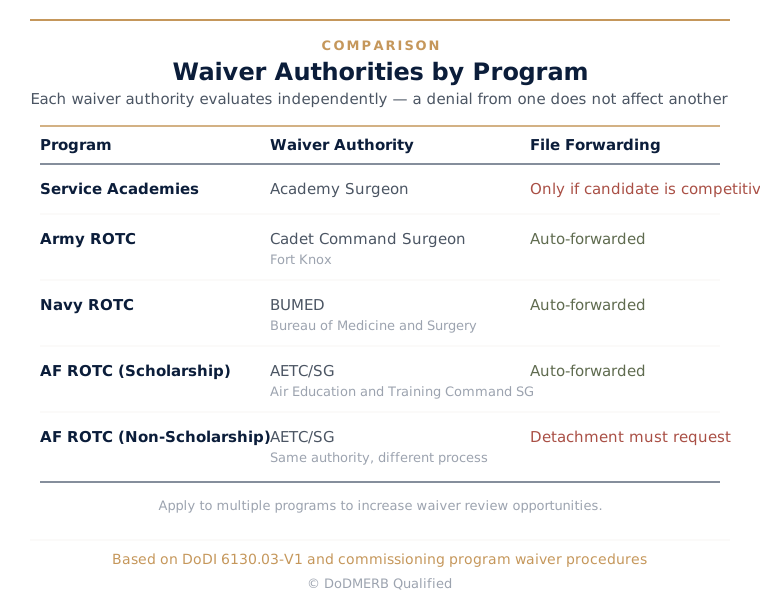
Service Academies
The Academy Surgeon reviews waiver cases, but only for candidates the admissions board considers competitive. If your student is not competitive for appointment, the academy will not request a waiver. This gate makes academy waivers fundamentally different from ROTC waivers.
Army ROTC (AROTC)
The Cadet Command Surgeon at Fort Knox serves as the waiver authority. DQ files are auto-forwarded for all scholarship candidates. The review happens without a separate request from the detachment.
Navy ROTC (NROTC)
The Bureau of Medicine and Surgery (BUMED) handles NROTC waivers. Files are auto-forwarded for scholarship applicants. BUMED tends to process cases methodically, which can mean longer timelines.
Air Force ROTC HSSP (High School Scholarship Program)
AETC/SG (Air Education and Training Command Surgeon General) is the waiver authority. Files are auto-forwarded for scholarship recipients.
Air Force ROTC Non-Scholarship
AETC/SG is still the waiver authority, but the process is not automatic. The detachment must specifically request a waiver review. If your student is non-scholarship AFROTC and has a DQ, confirm with the detachment that a waiver request has been submitted.
Why Different Programs Reach Different Conclusions
Col. Gregory, a former Air Force waiver authority, described the standard as whether the applicant could complete "one deployment" without the condition becoming a liability. Each branch applies that standard differently based on its mission requirements.
USAFA and USMA waive color deficiency more frequently than USNA, USMMA, or USCGA. Ship-based branches weigh certain conditions differently than ground-focused ones. These are not inconsistencies. They reflect genuinely different operational demands.
What Waiver Authorities Evaluate
The core question every waiver authority asks is straightforward: can this person train, commission, and deploy? Everything in the review flows from that single question.
Condition-Specific Factors
Type, severity, and recency of the condition drive the initial assessment. A resolved condition carries different weight than a chronic one. Approval rates vary dramatically by condition: shoulder injuries see roughly 84 percent approval rates, while eczema sits around 26 percent.
The difference reflects how each condition maps to the demands of military service. Whether a condition is fully resolved, well-managed, or potentially recurring shapes the risk calculation.
Time since last treatment or symptoms matters. A student who had asthma as a child but has been off medication for six years presents a fundamentally different case than one who used an inhaler last semester.
Candidate Competitiveness
At service academies, only competitive candidates receive waiver consideration. A strong whole-candidate score, high academic standing, varsity athletics, and leadership positions increase the likelihood that the admissions office will forward the file for waiver review. ROTC programs handle this differently since scholarship files are typically auto-forwarded.
Documentation Quality
This is where families have the most control. A former DoDMERB physician put it simply: "Clarity matters. If you confuse, you lose."
Letters from MDs carry more weight than those from PAs or nurse practitioners. A letter from a specialist whose field matches the condition is stronger than one from a generalist. Recent evaluations outweigh older records. One brain injury case illustrates the point: outdated 2016 records created concern during review, but a current neurologist evaluation resolved the issue entirely.
External Factors
Recruiting needs shift year to year. When personnel strength is low, branches grant more waivers to meet accession targets.
Policy changes open doors that were previously closed. Eczema waiverability has expanded over time as accession standards evolved. The Air Force now considers ADHD waivers at 15 months off medication, down from the regulation's 24-month standard.
Year-over-year trends in approval rates (AF officer waivers climbed from 56 to 74 percent over three years) reflect these broader shifts. You cannot control these factors, but understanding them provides context.
How to Strengthen Your Waiver Package
You cannot control the decision. You can control the evidence your student presents. A well-prepared waiver package does not guarantee approval, but a poorly prepared one almost guarantees problems.
Get the Right Physician Letter
The single most impactful document in a waiver package is a letter from the treating physician. Not a new doctor. Not a family friend who happens to be a doctor. The physician who knows your student's medical history.
The letter should include an explicit fitness-for-duty statement, along the lines of: "In my professional medical opinion, this condition does not limit this patient's ability to participate in rigorous physical activity, military training, or deployment."
When scheduling the appointment, tell the office "I need military medical clearance" and ask for the earliest available slot.
Gather Performance Evidence
Academic transcripts showing consistent attendance and performance demonstrate that the condition does not interfere with daily function. Statements from coaches documenting physical activity levels add weight.
Fitness test results, sports participation records, and school attendance data create a factual picture that complements the medical documentation. The waiver authority needs proof, not assertions.
Write a Personal Statement
Keep it factual and concise. The statement should address the condition directly, describe current status, and express commitment to service.
This is not the place for emotional appeals. Three to five paragraphs. No superlatives.
Submit Proactively
DoDMERB accepts supporting documentation at any time through your student's assigned Case Manager. You do not need to wait for a remedial request. If you have strong documentation, submit it early. Include a cover sheet and label every document clearly.
What Not to Do
Do not self-diagnose or reinterpret medical records. Do not submit disorganized stacks of paperwork. Do not attempt to contact or lobby the waiver authority directly. These approaches backfire.
For condition-specific guidance, see our detailed articles on ADHD and DoDMERB waivers and asthma and DoDMERB waivers.
DoDMERB Qualified
Avoid the 5 mistakes that cost families DoDMERB waivers
Free guide: why a disqualification is not the end, what happens when parents run the process, and 3 other errors we see families make repeatedly.
DoDMERB Qualified
Not sure if your student's waiver package is strong enough?
Our team reviews each case and identifies exactly what the waiver authority needs to see.
DoDMERB Waiver Timeline: How Long It Actually Takes
The total elapsed time from DQ to decision is almost always longer than the actual review time. Your student's file may sit for weeks before it reaches the waiver authority's desk. Once it does, the medical review itself may take days, but the queue and documentation gathering account for most of the wait. Historical backlogs have reached up to 60 days at the waiver authority level alone.
Timeline Ranges by Program
| Program | Typical Timeline | File Forwarding | Notes |
|---|---|---|---|
| Service Academies | Before April 15 | Only if competitive | Driven by appointment deadlines |
| Army ROTC | ~60 days | Auto-forwarded | Delays usually from documentation |
| Navy ROTC | Up to 3 months | Auto-forwarded | BUMED processes methodically |
| AF ROTC (Scholarship) | 60-90 days | Auto-forwarded | Per AFROTCI 36-2011 |
| AF ROTC (Non-Scholarship) | 60-90+ days | Detachment must request | Confirm request was submitted |
DoDMERB exams are valid for two years from the date of examination, so timing pressure is real but not immediate.
What Causes Delays
Incomplete documentation is the most common cause. If a remedial request goes out and the response takes three weeks, those three weeks are on the applicant's clock.
Condition complexity matters. A straightforward resolved fracture moves faster than a case involving multiple conditions or ongoing treatment. Peak season, typically November through February, creates backlogs. Portal updates may lag behind actual case status.
When to Follow Up and Who to Contact
Wait at least 60 days from the DQ posting before reaching out. One polite inquiry to the ROTC detachment, admissions liaison, or DoDMERB Case Manager is appropriate. Ask for a status update, not a decision.
| Program | Who to Contact |
|---|---|
| Service Academy | Admissions liaison or regional point of contact |
| Army ROTC | DoDMERB Case Manager |
| Navy ROTC | Medical Programs Coordinator (email) |
| Air Force ROTC | Detachment cadre (they escalate to AETC/SG) |
For a deeper look at timelines, see our DoDMERB waiver timeline guide.
DoDMERB Waiver Approval Rates: What the Data Shows
Air Force officer waiver approvals climbed from 56 percent to 74 percent over a three-year period (FY21 through FY23). That trajectory tells you something important about how the DoDMERB waiver process is evolving.
Overall Rates
Approximately 20 percent of entering classes at service academies and ROTC programs hold medical waivers.
For broader context, during FY21-22 the DoD Inspector General reviewed 54,206 enlisted waiver cases and found a 77 percent overall approval rate. These are enlisted numbers and do not directly reflect officer accession outcomes, but they illustrate the scale and variation across branches: the Marine Corps approved at 98 percent while the Air Force approved at 65 percent.
Air Force officer candidates specifically saw rates climb from 56 percent (FY21) to 64 percent (FY22) to 74 percent (FY23).
Condition-Specific Rates
Rates vary more by condition than by anything else. Shoulder injuries: roughly 84 percent approved. Eczema: roughly 26 percent.
The condition type is the single largest predictor of approval likelihood. Conditions that are resolved, stable, or outgrowable fare significantly better than chronic or episodic ones.
What Influences the Numbers
Three factors shape approval rates beyond the individual case. Recruiting climate affects how aggressively branches pursue waivers. When personnel strength drops, the threshold for granting waivers lowers.
Policy evolution opens new categories entirely. Expanded eczema waiverability and the Air Force's shorter ADHD medication-free threshold have both expanded the pool of eligible candidates.
Expert preparation makes a measurable difference. At DoDMERB Qualified, we maintain a high waiver approval rate for ROTC scholarship recipients and highly qualified Academy applicants. Documentation quality matters enormously.
What to Do If Your DoDMERB Waiver Is Denied
A denial is one program's decision, made by one medical authority, based on the evidence they had at the time. It is not a permanent verdict on your student's military career. You have options.
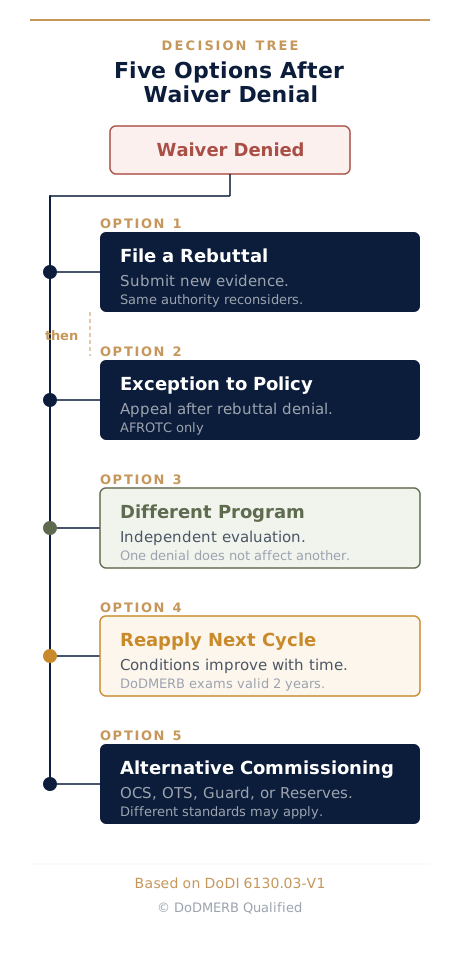
File a Rebuttal
You can submit genuinely new medical information that was not part of the original review: a new objective test result, a materially changed clinical finding, or performance records that were not previously included. Restating the same conclusion with additional letters is not enough. If the underlying objective measure is unchanged, more opinions will not reopen the case.
The reconsideration goes back through the same waiver authority. For Army ROTC in particular, U.S. Army Cadet Command is the terminal waiver authority: there is no appeal above it, and reconsideration is available only with new medical information.
AFROTC Exception to Policy
Air Force ROTC has a specific mechanism called an Exception to Policy (ETP), outlined in AFROTCI 36-2011 Attachment 48. This is a second-level appeal available after a rebuttal denial. It requires strong justification and supporting documentation but provides an additional pathway beyond the standard waiver.
Apply to a Different Program
Different Surgeon Generals apply different standards. One documented case: a candidate with an ACL repair was denied at an academy but approved through the Health Professions Scholarship Program (HPSP) after submitting an additional orthopedic evaluation confirming knee fitness. If one program denies, another may approve.
Reapply Next Cycle
Conditions improve over time. A student who was 12 months post-surgery at the time of their first application may be 24 months post-surgery the next year, with a stronger medical file and more recovery data.
Use the gap year strategically. Gather specialist evaluations, build a stronger package, and document continued physical performance. DoDMERB exams are valid for two years, so some existing records may carry over.
Alternative Commissioning Paths
OCS and OTS are available after completing a bachelor's degree. The National Guard and Reserves offer commissioning opportunities with their own medical review processes. These paths may have different medical standards or more flexible waiver criteria. They are legitimate paths to a commission, not consolation prizes.
For a complete breakdown of post-denial options, see our guide to denied DoDMERB waivers.
Frequently Asked Questions
Does DoDMERB decide whether my child gets a waiver?
No. DoDMERB determines qualification or disqualification. The commissioning program's waiver authority, a separate office, decides whether to grant a waiver.
What does "Pending Waiver Submission/Review" mean on the portal?
It means the DQ file is available to the waiver authority. It does not confirm a waiver has been requested or is under active review. Contact your admissions point of contact to verify.
Will applying to multiple programs hurt my child's waiver chances?
No. Each program evaluates independently. A denial from one has no bearing on another. Applying broadly increases the number of waiver authorities reviewing the case.
Can we submit medical records before being asked?
Yes. Contact your student's DoDMERB Case Manager to submit supporting documentation at any time. Proactive, well-organized submissions can strengthen the file before the waiver authority reviews it.
Should we hire a DoDMERB consultant?
Some families navigate the process on their own. At DoDMERB Qualified, our team maintains a high waiver approval rate for ROTC scholarship recipients and competitive Academy applicants. The value depends on your student's condition complexity and documentation needs.
My child is healthy and active but got disqualified. Does physical fitness matter?
Yes, but you must document it. Coach statements, fitness test results, sports records, and attendance data turn "my child is healthy" from an assertion into evidence.
Is there a deadline for waiver decisions?
Academy waivers typically resolve before April 15. ROTC timelines vary by branch, generally ranging from 60 days to three months.
For more on the DoDMERB waiver process from initial exam through final determination, visit our DoDMERB overview and waiver timeline guide.