A failed DoDMERB hearing screening does NOT mean your child's military career is over. A study published in Military Medicine (2024) found that 84% of candidates flagged for hearing loss on the initial screening audiogram passed the follow-up reference-standard test. The problem was the testing environment, not the applicant's ears.
This guide covers hearing loss military standards under DoDI 6130.03 for academy and ROTC applicants. You will learn the exact decibel thresholds that trigger a disqualification, how the two-stage audiogram process works, where branches differ on waivers, and how to pursue waivers across multiple services.
Key Takeaways
- 84% of candidates flagged for hearing loss on the DoDMERB screening audiogram pass the follow-up reference-standard test, so an initial disqualification is far from final.
- Every branch uses the same DoDI 6130.03 baseline thresholds (avg ≤25 dB at 500/1000/2000 Hz, no single frequency above 45 dB at 4000 Hz), but waiver willingness varies dramatically.
- Tinnitus alone is NOT a disqualifying condition under DoDI 6130.03. It only triggers a DQ if it measurably impairs hearing function.
- The Air Force generally does not grant hearing waivers, making it the strictest branch for applicants with borderline audiograms.
- Academy and ROTC applicants can pursue 5-7 separate waiver opportunities across services, turning one DQ into multiple chances.
DoDI 6130.03 Hearing Thresholds: The Numbers That Matter
Every branch starts from the same baseline. DoDI 6130.03, Section 6.6 defines the hearing thresholds that apply to all commissioning sources. These are the line between qualified and disqualified.
Pure-Tone Thresholds (Section 6.6.b)
All audiometric testing uses ANSI S3.6-2010 calibration standards. The thresholds below apply to each ear independently.
"Audiometric speech and pure tone thresholds when the average exceeds 25 decibels at 500, 1000, and 2000 Hz; or individual threshold level exceeds 30 dB at 500, 1000, and 2000 Hz; or 35 dB at 3000 Hz; or 45 dB at 4000 Hz" — DoDI 6130.03, Section 6.6.b
| Frequency | Maximum Threshold | Notes |
|---|---|---|
| 500 Hz | 30 dB individual, ≤25 dB average | Average calculated across 500, 1000, 2000 Hz |
| 1000 Hz | 30 dB individual, ≤25 dB average | Same three-frequency average |
| 2000 Hz | 30 dB individual, ≤25 dB average | Same three-frequency average |
| 3000 Hz | 35 dB | Individual threshold only |
| 4000 Hz | 45 dB | Individual threshold only |
Your student can pass every individual frequency and still fail the average. An applicant with 28 dB at 500 Hz, 26 dB at 1000 Hz, and 24 dB at 2000 Hz has a three-frequency average of 26 dB, which exceeds the 25 dB limit. That is a disqualification.
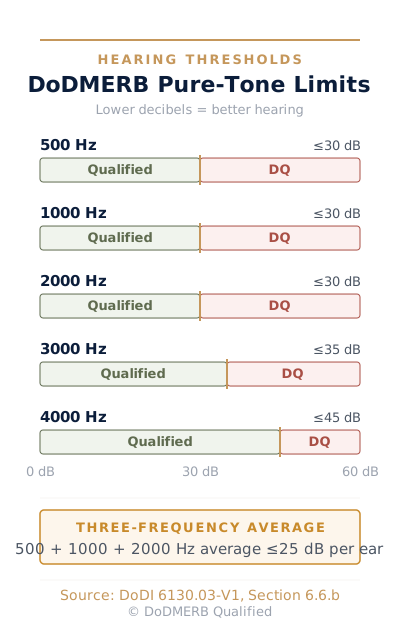
DoDMERB hearing thresholds by frequency. Lower decibels = better hearing.
Asymmetric Hearing Loss (Section 6.6.c)
The word "unexplained" in this regulation matters. If your student has a documented medical reason for the asymmetry (such as a childhood ear infection that resolved), that context becomes relevant during waiver review.
"Unexplained asymmetric hearing loss with a difference of 30 decibels or more between ears at 500, 1000, or 2000 Hz" — DoDI 6130.03, Section 6.6.c
Example that triggers DQ: Right ear 20 dB, left ear 55 dB at 1000 Hz. The 35 dB gap exceeds the 30 dB threshold. This is a disqualification under D122.32.
Example that does not trigger asymmetry DQ: Right ear 25 dB, left ear 50 dB at 2000 Hz. The 25 dB gap is below the 30 dB threshold. However, the left ear at 50 dB exceeds the 30 dB individual limit at 2000 Hz, so this still results in a disqualification under D122.30.
DQ Codes for Hearing
Three codes cover most hearing disqualifications: D122.30 (hearing loss exceeding standards), D122.31 (history of hearing aid use), and D122.32 (asymmetric hearing loss). These appear on your student's DoDMERB status page. The full list of ear and hearing codes is in the Section 6.5 table below.
After this section, you should know the exact dB thresholds your student must meet and which DQ codes apply to their situation.
How the DoDMERB Hearing Test Actually Works
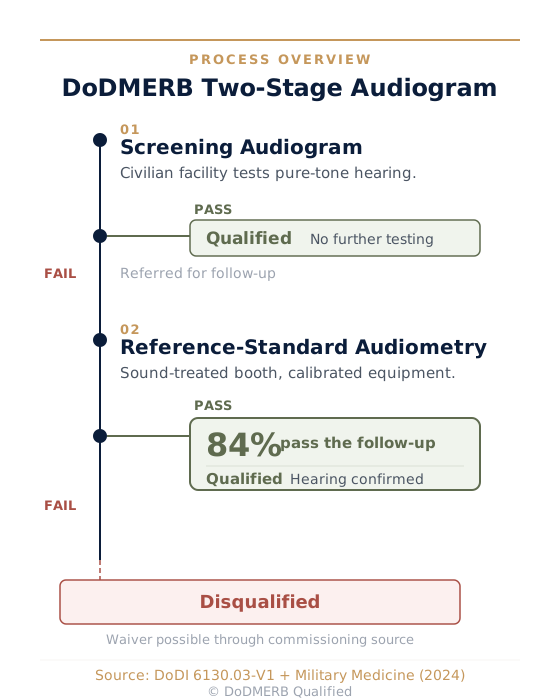
The DoDMERB hearing evaluation is a two-stage process, and most failures happen at stage one. Understanding the difference between these stages explains why the false-disqualification rate is so high.
Stage 1: Screening Audiogram
Your student's initial hearing test takes place at a contracted civilian facility during the standard DoDMERB physical. These are not military audiology labs. They are civilian offices with varying levels of ambient noise control.
The screening audiogram tests pure-tone hearing at each frequency listed in Section 6.6.b. If your student's thresholds exceed the limits, DoDMERB flags the result and the applicant is referred for follow-up testing. Before 2020, this single screening was the final word.
Stage 2: Reference-Standard Audiometry
Since 2020, DoDMERB sends flagged applicants for a follow-up test at a facility meeting reference-standard audiometry requirements. These facilities have sound-treated booths, calibrated equipment, and controlled testing environments.
This is where the 84% statistic becomes critical. A study published in Military Medicine (DOI: 10.1093/milmed/usad400) examined 134 candidates who failed the screening audiogram between 2017 and 2019. Of those, 84% passed the reference-standard follow-up. The ambient noise in contracted facilities was inflating their thresholds beyond the actual level of hearing loss.
What This Means for Your Applicant
A screening failure triggers additional testing, not a final disqualification. Your student will be scheduled for the reference-standard follow-up automatically. No action is required from your family to initiate this step.
If your student passes the follow-up, the screening result is discarded. If they fail the follow-up as well, the reference-standard results become the basis for the disqualification and any subsequent waiver request.
After this section, you should understand why an initial screening failure is not cause for alarm and what happens next in the process.
Hearing Standards by Branch: Where the Differences Actually Are
Every branch uses the same DoDI 6130.03 hearing thresholds for initial qualification. The differences that matter are in waiver willingness and post-commissioning specialty restrictions.
The Universal Baseline
All six branches apply Section 6.6 identically for commissioning purposes. There is no branch that accepts higher decibel levels at the DoDMERB stage. An applicant who fails for Army also fails for Navy, Air Force, Marine Corps, Coast Guard, and Space Force.
Where Branches Diverge
The divergence happens after the disqualification, when the service decides whether to grant a waiver.
| Branch | Waiver Willingness | Waiver Authority | Specialty Restrictions |
|---|---|---|---|
| Army | Moderate to high | Cadet Command Surgeon | PULHES H-profile (H-1/H-2/H-3) limits MOS assignment |
| Navy | Moderate | BUMED | Tinnitus restricts Nuclear and Firefighter specialties |
| Air Force | Generally does not grant | AETC Surgeon General | Strictest branch for hearing waivers |
| Marine Corps | Moderate | BUMED (via Navy pipeline) | Moderate waiver posture |
| Coast Guard | Case-by-case | Coast Guard medical authority | Limited waiver precedent |
| Space Force | Follows AF pipeline | AF medical authority | Same restrictions as Air Force |
What This Means Strategically
Your student is not limited to one branch. Each service makes its own waiver decision independently. Apply broadly. Army and Navy offer the most realistic waiver paths for hearing conditions. Air Force is the least likely to grant a waiver.
After this section, you should know which branches are most likely to grant a hearing waiver and why applying to multiple services matters.
Ear Conditions Beyond Hearing Loss: DoDI Section 6.5 Disqualifications
Hearing thresholds are not the only ear-related disqualification. DoDI 6130.03, Section 6.5 covers structural and functional ear conditions that are disqualifying independent of your student's audiogram results.
Section 6.5 Disqualifying Conditions
Section 6.5 covers nine ear-related DQ codes.
| Code | Condition | DoDI Reference |
|---|---|---|
| D121.00 | Aural atresia or severe microtia | Section 6.5.a |
| D121.20 | Vertigo or disequilibrium (recurring) | Section 6.5.c |
| D121.30 | External ear deformity affecting function | Section 6.5.a |
| D121.70 | Meniere's disease | Section 6.5.b |
| D121.71 | Implanted hearing or balance device | Section 6.5.d |
| D121.80 | Eustachian tube dysfunction (chronic) | Section 6.5.h |
| D121.90 | Cholesteatoma (current or history of) | Section 6.5.e |
| D122.00 | History of inner or middle ear surgery | Section 6.5.f |
| D122.10 | Tympanic membrane perforation (current) | Section 6.5.g |
Each of these is a standalone disqualification. Your student could have perfect hearing thresholds and still receive a DQ for any condition on this list.
Tinnitus: Not a Standalone Disqualification
Tinnitus is not listed as a disqualifying condition in DoDI 6130.03. It only becomes relevant if it measurably impairs hearing function. If your student's audiogram meets all Section 6.6 thresholds, tinnitus alone will not result in a DQ. If tinnitus accompanies hearing loss that exceeds thresholds, the disqualification is for the hearing loss (D122.30), not the tinnitus itself.
Which Conditions Are Waiverable?
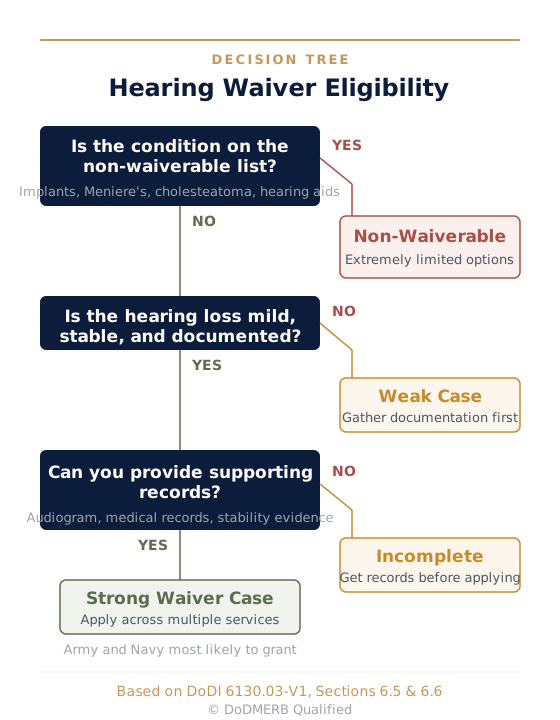
Most Section 6.5 conditions are waiverable if the condition has resolved. Prior ear surgery with documented healing, healed TM perforations, and resolved Eustachian tube dysfunction are all waiverable with documentation. The non-waiverable conditions: implanted devices, active Meniere's, and cholesteatoma.
For a complete overview of how DoDMERB works, see our guide on What Is DoDMERB?
After this section, you should know whether your student's ear condition falls under Section 6.5 or Section 6.6, and whether it is likely waiverable.
Pilot and Aviation Hearing Standards: The Stricter Tier
Passing DoDMERB gets your child commissioned. Flying requires more. Aviation-specific hearing standards are tighter than the commissioning baseline, and they vary by branch.
Navy Student Naval Aviator (Class I)
Navy SNA (Class I) physicals apply stricter hearing criteria than the DoDMERB commissioning baseline, with tighter requirements at lower frequencies. The Class I flight physical is a separate evaluation from the DoDMERB exam and includes additional audiometric frequencies and speech discrimination testing.
An applicant who passes DoDMERB could still fail the Navy SNA physical if their hearing is borderline at any tested frequency.
Air Force Aviation
Air Force pilot candidates face additional speech clarity requirements beyond pure-tone thresholds. Speech recognition testing evaluates how well your student can distinguish spoken words at varying volume levels. Cockpit communication depends on speech clarity, not just the ability to detect tones.
Army Aviation
Army aviation uses the PULHES hearing profile system. Pilot candidates need an H-1 or H-2 profile, which corresponds to hearing thresholds well within the DoDI 6130.03 limits. An H-3 profile (mild hearing loss that may still pass commissioning standards) disqualifies a candidate from the aviation branch. Your student can still commission into other career fields with an H-3 profile.
After this section, you should understand whether aviation is realistic for your student's hearing profile and that commissioning remains possible even if flight training is not.
Hearing Waiver Process: Who Decides and How to Strengthen Your Case
DoDMERB disqualifies. The services decide whether to waive. DoDMERB applies DoDI 6130.03 standards uniformly. The waiver decision belongs entirely to the service your student is applying to.
Waiver Authority by Commissioning Source
Each authority evaluates independently. A waiver denial from Air Force has no bearing on Army's decision.
| Program | Waiver Authority | Processing Time |
|---|---|---|
| West Point | USMA Command Surgeon + Admissions | Weeks to months |
| Army ROTC | Cadet Command Surgeon (Fort Knox) | Weeks to months |
| USNA / NROTC | BUMED | Weeks to months |
| USAFA | Academy Command Surgeon | Weeks to months |
| AFROTC | AETC Surgeon General | Weeks to months |
| Coast Guard Academy | Coast Guard Medical Review Board | Weeks to months |
The Multi-Service Strategy
This is where academy and ROTC applicants have a significant advantage. A student applying to West Point, USNA, Army ROTC, and Navy ROTC creates four separate waiver opportunities from a single DoDMERB disqualification.
Add USAFA and AFROTC, and your student has up to six reviews. Applicants pursuing both academy and ROTC tracks across three services create 5-7 distinct chances.
DoDMERB Qualified
Not sure which services offer the best waiver odds for your student's hearing profile?
LTC Kirkland (Ret.) evaluates each applicant's audiogram results against branch-specific waiver patterns.
What Strengthens a Hearing Waiver
The strongest cases show hearing loss that is mild, stable, explained, and non-progressive. Key documentation includes:
- Reference-standard audiogram results (especially if they show improvement over the screening)
- Medical records explaining the cause of hearing loss
- Evidence that hearing is stable and not degenerating
- Audiologist statement on functional hearing ability
- Records showing the condition is static rather than progressive
Waiver authorities want confidence that the condition will not worsen during a military career.
Generally Non-Waiverable
Certain hearing-related conditions face extremely low waiver approval odds. Implanted hearing or balance devices, active Meniere's disease, cholesteatoma history, and history of hearing aid use (D122.31) are the most difficult to waive across all branches. Profound or complete hearing loss in one ear (single-sided deafness) is also essentially non-waiverable for accession: if the same profile would send a serving member to a medical evaluation board, the services will not waive it in.
After this section, you should know which authority reviews your student's waiver, how to apply across multiple services, and what documentation strengthens the case.
Frequently Asked Questions
Does my student need to disclose mild hearing loss if they think they can pass the test?
Your student does not choose what to disclose on the audiogram. The test measures hearing objectively. If thresholds are within DoDI 6130.03 limits, they pass. If not, they are flagged automatically.
Can noise exposure from shooting sports or concerts cause a DoDMERB failure?
Yes. Noise-induced hearing loss typically affects 3000-4000 Hz first. If your student shoots regularly or attends loud events without hearing protection, their high-frequency thresholds may exceed the 35 dB limit at 3000 Hz or 45 dB limit at 4000 Hz.
What happens if my student passes DoDMERB but hearing worsens during college?
Commissioning sources conduct periodic medical screenings. If hearing degrades below standards during the ROTC program or at an academy, the service evaluates whether the candidate can still commission.
Is tinnitus disqualifying for DoDMERB?
No. Tinnitus is not a standalone disqualification under DoDI 6130.03. It only matters if it accompanies hearing loss exceeding the thresholds in Section 6.6. Your student should report tinnitus honestly.
Can hearing aids or surgery fix hearing loss enough to pass?
Surgery results depend on the condition. Corrective procedures for tympanic membrane perforation can restore hearing to qualifying levels. However, hearing aid use itself is a separate disqualification (D122.31) and is difficult to waive. The goal is unaided hearing that meets standards.
How long does a hearing waiver take to process?
Allow up to three months per service. Applying to multiple services means multiple concurrent timelines. Academy applicants generally need medical qualification resolved by approximately April 15 of their entry year.
My student failed the screening audiogram. What should we do right now?
Wait for the reference-standard follow-up. DoDMERB will schedule it automatically. Do not seek outside audiograms or submit unsolicited test results. The follow-up is your student's best opportunity, and 84% of candidates pass it.
Can my student apply to branches that are unlikely to grant a hearing waiver?
Yes. Apply broadly. Waiver patterns are trends, not guarantees. The Air Force rarely grants hearing waivers, but "rarely" is not "never." There is no penalty for applying to a service that ultimately denies the waiver.
After this section, you should be able to answer the most common questions families ask about hearing standards and DoDMERB.