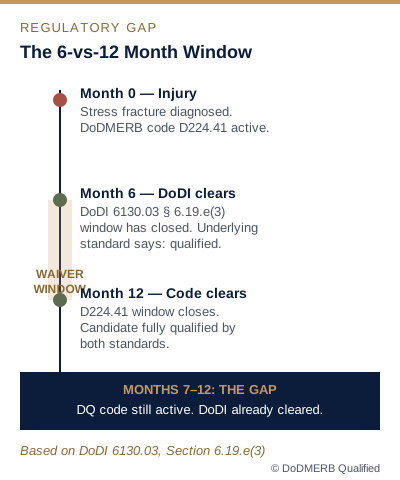
Your orthopedist cleared the stress fracture months ago. DoDMERB still flagged it. That gap between clinical healing and regulatory clearance is the most frustrating part of a DoDMERB stress fracture DQ, and the part families can plan around.
DQ codes D224.41 through D224.43 govern these injuries on top of DoDI 6130.03. The windows are not arbitrary. Prior stress fracture pushes one-year recurrence to 10.6 percent versus 1.7 percent for injury-free recruits (Royal Marines, PMC4590895).
Clinical healing takes 6 to 8 weeks. The DoDMERB clock takes 6 to 12 months. Waiver-readiness lives in the middle. This guide covers the exact codes, how the stress-reaction-versus-fracture distinction sets the window, why MRI grade can move the timeline by half a year, the shin splints code most families miss, the female athlete risk profile, and what goes in a waiver package. See the DoDMERB DQ codes tool for cross-references.
Key Takeaways
- D224.41: Stress fractures are DQ if recurrent, or if a single episode occurred within the past 12 months.
- D224.42: Recurrent shin splints, periostitis, or tibial stress syndrome within the past 12 months is DQ. The code most families forget to disclose.
- D224.43: Stress reaction in a weight-bearing bone within the past 6 months is DQ.
- Stress reactions clear in 6 months; stress fractures in 12. The difference is the diagnosis (marrow edema versus a visible fracture line), and the DoDMERB codes match DoDI 6130.03 on both — there is no code-versus-regulation loophole.
- 10.6 percent recurrence versus 1.7 percent in injury-free recruits is the scientific basis for the windows.
Why "It's Already Healed" Doesn't End the DQ
Bone heals on a stopwatch. DoDMERB grades risk on a calendar.
Civilian orthopedists release athletes back to sport at 6 to 8 weeks once pain-free with imaging resolution. The military's question is different. Not "has this bone healed?" but whether your candidate will survive 8 weeks of ruck marches or Basic Cadet Training without re-fracturing in week 5.
The Recurrence Data That Drives the Window
- Prior stress fracture: 10.6 percent one-year recurrence versus 1.7 percent in uninjured recruits (Royal Marines, PMC4590895).
- Stress fracture risk peaks at weeks 5 through 8 of initial military training.
- Tibial stress fractures average 21 weeks or more before return-to-training.
- Grade 4 MRI lesions average 31.7 weeks before return to play (PMC4367232).
Two Calendars, One Candidate
Civilian clearance asks: is the candidate symptom-free, is imaging resolved, can they return to sport? Yes at 6 weeks. DoDMERB clearance asks whether 6 or 12 months have elapsed, whether there has been recurrence, and whether bone health is documented. The civilian doctor is answering a different question about the same bone.
A 6-week clinical clearance and a 12-month regulatory window are not a contradiction. They are answering two different questions about the same bone.
Why This Helps Your Plan
Understanding the gap lets you stage it. Get clinical clearance early. Document return to full athletic load. Track meets, soccer matches, and ruck-equivalent runs close a waiver package. By the time the regulatory window closes, your candidate has banked months of real-world performance under load.
After this section, you understand why a healed stress fracture still triggers a DQ and what the underlying recurrence data means for your candidate's timeline.
Stress Reaction vs. Stress Fracture: Why One Clears at 6 Months and the Other at 12
The 6-month and 12-month windows are not a code-versus-regulation conflict. They track two different diagnoses on the same continuum. A stress reaction (marrow edema, no fracture line) clears faster than a stress fracture (a visible cortical break), and the DoDMERB codes match the DoD instruction on both.
DoDMERB's DQ codes are screening shorthand layered on top of DoDI 6130.03. For stress injuries the two line up — the window your candidate faces depends on which diagnosis the imaging supports.
The Verbatim Regulatory Text
"Stress fractures, either recurrent or a single episode occurring during the last 12 months." — DoDI 6130.03, Section 6.18.d(14)
"Stress reaction in a weight bearing bone within the last 6 months." — DoDI 6130.03, Section 6.19.u
"Recurrent periostitis, shin splints, or tibial stress syndrome within the last 12 months." — DoDI 6130.03, Section 6.18.d(15)
The DoDMERB DQ codes use the same windows:
| Citation | Condition | Window | Source |
|---|---|---|---|
| D224.41 / §6.18.d(14) | Stress fracture (single within 12 months, or recurrent) | 12 months | Code matches DoDI |
| D224.42 / §6.18.d(15) | Recurrent shin splints / periostitis / MTSS | 12 months | Code matches DoDI |
| D224.43 / §6.19.u | Stress reaction, weight-bearing bone | 6 months | Code matches DoDI |
What the Diagnosis Means in Practice
The lever is not a regulatory loophole — it is the diagnosis. If your candidate's MRI shows only marrow edema with no cortical fracture line, the correct diagnosis is a stress reaction, which clears at 6 months under §6.19.u rather than the 12 months a true stress fracture carries. A candidate mislabeled with a "stress fracture" on clinical exam alone, whose imaging shows only a stress reaction, can have the shorter window applied with the right radiology documentation. Recurrent fractures carry the 12-month window regardless of timing.
Related: For a structurally similar case where a vertebral stress fracture follows different timing rules, see Spondylolysis and DoDMERB: The Pars Fracture Waiver Path.
After this section, you should know the exact DoDI section numbers that apply to your candidate's diagnosis and which window (6 or 12 months) applies and why.
MRI Grade Decides Whether the Window Is 6 or 12 Months
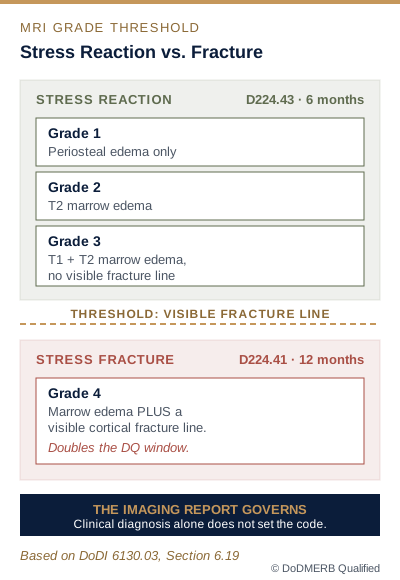
A stress reaction and a stress fracture are not the same diagnosis. The difference, made on MRI, is worth six months of your candidate's calendar.
Stress injuries sit on a continuum: pain first, edema second, microfractures third, a visible cortical fracture line last. The DoDMERB codes track the MRI grade.
The Fredericson MRI Grading System
The Fredericson scale is the standard for tibial stress injuries. Most other long bones use a similar four-grade system.
- Grade 1: Periosteal edema only
- Grade 2: Bone marrow edema visible on T2 only
- Grade 3: Marrow edema on both T1 and T2, no fracture line
- Grade 4: Marrow edema plus a visible fracture line
Grades 1 through 3 are stress reactions. Grade 4 is a stress fracture.
How the Grade Maps to the DoDMERB Code
| MRI Grade | What It Shows | DoDMERB Code | Window |
|---|---|---|---|
| Grade 1 | Periosteal edema | D224.43 | 6 months |
| Grade 2 | T2 marrow edema | D224.43 | 6 months |
| Grade 3 | T1 + T2 marrow edema, no fracture line | D224.43 | 6 months |
| Grade 4 | Marrow edema + visible fracture line | D224.41 | 12 months |
A candidate diagnosed with a "stress fracture" by clinical exam alone, but whose MRI shows only marrow edema, is technically a stress reaction.
Why MRI, Not X-Ray, Matters
Plain X-rays miss stress fractures for 2 to 3 weeks after injury because the callus that makes the fracture visible has not yet formed. MRI sensitivity runs 80 to 100 percent. If your candidate was diagnosed by X-ray alone, request an MRI before the DoDMERB exam.
Read the Radiology Report Yourself
Reviewers key on the radiologist's exact wording, not the orthopedist's discharge summary.
- Grade 4 markers: "cortical break," "fracture line," "discrete fracture," "linear lucency"
- Grade 1 to 3 markers: "periosteal edema," "marrow edema without cortical disruption," "bone stress reaction"
If the discharge summary says "stress fracture" but the MRI says "marrow edema, no cortical disruption," the imaging report governs.
After this section, you should be able to read your candidate's radiology report, identify the MRI grade, and know which DoDMERB code that grade triggers.
Shin Splints Are a DoDMERB Code Too: D224.42 and the Sibling Conditions
Medial tibial stress syndrome, what every coach calls shin splints, has its own DoDMERB code. Most families do not know it, and most candidates forget to disclose it.
D224.42 covers recurrent periostitis, shin splints, and tibial stress syndrome within the past 12 months, matching DoDI 6.18.d(15). The code exists because shin splints sit on the same continuum as the more severe injuries reviewers care about.
Why Shin Splints Get Missed
Coaches treat shin splints as routine training soreness. Pediatricians often do not chart the visit unless imaging is ordered. The candidate self-reports "no injuries" on the initial form. Months later the PT discharge note surfaces, and the question shifts from "is this a DQ" to "why did your candidate not disclose."
The Continuum Problem
Untreated MTSS can progress to stress reaction (D224.43), which can progress to stress fracture (D224.41). All three sit on the same tibial bone overload continuum. Reviewers look at the whole continuum, not the label on the most recent visit.
What "Recurrent" Means in D224.42
The standard interprets "recurrent" as two or more documented episodes of MTSS, or one chronic episode that required PT, gait analysis, or activity modification. Brief episodes that resolved with rest and never reached a clinician usually fall outside the code. Disclose them anyway.
Disclosure Checklist
- List every treated episode of shin pain, MTSS, or tibial pain on the initial form
- Keep PT discharge summaries showing resolution ready
- Get a current orthopedic note confirming asymptomatic status
- Document the most recent athletic season completed without recurrence
- Keep records organized at home for any Remedial request
After this section, you should have a written list of every MTSS or shin splints episode in your candidate's history and the documentation that resolves each one.
Female Candidates: 4.14x Risk and the Bone Density Trap
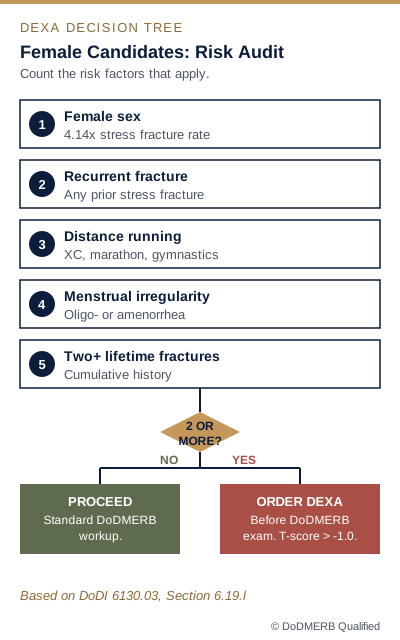
Female military trainees develop stress fractures at 4.14 times the rate of male trainees in identical programs. The waiver process anticipates that, and so should the family.
The hazard ratio comes from a 2022 cohort study (PMC8675322). Women showed 53 percent MTSS incidence versus 28 percent in men. The drivers are bone geometry, hormonal status, body composition, and energy availability.
The Triad Risk Profile
The female athlete triad (Relative Energy Deficiency in Sport, or RED-S) drives most stress fractures in young female athletes:
- Low energy availability (under-fueling relative to training load)
- Menstrual dysfunction (oligomenorrhea or amenorrhea)
- Low bone mineral density
Any two components raise concern. Distance running, cross-country, gymnastics, and dance carry the highest triad risk.
DEXA Bone Density Is a Separate DQ Pathway
DoDI 6.19.l independently disqualifies for low bone density with risk factors, and 6.19.m for osteopenia, osteoporosis, or a fragility fracture.
"History of atraumatic fractures or bone mineral density below the expected range for age with risk factors for low bone density." — DoDI 6130.03, Section 6.19.l
A female candidate with both D224.41 and a low DEXA T-score faces stacked DQs. Order the DEXA proactively if any two apply: female sex, recurrent fracture, distance running background, menstrual irregularity, or two or more lifetime stress fractures.
The Waiver Reframe
Do not hide the risk profile. Document it and show mitigation. A credible package includes:
- Sports nutrition consult notes addressing energy availability
- Documented return to normal menstrual function
- Normalized DEXA readings over time
- Demonstrated training tolerance under increasing load
The strongest packages treat the underlying triad as the case to make, not the problem to hide.
Related: The DoDMERB DQ codes tool lets you cross-reference D224.41, D224.42, and D224.43 against the underlying DoDI sections.
After this section, you should know whether your female candidate falls into the triad risk profile and whether a proactive DEXA is warranted before the DoDMERB exam.
The Waiver Documentation Package: Six Documents That Actually Work
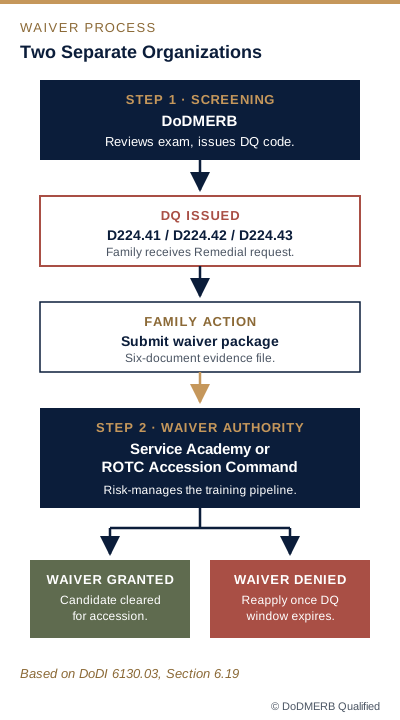
A waiver package is not a stack of paper. It is a story told in documents. Six documents tell the story DoDMERB and the academy waiver authority need to hear.
The waiver authority is risk-managing a four-year training pipeline. Every document answers one of two questions: is the bone healed, and has the candidate trained at military load without recurrence?
The Six-Document Package
Keep these records organized at home, ready when DoDMERB issues a Remedial. Do not submit them proactively.
- Original imaging. X-ray, MRI, or bone scan with date and Fredericson grade specified.
- Follow-up imaging showing resolution. MRI preferred for high-risk locations. Dated within 6 months of submission, with explicit "resolved" or "no acute findings" language.
- Orthopedic clearance letter with diagnosis, treatment summary, return-to-full-activity date, and an explicit training tolerance statement: "Patient may participate in unrestricted physical training including running, rucking, and impact athletics."
- Evidence of actual athletic return. Race results, training logs, or a signed coach note documenting two consecutive seasons without recurrence.
- Bone density (DEXA). Required for female candidates with recurrence, any triad risk factor, or two or more lifetime fractures. T-score above -1.0 with a recent date stamp.
- PT discharge summary documenting completion of return-to-sport progression and asymptomatic status at discharge.
High-Risk vs. Low-Risk Locations
- High-risk: femoral neck, anterior tibial cortex, navicular, fifth metatarsal proximal diaphysis. Femoral neck stress fractures carry a high surgical rate and a 33 percent medical discharge rate in military recruit cohorts (PMC6676320). Require follow-up MRI.
- Lower-risk: posteromedial tibia, metatarsals 2 through 5, fibula. Follow-up X-ray with documented athletic return is often sufficient.
What Gets Packages Rejected
- "Cleared for sport" notes that say nothing about military training load
- Imaging older than 6 months at submission
- No evidence of athletic return, only doctor notes
- No DEXA on a female candidate with recurrent fractures
- Packages that argue the regulation is wrong rather than working within it
DoDMERB is the screening filter. The waiver authority is the risk manager. The package speaks to the second audience, even though it routes through the first.
DoDMERB Qualified
Building a stress fracture waiver package?
We help families translate orthopedic records into the documentation DoDMERB and academy waiver authorities actually accept. Start with a free case review.
After this section, you should have a six-document checklist with each item either complete, in progress, or clearly identified as needed before the DoDMERB exam.
Frequently Asked Questions
How long after a stress fracture can my candidate apply?
D224.41 sets a 12-month window from the most recent episode, or any recurrence regardless of timing, matching DoDI 6.18.d(14). A stress reaction (marrow edema with no fracture line) carries a shorter 6-month window under DoDI 6.19.u. Plan around whichever diagnosis the imaging actually supports.
Is a stress reaction the same as a stress fracture for DoDMERB?
No. Fredericson grades 1 through 3 (marrow edema only) are stress reactions and trigger D224.43 with a 6-month window. Grade 4 (visible fracture line) triggers D224.41 with a 12-month window. Read the radiology report carefully.
Do I have to disclose shin splints on the DoDMERB form?
Yes if treated. D224.42 covers recurrent MTSS within the past 12 months, matching DoDI 6.18.d(15). Disclose every documented episode with PT notes and resolution.
Can a single old stress fracture be waived?
Routinely yes, outside the 12-month window with imaging-confirmed healing and documented athletic return. Recurrent fractures and high-risk locations like the femoral neck face harder paths. The package matters more than the diagnosis.
My daughter has had two stress fractures. Is she still eligible?
Eligibility is preserved, but the waiver bar rises. Expect DEXA bone density screening, female athlete triad assessment, and a longer documentation trail. Recurrent fractures specifically trigger D224.41 regardless of timing. Order the DEXA proactively.
Does the academy or DoDMERB grant the waiver?
The academy or ROTC accession command grants the waiver. DoDMERB issues the DQ only. They are separate organizations with separate timelines and decision-makers. The waiver package goes to the academy or accession command.
My orthopedist says it's fully healed. Why is DoDMERB still flagging it?
Because the regulation measures recurrence risk, not healing. Bone heals in 6 to 8 weeks. DoDMERB applies a 6 or 12-month window. The 10.6 percent recurrence rate in prior-fracture recruits versus 1.7 percent baseline is the basis for that gap.
Can a tibial stress fracture be waived faster than other locations?
A true tibial stress fracture carries the same 12-month window as other stress fractures (DoDI 6.18.d(14)). What moves faster is a tibial stress reaction — marrow edema with no fracture line — which clears at 6 months under DoDI 6.19.u. If the imaging supports a reaction rather than a fracture, the shorter window applies. Anterior cortex tibial fractures are high-risk and reviewed more strictly regardless.