Your student was sick, the doctor prescribed an inhaler to help them breathe, and the discharge paperwork said bronchitis, not asthma. Now you are looking at DoDI 6130.03 and wondering whether a prescription written during a chest cold could end a service academy or ROTC path.
The short answer: a single bronchitis episode treated with an inhaler is unlikely to result in a DoDMERB disqualification for asthma. But the full answer depends on how often it happened, and DoDMERB reviewers will look closely at the clinical records to find out.
Key Takeaways
- A one-time inhaler prescription for bronchitis or respiratory infection is typically not a disqualifying event under DoDI 6130.03, Section 6.10.e
- DoDMERB physicians know that inhalers are a standard treatment for bronchitis and that wheezing can be a symptom of infection, not only asthma
- Repeated episodes — multiple bronchitis visits requiring inhalers or steroid bursts — can trigger a disqualification for airway hyperresponsiveness even without a formal asthma diagnosis
- The diagnosis label does not protect or disqualify your student. The clinical picture does.
- DoDMERB will request the original clinical records, not just the diagnosis code
What the Regulation Says About Bronchitis and Inhalers
The standard is broader than the word "asthma." DoDI 6130.03, Section 6.10.e disqualifies applicants who have a history of:
"airway hyper responsiveness including asthma, reactive airway disease, exercise-induced bronchospasm or asthmatic bronchitis, after the 13th birthday."
Two sub-provisions extend this further. Symptoms — cough, wheeze, chest tightness, shortness of breath, or exercise limitation after age 13 — are disqualifying. So is any prescription for an inhaled or oral corticosteroid, leukotriene receptor antagonist, or beta agonist (albuterol, for example) for airway hyperresponsiveness after age 13.
Read literally, a single albuterol inhaler prescribed at age 16 could appear disqualifying. But the standard is applied by physicians who understand clinical context, not by an automated filter.
⚠️ Note: "Asthmatic bronchitis" is named explicitly in Section 6.10.e as a disqualifying form of airway hyperresponsiveness. The word "asthma" does not need to appear in your student's chart.
The Question DoDMERB Is Actually Asking
When a DoDMERB physician reviewer sees an inhaler prescription in the records, they are not asking "was this labeled asthma?" They are asking: does this look like airway hyperresponsiveness, or does it look like a one-time infectious illness?
Those two situations produce different clinical pictures.
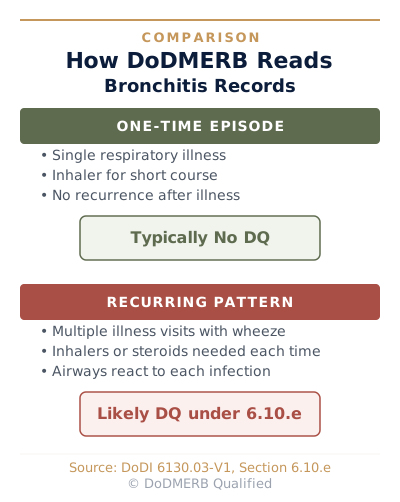
One-time bronchitis with an inhaler means a single episode of respiratory infection, documented as bronchitis or upper respiratory infection, treated with an inhaler and possibly antibiotics, with no recurrence and no ongoing symptoms. DoDMERB physicians know this is standard care for managing airway inflammation during a chest infection. If the records confirm the inhaler was used for a defined illness and the student has had no subsequent respiratory issues, this typically does not result in a disqualification for asthma.
A recurring pattern means every time the student gets sick, they develop cough, wheezing, and shortness of breath and require an inhaler or a steroid course to recover. If this happens two or three times, the diagnosis label on the chart is almost irrelevant. The pattern itself describes airway hyperresponsiveness triggered by pathogens. That meets the definition under 6.10.e regardless of whether a physician ever wrote the word "asthma."
The line is not always clean, but the principle is consistent: frequency and pattern determine risk, not the label.
DoDMERB Qualified
Not sure whether your student's inhaler history fits the one-time or recurring pattern?
We review the clinical records alongside DoDI 6130.03 standards and give you a clear picture of what DoDMERB is likely to see before your student submits anything.
What DoDMERB Will Review
When an inhaler or respiratory condition appears on the DoDMERB questionnaire, reviewers will typically request the original clinical records. That means the actual physician notes, not just a summary or diagnosis code.
Those records will show the stated diagnosis at each visit, whether symptoms were recurring or isolated, what medications were prescribed and for how long, and whether the provider noted any concern about underlying airway reactivity.
Do not attempt to manage this by omitting information on the questionnaire. If a waiver is requested, the waiver authority may ask for pharmacy records, specialist notes, and provider letters — and inconsistencies between what your student reported and what those records contain create credibility problems that are harder to overcome than the medical condition itself.
What to Have Ready
Gather records now, before the DoDMERB exam. This puts you in a position to respond quickly to any remedial request rather than scrambling under deadline pressure.
Medical Records
- Office visit notes from each bronchitis or respiratory illness visit
- Any pharmacy records showing inhaler prescriptions (drug name, date, fill quantity)
- Records confirming the inhaler was discontinued after the illness resolved
If a Waiver Becomes Necessary
- Spirometry or pulmonary function test results (baseline and post-bronchodilator)
- Primary care physician letter documenting that the inhaler was prescribed for an acute illness, not for ongoing airway management
- Documentation of current athletic activity and absence of respiratory symptoms
Frequently Asked Questions
My student's chart says "bronchitis," not "asthma." Is that enough protection?
No. DoDMERB physicians read clinical records, not diagnosis codes. If the records describe recurring wheeze, steroid use, and multiple rescue inhaler prescriptions, the pattern will be evaluated as potential airway hyperresponsiveness regardless of what the visit was labeled. The label alone provides no protection.
The inhaler was prescribed once, two years ago. My student has had no breathing issues since. Will this still come up?
Yes, it will appear on the DoDMERB questionnaire and likely result in a records request. A single, isolated episode with no recurrence is generally the most favorable scenario. Have the original visit notes available to confirm the clinical context.
My student still needs the inhaler occasionally. Should they stop using it before the DoDMERB exam?
No. Stopping medication to appear clear for DoDMERB is both medically risky and strategically counterproductive. Waiver authorities want to see genuine stability documented over time, not artificial stability from discontinuing treatment. Use the medication appropriately, then let the records reflect what your student's airways actually do over time.
What if the inhaler was prescribed before age 13?
Section 6.10.e applies after the 13th birthday. A rescue inhaler prescribed at age 10 for a single chest cold, with no medication use or symptoms after age 13, is generally not a disqualifying factor on its own.
Inhaler use and bronchitis are among the most misread items on the DoDMERB questionnaire. A single episode treated during an illness is a very different clinical picture from recurring airway events that required medication. DoDMERB physicians understand the difference, and the records will reflect which situation applies to your student.
If you are not certain how your student's history reads on paper, that is worth clarifying before the exam. At DoDMERB Qualified, we review the actual records against the DoDI 6130.03 standard and tell you exactly what DoDMERB is likely to see. DoDMERB Consulting begins at $800.