Your student's medical records mention asthma, and now a DoDMERB spirometry test stands between them and a service academy or ROTC scholarship. The word "disqualified" on a DoDMERB letter feels final. It is not.
Asthma is among the most commonly cited medical disqualifying conditions in military accessions. It is also one of the most waiverable. Officer candidate waiver approval rates rose from 56% in FY2021 to 74% in FY2023, according to Air Force Recruiting Service data, reflecting a broader shift in how the military evaluates medical history.
This guide explains what DoDMERB spirometry tests measure, how the methacholine challenge works, what waiver authorities look for, and what to do right now if your student has been disqualified. It covers service academy and ROTC scholarship applicants specifically.
Key Takeaways
- DoDI 6130.03 ties the asthma DQ to symptoms or medication use after the 13th birthday, not a childhood diagnosis alone
- Spirometry measures FEV1 and FVC to determine if airway obstruction exists; a post-bronchodilator FEV1 change below 12% indicates no active reversible obstruction
- A negative methacholine challenge (PC20 >16 mg/mL) is the single strongest piece of evidence for a favorable asthma waiver
- Waiver standards vary by branch: Army is the most accommodating for asthma waivers; Air Force expanded its asthma waiver policy in December 2024
- A proactive specialist evaluation before the DoDMERB exam can prevent a DQ from being issued in the first place
What DoDI 6130.03 Actually Says About Asthma
The regulation is specific, and understanding exactly what it says is the first step to knowing where your student stands. DoDI 6130.03-V1, Section 6.10.e, defines the disqualifying standard for airway hyperresponsiveness:
"History of airway hyper responsiveness including asthma, reactive airway disease, exercise-induced bronchospasm or asthmatic bronchitis, after the 13th birthday. (1) Symptoms suggestive of airway hyper responsiveness include, but are not limited to, cough, wheeze, chest tightness, dyspnea, or functional exercise limitations after the 13th birthday. (2) History of prescription or use of medication (including, but not limited to, inhaled or oral corticosteroids, leukotriene receptor antagonists, or any beta agonists) for airway hyper responsiveness after the 13th birthday." DoDI 6130.03-V1, Section 6.10.e
Two separate triggers exist. Any symptoms of airway hyperresponsiveness after age 13 (cough, wheeze, chest tightness, shortness of breath, or exercise limitations). Or any use of respiratory medications after age 13 (inhalers, corticosteroids, or leukotriene receptor antagonists). Either trigger alone is sufficient for a disqualification.
The age 13 threshold matters. If the last time your student had wheezing and needed an inhaler was at age eight or nine, and from age 13 onward they had no symptoms, no ER visits, no steroid bursts, and no asthma medications, they are in a much better position. Candidates in this situation may receive a qualified designation at the DoDMERB level without needing a waiver at all.
A disqualification at the DoDMERB level does not determine the final outcome. That's the accession standard. It doesn't automatically tell you what the waiver authority will do. The DQ opens a door to the waiver system, where the actual decision gets made.
After this section, you understand the exact standard DoDMERB applies and whether your student's history triggers it.
Related: For a full list of respiratory DQ codes, see our Respiratory Disqualifications Guide.
What Spirometry Tests Actually Measure
Spirometry is the foundation of every asthma evaluation in the DoDMERB process, and the results carry significant weight in waiver decisions. Understanding what the numbers mean removes the mystery from test results and lets you assess where your student stands before the waiver authority weighs in.
FEV1, FVC, and the Ratio
FEV1 (Forced Expiratory Volume in 1 second) measures the maximum volume of air a person can blow out in one second of a forced breath. FVC (Forced Vital Capacity) measures the total amount of air forcefully exhaled after taking the deepest breath possible.
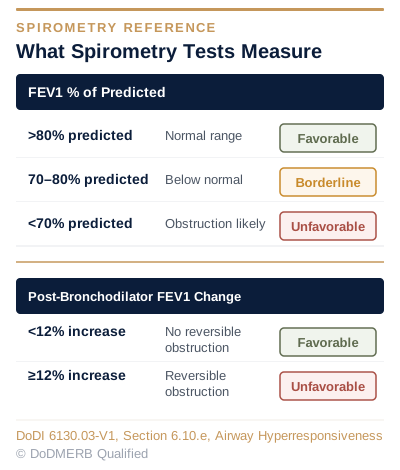
The FEV1/FVC ratio is the critical number. It reveals whether airway obstruction exists. A ratio above 0.70 is generally normal; below 0.70 suggests obstruction. A favorable result shows FEV1 greater than 80% of predicted with a normal FEV1/FVC ratio. These two numbers together form the baseline that every subsequent waiver decision builds on.
Pre/Post Bronchodilator Testing
After baseline spirometry, the candidate inhales a rescue bronchodilator (albuterol) and repeats the test. This pre/post comparison reveals whether the airways are reversibly obstructed.
If FEV1 does not change significantly (less than 12% increase), this indicates no reversible obstruction and no active asthma pattern. If FEV1 increases more than 12%, the airways were constricted and responded to medication, which is clinical evidence of active asthma.
Waiver authorities are looking to see whether your lungs behave like someone who still has asthma on spirometry.
One candidate reported achieving 112% of predicted on baseline spirometry with only a 1% post-bronchodilator change, well below the 12% threshold. That result demonstrated no reversible obstruction and contributed to a favorable waiver outcome. Athletes who train at high intensity often produce above-predicted baselines, which strengthens the overall spirometry picture.
After this section, you can read a spirometry report and know whether the results favor a waiver.
The Methacholine Challenge: When DoDMERB Orders It and What Results Mean
The methacholine challenge is the most sensitive test for ruling out asthma, and a negative result is the single strongest piece of evidence for a favorable waiver. If your student's baseline spirometry comes back normal, this is likely the next test the waiver authority will order.
What the Test Does
The candidate inhales increasing doses of nebulized methacholine, a substance that provokes bronchospasm in hyperresponsive airways. Spirometry is performed after each dose level. Concentrations range from 0.016 to 16 mg/mL using two- to four-fold dilutions.
The test endpoint is a 20% drop in FEV1 from baseline. If that drop occurs, the test is positive, meaning the airways are hyperresponsive. If the candidate reaches the highest concentration without a 20% FEV1 drop, the test is negative.
One NROTC scholarship candidate who was DQ'd for asthma history described the experience: lung function needed to stay above 83% of baseline (no more than a 17% FEV1 drop) throughout the test. He passed and obtained his waiver.
Reading the Results
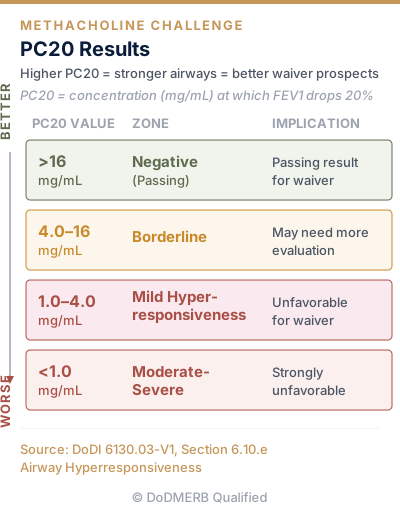
The key metric is PC20, the concentration of methacholine at which FEV1 drops 20%. Higher PC20 values are better because they mean airways resisted provocation at higher doses.
| PC20 Range | Interpretation | DoDMERB Implication |
|---|---|---|
| >16 mg/mL | Normal (Negative) | Passing result for waiver purposes |
| 4.0–16 mg/mL | Borderline | May require additional evaluation |
| 1.0–4.0 mg/mL | Mild hyperresponsiveness | Unfavorable for waiver |
| <1.0 mg/mL | Moderate-severe | Strongly unfavorable |
The Navy aviation standard requires a negative methacholine challenge (PC20 >16 mg/mL) within one year of the waiver application, combined with at least five years symptom-free. The Air Force announced in 2017 that it would process candidates with a questionable asthma history for a waiver if they pass the methacholine challenge.
The methacholine challenge has high sensitivity and strong negative predictive value for ruling out asthma. However, up to 7% of asymptomatic individuals may test positive, making it more reliable for exclusion than confirmation.
After this section, you understand what the methacholine challenge tests, what a passing result looks like, and what can affect the outcome.
The Bronchitis Inhaler Problem: When an Inhaler Is Not an Asthma Diagnosis
One of the most common fears parents bring to us: their teenager was prescribed an inhaler for bronchitis years ago, and now they worry DoDMERB will treat it as asthma. The answer depends on what the records show and how often it happened.
A Single Inhaler for Bronchitis
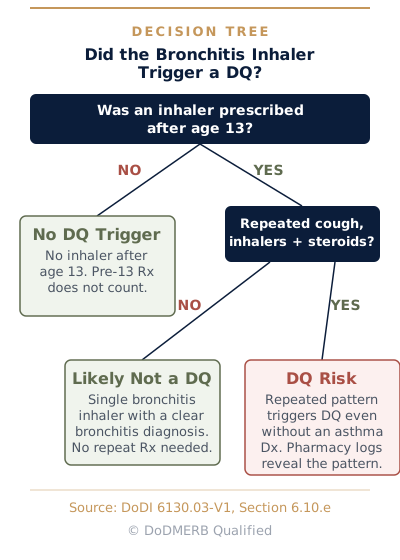
Doctors prescribe inhalers as an adjunct treatment for bronchitis and upper respiratory infections. When DoDMERB requests the primary clinical records, they will typically show bronchitis as the diagnosis and treatment consisting of an inhaler plus other medications, possibly antibiotics. This will not be a DQ for asthma.
The key factor is what the records say. If the diagnosis is bronchitis and the inhaler was part of a short-term treatment plan, you are in a defensible position.
When the Pattern Becomes a Problem
A single episode is one thing. If your teenager went to the doctor multiple times for cough, wheezing, and shortness of breath, received bronchitis diagnoses each time, and required inhalers and short courses of steroids repeatedly, this pattern is likely a DQ even without a formal asthma diagnosis. DoDMERB evaluates the clinical pattern, not just the label. Pharmacy records reveal the pattern clearly.
The Mislabeled-Asthma Problem
Doctors sometimes note "asthma" loosely for respiratory symptoms during an acute illness. If your student's records contain a mislabeled asthma reference from a bronchitis or strep throat episode, a current pulmonologist evaluation explicitly clarifying the original diagnosis becomes essential. (True cough-variant asthma — chronic cough as the only symptom — is a real asthma phenotype and is treated as asthma, not a mislabel.)
After this section, you know how DoDMERB distinguishes bronchitis inhalers from asthma and what documentation patterns cause problems.
What Waiver Authorities Actually Want to See
DoDMERB does not grant waivers. The waiver authority is the specific academy or ROTC program your student applied to, and each one evaluates cases independently.
The Favorable Profile
The strongest profile combines several elements: a remote asthma history, normal spirometry, normal methacholine challenge results, several years off asthma medications, and high-intensity athletics with no symptoms. All elements together create the strongest case. Missing any single one weakens the profile, but no single element is automatically disqualifying on its own.
The Unfavorable Profile
If testing still shows airway hyperresponsiveness, or if daily life still involves inhalers or steroid bursts, the waiver prospect becomes much more difficult. The Air Force Academy states explicitly: "Ongoing use of medication to treat or prevent bronchospasm does not convey resolution of such a condition and will result in waiver denial."
How Standards Vary by Branch
Each service applies its own standards to the same DQ.
| Service | Waiver Approach | Key Standard |
|---|---|---|
| West Point / Army ROTC | Most accommodating | Historically the most flexible for asthma waivers; holistic review |
| USNA / Navy ROTC | Middle ground | Navy aviation: 5 years symptom-free + negative MCT within 1 year |
| USAFA / Air Force ROTC | Expanded waivers (Dec 2024) | Passing MCT required; ongoing daily medication = denial; no-daily-medication candidates now waiver-eligible |
ROTC programs offer an additional advantage: their December deadline gives candidates more time than the typical April 15 academy deadline.
After this section, you can assess whether your student's profile is favorable, unfavorable, or somewhere in between.
DoDMERB Qualified
Not sure whether your child's asthma profile supports a waiver?
We evaluate your student's specific respiratory history against each service's standards so you know which programs remain realistic.
What to Do After an Asthma DQ: Action Steps
A disqualification does not end the process. It opens the door to the waiver system, where the actual decision gets made. The following steps convert uncertainty into organized action.
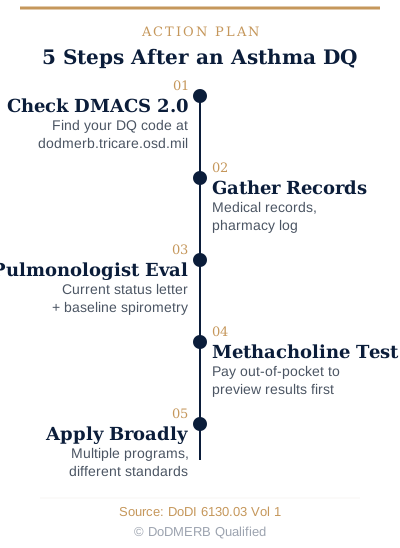
Step 1: Understand What Triggered the DQ
Check the DMACS 2.0 portal (dodmerb.tricare.osd.mil) for your student's status and the specific DQ code. The code tells you exactly which condition was flagged and which section of DoDI 6130.03 applies. This determines what documentation you need and what testing the waiver authority may order.
Step 2: Gather Medical Records and Pharmacy Logs Proactively
Pull all records related to your student's respiratory history: diagnoses, prescriptions, ER visits, and specialist evaluations. Request pharmacy records separately. The pharmacy log shows every prescription filled, when, and how often.
Step 3: Schedule a Pulmonologist Evaluation
Find a pulmonologist familiar with military medical standards. Request a current-status letter confirming whether active asthma is present. Get baseline spirometry with pre/post bronchodilator testing if your student has not already completed it.
Step 4: Prepare for the Methacholine Challenge
Start with current pre/post-bronchodilator spirometry and complete clinical records. DoDMERB or the waiver authority will request a methacholine challenge if it needs one. Wait for that request before scheduling the challenge.
Step 5: Apply Broadly
Apply to multiple academies and ROTC programs simultaneously. Different waiver authorities apply different standards. Army is historically the most accommodating for asthma waivers. The Air Force expanded its asthma waiver policy in December 2024, making waivers available for candidates who do not require daily preventive medication. One branch may grant what another denies.
Records to Gather
- All respiratory-related medical records (diagnoses, ER visits, prescriptions)
- Pharmacy log showing all inhaler prescriptions filled, dates, quantities
- Pulmonologist evaluation letter confirming current status
- Spirometry results (pre/post bronchodilator PFT)
- Methacholine challenge results (if completed)
- Athletic records or coach letters confirming high-intensity activity without symptoms
After this section, you have a concrete action plan and a documentation checklist you can start today.
Related: For a detailed walkthrough of the waiver timeline and authority structure, see our DoDMERB Waiver Process Guide.
The Bottom Line
Asthma is one of the most common DoDMERB disqualifications and one of the most waiverable. The word "asthma" in your student's chart does not determine the outcome. Objective test results do.
Three things matter most. Normal spirometry combined with a negative methacholine challenge and years off medications creates the strongest waiver profile. A proactive specialist evaluation before the DoDMERB exam can prevent a DQ entirely. And different waiver authorities evaluate independently, so applying broadly is the plan.
The trend favors your student. Air Force officer candidate waiver approval rates climbed from 56% to 74% between FY2021 and FY2023, according to Air Force Recruiting Service data. The process is documented, the testing is objective, and preparation matters more than the diagnosis.
Frequently Asked Questions
Does childhood asthma automatically disqualify you from a service academy?
Not if it resolved before age 13. DoDI 6130.03 ties the disqualification to symptoms or medication use after the 13th birthday. If your student's records show no symptoms, ER visits, or prescriptions from age 13 onward, they may qualify outright without needing a waiver.
What is the DoDMERB spirometry test and what does it measure?
Spirometry measures FEV1 (air blown out in one second) and FVC (total forced exhale). The FEV1/FVC ratio reveals airway obstruction. Pre/post bronchodilator testing checks whether airways respond to a rescue inhaler. Less than 12% FEV1 change after bronchodilator indicates no active reversible obstruction.
What is a methacholine challenge test and will DoDMERB order one?
The methacholine challenge inhales increasing doses of a substance that provokes bronchospasm. If FEV1 drops 20% or more, the test is positive. DoDMERB or the waiver authority orders it when baseline spirometry is normal but asthma history exists. A PC20 greater than 16 mg/mL is a negative (passing) result.
Can you get a waiver if you failed a methacholine challenge?
It is very difficult. A failed methacholine confirms airway hyperresponsiveness, the core clinical basis for an asthma DQ. Some candidates retest after addressing congestion or improving cardiovascular fitness. A positive result significantly narrows waiver options across all branches, though retesting after the underlying issue resolves may be worth discussing with a pulmonologist.
What FEV1 score do you need to pass a DoDMERB spirometry test?
FEV1 above 80% of predicted with a normal FEV1/FVC ratio is the general threshold. Post-bronchodilator FEV1 change below 12% indicates no reversible obstruction. These numbers together create the strongest baseline for a waiver review.
Does a bronchitis inhaler count as asthma for DoDMERB?
A single bronchitis inhaler typically does not. DoDMERB physicians recognize inhalers as standard bronchitis treatment. A repeated pattern of cough, wheezing, and inhaler prescriptions across multiple visits may be treated as airway hyperresponsiveness regardless of the diagnosis label in the chart.
Does DoDMERB check pharmacy records for inhaler prescriptions?
Yes. DoDMERB may issue a Remedial requesting a pharmacy log showing every prescription filled, when, and how often. DoDMERB does not automatically pull civilian pharmacy records — the request comes through a manual Remedial process. That makes this one of the most objective tools when it is requested, because the log shows exactly when and how often medications were prescribed. Obtain your pharmacy records proactively so you know what they contain before any Remedial arrives.
What is the difference between a DoDMERB DQ and a waiver denial?
A DQ means DoDMERB determined the candidate does not meet the medical accession standard. A waiver denial means the waiver authority (the academy or ROTC program) reviewed the case and declined to grant an exception. These are two separate decisions by two separate entities. Different waiver authorities may reach different conclusions on the same DQ, which is why applying broadly matters.