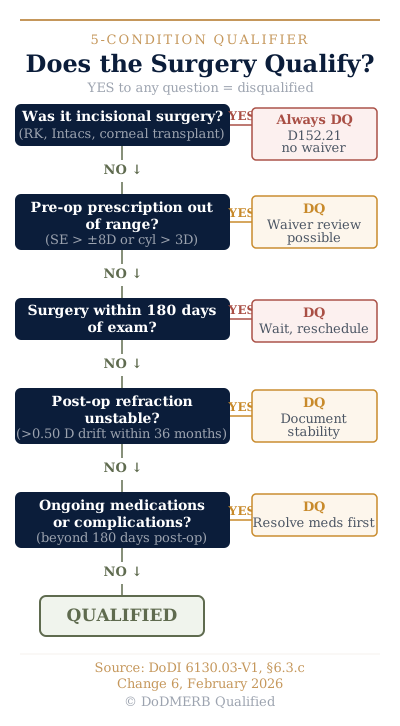
Every year, parents read online that "just get LASIK and you're good to go." Then their student, with a -7.50 prescription, gets the surgery, achieves 20/20, and opens a DoDMERB disqualification letter three months later. The regulation is not a single pass/fail checkbox for LASIK DoDMERB qualification. It contains five independent conditions, and any one of them triggers a disqualification.
This article breaks down each condition in DoDI 6130.03-V1 Section 6.3.c.(3) so you know exactly what the standard requires. We quote the regulation directly, explain it in plain English, and show you how to prepare your student's records before the exam.
Key Takeaways
- LASIK, PRK, and SMILE are NOT automatically disqualifying. They are conditionally acceptable under five specific criteria.
- Your student's pre-operative prescription is evaluated independently from the post-surgical result. A pre-op spherical equivalent exceeding +/-8.00 D or astigmatism exceeding 3.00 D is disqualifying.
- Surgery must be completed at least 180 days before the DoDMERB exam. The clock starts on the day of surgery.
- Post-op stability must be documented with at least two refraction measurements taken at least one month apart.
- Radial keratotomy (RK) and other incisional surgeries are always disqualifying with no standard waiver pathway.
- Prescription eye drops or therapeutic interventions required beyond 180 days post-surgery are independently disqualifying.
What the Regulation Actually Covers
DoDI 6130.03-V1 Section 6.3.c.(3) governs all laser-based refractive surgery under a single paragraph. This includes LASIK, PRK, LASEK, and SMILE. The regulation does not treat these procedures differently from one another. They are all evaluated against the same five conditions.
Here is the critical distinction most families miss: these procedures are not automatically disqualifying. They are conditionally acceptable. The regulation lists specific criteria, and your student must satisfy every one of them. Failing any single condition triggers a DQ, even if all other conditions are met.
"Corneal refractive surgery performed with an excimer or femtosecond laser, including, but not limited to, photorefractive keratectomy, laser epithelial keratomileusis, laser-assisted in situ keratomileusis, and small incision lenticule extraction, if any of the following conditions are met..." (DoDI 6130.03, Section 6.3.c.(3))
The exam does not ask "did your student have LASIK?" and issue a DQ. It asks whether the surgery meets all five conditions. The answer depends on the details.
| Procedure | Type | DoDMERB Status |
|---|---|---|
| LASIK | Laser (excimer/femtosecond) | Conditional |
| PRK | Laser (excimer) | Conditional |
| SMILE | Laser (femtosecond) | Conditional |
| Radial Keratotomy (RK) | Incisional | Always DQ |
| Intacs (corneal implants) | Incisional | Always DQ |
One additional note: LASIK and PRK performed at service academies typically happen during the junior year, around ages 20 to 22, when vision has stabilized. The FDA requires patients to be at least 18 for refractive surgery. This timing is intentional and reflects the stability requirements discussed below.
DQ Condition 1: Your Pre-Op Prescription Is the Hidden Test
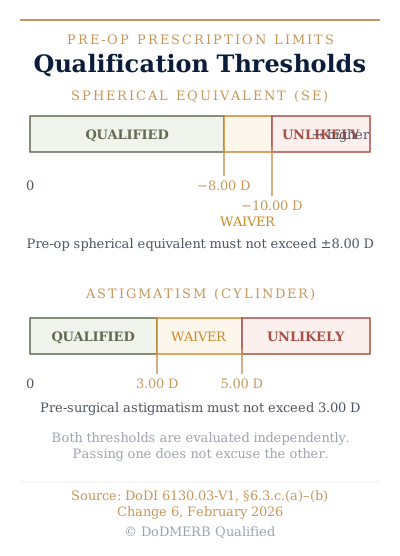
This is the most common misconception families encounter: your student's prescription before surgery is evaluated independently from the post-operative result. Surgery may produce perfect 20/20 vision, but if the starting prescription exceeded the regulation's limits, the DQ stands.
The regulation establishes two separate thresholds.
"Pre-surgical refractive error in either eye exceeded a spherical equivalent of +8.00 or -8.00 diopters." (DoDI 6130.03, Section 6.3.c.(3)(a))
"Pre-surgical astigmatism exceeded 3.00 diopters." (DoDI 6130.03, Section 6.3.c.(3)(b))
These are two independent tests. Your student can pass the spherical equivalent limit and still fail on the astigmatism limit, or vice versa. Both must be within range.
How spherical equivalent works: The formula is sphere + (cylinder / 2). Your student's pre-op prescription reads sphere -7.00 D, cylinder -2.50 D. The spherical equivalent calculation is -7.00 + (-2.50 / 2) = -8.25 D. That exceeds the +/-8.00 D limit. Even if the post-operative result is 20/20 with a flat refraction, the pre-op calculation triggers a DQ.
Why does the regulation care about the original prescription? LASIK corrects the optical error, but it does not shorten the elongated eyeball that caused the myopia. High myopes still carry elevated retinal risks: lattice degeneration, retinal holes, tears, and detachment. These structural risks persist regardless of how well the laser corrected the optics. A candidate with a pre-op of -9.50 D and perfect 20/20 post-op still carries the retinal risk profile of a -9.50 D myope. DoDMERB reviews the retina separately as part of the eye examination.
Related: For a full breakdown of refractive error standards by branch, see Vision Requirements by Branch.
DQ Condition 2: The 180-Day Window
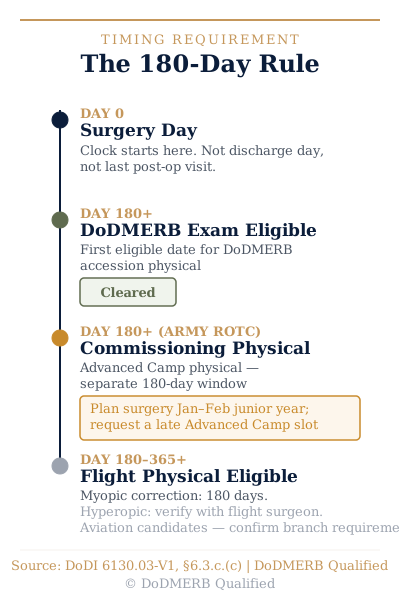
The regulation requires a minimum waiting period between surgery and the DoDMERB exam.
"Within 180 days of accession medical examination." (DoDI 6130.03, Section 6.3.c.(3)(c))
The clock starts from the surgery date. Not the discharge date. Not the last post-op visit. If the DoDMERB exam is scheduled for October, surgery must be completed by mid-April at the latest. Missing this window by even one day can mean waiting another full commissioning cycle.
This timing constraint creates a real planning challenge for families. Army ROTC candidates face two separate 180-day windows: one for the DoDMERB accession exam, and one for the commissioning physical at Advanced Camp. Our team's guidance is to schedule surgery in January or February of junior year and book a late-summer camp slot. That sequence clears both windows with margin.
For candidates pursuing aviation, the stakes are higher. The same 180-day requirement applies to the commissioning flight physical. Planning surgery around both the accession exam and the camp physical requires working backward from the latest possible exam date.
| Exam Type | Minimum Wait After Surgery |
|---|---|
| DoDMERB accession exam | 180 days (6 months) |
| Army commissioning physical (Advanced Camp) | 180 days (6 months) |
| Air Force flight physical (hyperopic correction) | 12 months |
| Air Force flight physical (myopic correction) | 6 months |
DQ Condition 3: Stability Requirements
Stability is not a subjective judgment. The regulation defines it with specific numbers and a specific testing protocol.
"Post-surgical refraction in each eye is not stable. For refractive surgery procedures within the last 36 months, stability is demonstrated by at least two separate post-operative refractions performed at least 1 month apart that demonstrate no more than +/- 0.50 diopters difference in sphere or no more than +/- 0.50 diopters in cylinder. For refractive surgery procedures more than 36 months ago, stability is demonstrated by at least two separate post-operative refractions that demonstrate no more than +/- 1.00 diopters difference in sphere or no more than +/- 1.00 diopters in cylinder." (DoDI 6130.03, Section 6.3.c.(3)(e))
Your student needs two refraction measurements taken at least one month apart. If surgery was within the last 36 months, those measurements must show no more than 0.50 diopters of change in either sphere or cylinder. If surgery was more than 36 months ago, the tolerance widens to 1.00 diopter.
Your student needs all post-op refraction records from their eye doctor, organized and accessible at home. If DoDMERB issues a Remedial request, you will need to submit these records.
Post-Op Records to Keep Organized at Home
- Date of surgery and procedure type (LASIK, PRK, or SMILE)
- Pre-operative refraction records (sphere, cylinder, axis for each eye)
- All post-operative refraction records (minimum 2 measurements, at least 1 month apart)
- Operative report from surgeon
- Surgeon name, clinic, and contact information
DQ Condition 4: Ongoing Medications or Complications After 180 Days
Any prescription eye medication required beyond the 180-day post-surgical mark is independently disqualifying.
"Complications, ongoing medications, ophthalmic solutions, or any other therapeutic interventions required beyond 180 days of procedure." (DoDI 6130.03, Section 6.3.c.(3)(d))
If your student is still using prescription eye drops regularly after the 180-day mark, that alone is a DQ trigger, regardless of how long ago the surgery was performed or how good the visual outcome is.
Dry eye is the most common post-LASIK complication. Prescription drops like Restasis or Xiidra fall squarely under this provision. Over-the-counter lubricating drops, if required continuously for daily function, may also raise flags during the DoDMERB exam.
There is an important distinction here. If your student uses lubricating drops intermittently for comfort, not because they are required for daily function, document that clearly. The standard applies to drops "required" as a therapeutic intervention. Discuss the documentation language with your student's eye doctor before the exam so the records reflect the clinical reality accurately.
DQ Condition 5: RK and Other Incisional Surgeries Are Always Disqualifying
Radial keratotomy and all other incisional corneal surgeries carry an absolute disqualification with no standard waiver pathway.
"History of any incisional corneal surgery including, but not limited to, partial or full thickness corneal transplant, radial keratotomy, astigmatic keratotomy, or corneal implants (e.g., Intacs)." (DoDI 6130.03, Section 6.3.c.(2))
This is DQ code D152.21. Unlike D152.20 (corneal refractive surgery that does not meet standards, which is potentially waiverable), D152.21 has no waiver pathway under standard accession policy.
RK was a common procedure in the 1980s and 1990s. It also causes progressive hyperopic shift and diurnal vision fluctuation, conditions military standards do not accommodate. If your student had "laser surgery" more than 10 years ago, or had a procedure performed outside the United States, verify the exact procedure type with the surgeon before the DoDMERB exam. The exam questionnaire asks about all prior eye surgeries, and "laser eye surgery" is not a specific enough answer.
DoDMERB Qualified
Your student had surgery, but do their pre-op records qualify?
We review your student's pre-operative prescription, surgical records, and post-op stability data against DoDI 6130.03 criteria so you know where you stand before the DoDMERB exam.
If You Are Already Disqualified: What a Waiver Actually Requires
Getting a DQ letter after LASIK surgery is not the end of the process. It is the beginning of the waiver review.
For DQ code D152.20 (refractive surgery not meeting standards), the waiver authority evaluates three things:
-
Pre-op prescription range. The waiver window for myopia is generally 8.00 to 10.00 diopters spherical equivalent. Above 10.00 D, the retinal risk is significant enough that waivers are uncommon. For astigmatism, the waiver window extends to approximately 5.00 diopters if corneal topography is normal.
-
Retinal exam. The waiver authority needs a documented dilated retinal exam showing no lattice degeneration, no holes, no tears. LASIK corrects the optics but does not reduce the structural risk of an elongated, highly myopic eye. Have color retinal imaging available at home, organized and ready if the waiver authority requests it.
-
All other criteria met. The 180-day window, stability, and no ongoing medications must all be satisfied. A waiver for the pre-op prescription does not cover other deficiencies. Each condition is evaluated independently.
| DQ Trigger | Waiver Window | Key Documentation |
|---|---|---|
| Pre-op myopia >8.00 D SE | Up to ~10.00 D (normal retinal exam) | Dilated retinal exam, all post-op refractions |
| Pre-op astigmatism >3.00 D | Up to ~5.00 D (normal topography) | Corneal topography (color images) |
| Surgery <180 days before exam | Wait and reschedule exam | Surgery date documentation |
Related: For the full waiver review process, see DoDMERB Waiver Process: Complete Guide.
Should Your Student Get Surgery Before or After Applying?
The decision depends entirely on your student's pre-operative prescription and the timeline.
If pre-op is within limits (less than or equal to +/-8.00 D SE, less than or equal to 3.00 D cylinder): LASIK, PRK, or SMILE done correctly can help your student clear the DoDMERB vision standard, provided timing and stability requirements are met. The key constraint is the 180-day window. Plan surgery at least six months before the anticipated DoDMERB exam date.
If pre-op is outside the limits: Surgery does not help with DoDMERB. It creates a D152.20 DQ. The underlying pre-operative prescription remains on record regardless of the post-op result.
Several practical considerations apply:
- FDA approval for refractive surgery is 18 and older. There is no path to LASIK or PRK during high school.
- Vision typically stabilizes in the early 20s. Service academies perform LASIK and PRK on cadets in their junior year for exactly this reason.
- Active duty service members receive LASIK at DoD refractive surgery centers at no cost. The primary centers are at Fort Belvoir (Army), San Diego (Navy), and San Antonio (Air Force). If your student is borderline on the pre-op limit, commissioning first and receiving surgery afterward may be the cleaner path.
Related: D152.20 — Corneal Refractive Surgery Not Meeting Standards | D152.21 — History of Incisional Corneal Surgery
Frequently Asked Questions
Can my student apply to West Point, Annapolis, or Air Force Academy if they had LASIK?
Yes, if the surgery meets all five DoDI 6130.03 criteria: pre-op prescription within limits, surgery more than 180 days before the exam, stable post-op refraction, no ongoing medications, and no incisional surgery. LASIK is not automatically disqualifying.
What if my student had LASIK in high school?
LASIK is FDA-approved for ages 18 and older. If surgery happened before age 18, verify the procedure type and confirm all documentation is available. The DQ criteria apply the same way, but vision stability is a concern when surgery is performed before the early 20s.
Does PRK have different DoDMERB standards than LASIK?
No. DoDI 6130.03 Section 6.3.c.(3) treats PRK, LASIK, and SMILE identically. All three are subject to the same five conditions. The choice between procedures is a medical decision, not a DoDMERB strategy.
My student's eye doctor says their results are stable. Is that enough for DoDMERB?
Not on its own. DoDMERB requires two separate post-op refraction measurements taken at least one month apart, showing no more than 0.50 diopters of change within 36 months. Your doctor's verbal assessment is not the standard. The records are.
What DoDMERB disqualification code is issued for LASIK that doesn't meet standards?
DQ code D152.20, "Corneal refractive surgery that does not meet standards." This code is potentially waiverable. D152.21, "History of any incisional corneal surgery," applies to RK and is not waiverable under standard accession policy.
Can keratoconus be discovered during the DoDMERB exam even if LASIK was already performed?
Yes. The DoDMERB exam includes a slit-lamp evaluation. Keratoconus of any degree is independently disqualifying under Section 6.3.c.(1). Surgery performed without screening out keratoconus can result in both DQ codes being applied.
Does SMILE count the same as LASIK for DoDMERB?
Yes. DoDI 6130.03 Section 6.3.c.(3) explicitly names "small incision lenticule extraction" alongside LASIK and PRK. SMILE is subject to the same five conditions. There is no difference in how the standard is applied.