DoDMERB does not grant a single waiver. It evaluates, flags, and forwards. The real decision happens somewhere else entirely.
Most families learn this too late. When DoDMERB returns a "disqualified" stamp, the system has finished its job. What happens next runs through a different office, with a different team, applying a different review framework, on a different timeline.
A 2023 DoD Inspector General review found that 77 percent of medical waiver requests were approved out of 54,206 processed in FY2021-22. The average hides the spread: Marine Corps 98 percent, Navy 84 percent, Army 69 percent, Air Force 65 percent. Same diagnosis, different odds, because different humans in different commands are reading the file.
This guide names every waiver authority by branch and program, in plain language. It also explains why an AFROTC non-scholarship cadet and a USAFA candidate, holding the same medical history, face fundamentally different processes. DoDMERB is the medical examiner. Your branch's waiver authority is the judge. You have not met the judge yet.
Key Takeaways
- DoDMERB is not a waiver authority. It applies DoDI 6130.03, flags disqualifying findings, and forwards the file. Waiver decisions live with each branch.
- Branch approval rates range from 65 to 98 percent. Marine Corps 98, Navy 84, Army 69, Air Force 65 (DoD IG review, FY2021-22).
- Army ROTC is the only program with an automatic waiver review for every cadet. Scholarship or not, the U.S. Army Cadet Command Surgeon at Fort Knox reviews the file in roughly 60 days.
- AFROTC non-scholarship cadets are not automatic. The detachment commander must initiate the waiver request, and can decline.
- BUMED carries the longest timelines in the DoD. Navy, Marine Corps, USNA, and NROTC reviews routinely run 3 to 6 months or more.
- A granted waiver does not guarantee an appointment. The candidate still has to be competitive on the academic, scholastic, and physical sides.
DoDMERB Does Not Decide Your Waiver. Here Is Who Does.
When DoDMERB stamps your file disqualified, its job is finished.
DoDMERB is an examining entity run under the Defense Health Agency. Its mandate is narrow: apply the medical accession standard set by DoD Instruction 6130.03, document findings, and report results to the commissioning program. DoDMERB itself states the board and the waiver authorities work together but are separate and independent entities.
DoDMERB cannot waive its own findings. It cannot reconsider its standard. It does not weigh a candidate's competitiveness, military potential, or condition trajectory. Those questions belong to the branch that would commission the officer.
What DoDMERB Actually Does
DoDMERB schedules the exam, collects records, applies DoDI 6130.03, and issues a status: qualified, disqualified pending review, or disqualified. If disqualified, the case is held until the commissioning program requests a waiver review or the application closes.
Where the Waiver Decision Lives
Each branch decides who it is willing to risk a commission on. That decision is made by a branch-level medical authority, working from the same records DoDMERB has, but applying a different question: not "does this candidate meet the strict accession standard?" but "can this candidate serve in this program with this condition?"
That shift in framing is why the same file can yield a denial from one authority and an approval from another.
The One Channel Rule
Service academies request waiver review only when the candidate is judged competitive on the academic and scholastic side. ROTC scholarship programs request automatically. AFROTC non-scholarship requires the detachment commander to initiate. The route in matters as much as the medicine.
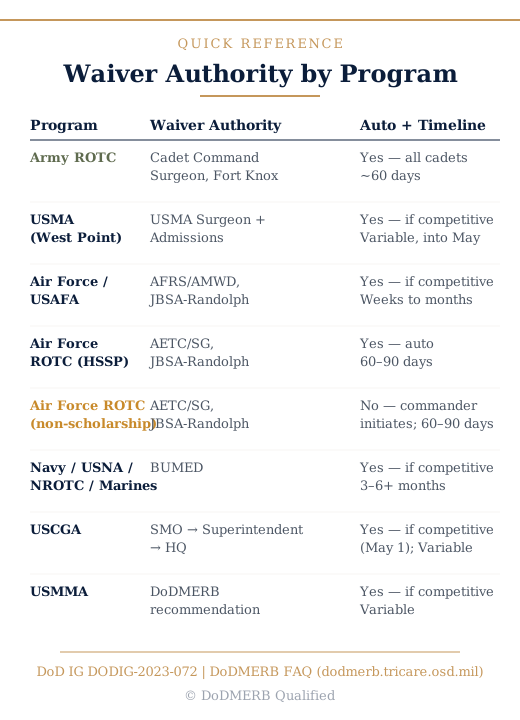
Every commissioning program routes waivers through a different office. Army ROTC (all cadets) and Air Force ROTC non-scholarship (commander must initiate) are the key outliers.
Related: DoDMERB Waiver Process: Complete Guide
AFROTC: The Non-Scholarship Trap Nobody Warns You About
If your student is an AFROTC cadet without a scholarship, nobody is automatically working on their waiver.
This is the single most common gap in the process. HSSP scholarship cadets get an automatic referral. Non-scholarship cadets do not. The waiver request must be initiated by the detachment commander, and the commander has discretion to decline.
HSSP Scholarship: Automatic Through AETC
For Air Force ROTC cadets on a High School Scholarship Program award, a disqualifying DoDMERB finding triggers an automatic referral to the Air Education and Training Command Surgeon General (AETC/SG) at JBSA-Randolph, Texas. Typical review window: 60 to 90 days.
Non-Scholarship: Your Commander Must Initiate
For non-scholarship AFROTC cadets, the path runs through the detachment. The detachment commander decides whether to request a waiver. If the commander does not request one, the file sits. The cadet may continue drilling, attending PT, and showing up for class for an entire semester without any waiver work happening behind the scenes.
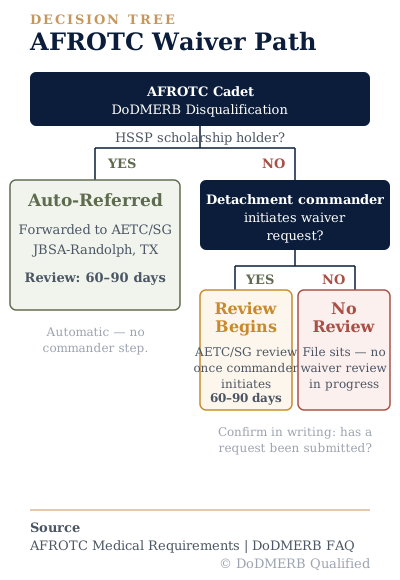
HSSP scholarship holders are auto-referred. Non-scholarship cadets need the commander to act — confirm this in writing.
The Question to Ask in Writing
Exact wording matters. A clear question creates a clear paper trail.
"Has a waiver request been submitted on my behalf to AETC/SG? If not, what is the timeline for that decision?"
Get the answer in email, with the date. If no request has been submitted, ask what evidence the detachment needs to support the decision. Build that evidence file through the DoDMERB Case Manager, never directly to AETC.
The Air Force overall waiver rate is 65 percent, the lowest of the four major services. The officer-specific rate has improved meaningfully, from 56 percent in FY2021 to 74 percent in FY2023. The trend is positive. The system is still strict.
Air Force Waiver Authorities: USAFA and AFROTC Compared
There is no single Air Force waiver authority. USAFA candidates and AFROTC cadets go through different offices on different timelines.
A USAFA candidate disqualified for the same condition as an AFROTC scholarship cadet will see two different review teams, two different turnaround windows, and two slightly different review frameworks. The branch is the same. The pipeline is not.
USAFA: AFRS/AMWD at JBSA-Randolph
Air Force Academy waivers run through the Air Force Recruiting Service Accession Medical Waiver Division (AFRS/AMWD) at Joint Base San Antonio-Randolph, Texas. The team is roughly 40 people. Average pickup time after a complete file lands is about three days.
| Program | Waiver Authority | Auto-Initiated? | Typical Timeline |
|---|---|---|---|
| USAFA | AFRS/AMWD, JBSA-Randolph | Yes, if competitive | Variable, weeks to months |
| AFROTC HSSP Scholarship | AETC/SG, JBSA-Randolph | Yes | 60 to 90 days |
| AFROTC Non-Scholarship | AETC/SG, JBSA-Randolph | No, commander must initiate | 60 to 90 days after initiation |
AFROTC Scholarship: AETC/SG
AETC/SG sits at the same installation but is a separate office handling a different population. Scholarship cadets are referred automatically once DoDMERB issues a disqualifying finding.
What the Air Force Waiver Team Is Weighing
The Air Force framework is a recurrence and operational impact question. Reviewers ask how likely the condition is to recur or require treatment, and whether the candidate can complete roughly one deployment cycle, about four years, without excessive medical stress. The applicant does not need to be condition-free for life. The applicant needs to be reasonably durable across a serving rotation.
Army Waiver Authorities: USMA and Army ROTC
Army ROTC is the most consistent waiver pathway in the DoD: every cadet, scholarship or not, gets an automatic review by the same office.
This is the operational reality that reshapes a denial at AFROTC into a viable second path. Army ROTC does not require a commander to initiate. The system does it.
USMA: Surgeon Recommends, Admissions Decides
For West Point, the flow runs in stages. DoDMERB issues the disqualification. USMA Admissions evaluates whether the candidate is competitive in the rest of the file. If competitive, the case goes to the USMA Surgeon, who functions as the academy's Command Medical Officer. The surgeon writes a recommendation. Admissions makes the final call.
The recommendation is not the decision. That distinction matters. Strong surgeon language helps, but a competitive academic and scholastic file is the gate. Timelines vary and decisions can extend well into May.
Army ROTC: Cadet Command Surgeon at Fort Knox
The U.S. Army Cadet Command Surgeon at Fort Knox, Kentucky reviews waivers and makes the recommendation for all Army ROTC cadets, scholarship and non-scholarship; the ROTC Brigade Commander signs the final grant under delegated authority. Typical turnaround is about 60 days. The DoD-wide Army waiver rate is 69 percent.
The Army ROTC Re-Application Path
For families running out of options on one branch, Army ROTC is the structural fallback most worth understanding. A candidate denied at AFROTC for mild asthma, vision, or another reviewable condition can apply to Army ROTC under a different authority with a more inclusive review model. The medical record is the same. The framework is different.
Navy and Marine Corps Waiver Authorities: BUMED and the Long Wait
BUMED is the waiver authority for the Navy, the Marines, USNA, and NROTC, and it carries the longest review timelines in the DoD.
The Bureau of Medicine and Surgery centralizes all officer accession waivers for the maritime services. One office, three programs. High approval rates at the end. Long, opaque waits in the middle.
One Authority, Three Programs
BUMED handles USNA, NROTC, and Marine Corps officer accession reviews. The reviewer pool is the same. The standards are tuned to each program, but the operational chokepoint is shared. When BUMED is busy, every program waits.
Why BUMED Takes 3 to 6+ Months
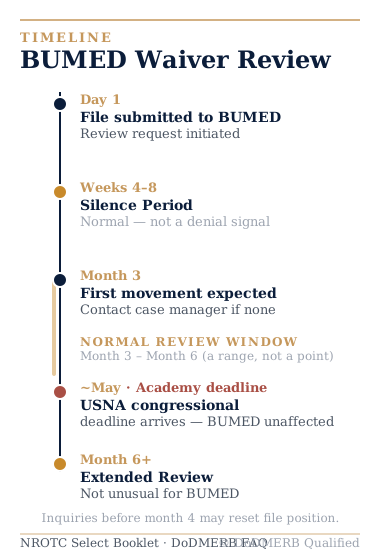
Centralized review for a broader population means volume plus depth at a single office. Three months is normal. Six months is not unusual. Families regularly report eight to ten weeks of complete silence before any movement on a file.
Usually when they grant you a waiver, you are competitive enough for them to want you with the risk of the condition.
— Applicant community observation
That observation lines up with the numbers. The Marine Corps approves 98 percent of waiver requests, the highest in the DoD by a wide margin. The Navy approves 84 percent. The screen happens before the case is requested. By the time BUMED is reading the file, the program has already decided the candidate is worth the time.
How the Wait Interacts with Deadlines
This is where BUMED bites. USNA candidates waiting on a decision in late April, facing a May congressional offer deadline, sometimes run out of time before the answer arrives. The waiver review does not respect outside deadlines. Other branches, congressional offices, and the academy admissions calendar all move on their own clocks.
Documentation completeness on day one is the biggest lever a family controls. Every gap at submission compounds at month four.
Coast Guard and Merchant Marine: The Often-Forgotten Academies
USCGA and USMMA both review waivers automatically for competitive applicants, but each has a specific deadline or restriction that families discover too late.
These two academies receive a fraction of the applications USAFA, USMA, and USNA see. Information is thinner. Mistakes that would never happen at the big three get made here because nobody warned the family.
USCGA: Three Levels of Approval and a Hard Deadline
The Coast Guard Academy uses a three-level review. The Senior Medical Officer at USCGA reviews the file and writes a recommendation. The Superintendent receives the recommendation and decides whether to forward. Final authority sits at U.S. Coast Guard Headquarters. The DoDMERB Liaison at USCGA, working with Academy Medical Administration staff, manages the routing.
USMMA: The Smallest Academy, the Same Model
The Merchant Marine Academy at Kings Point automatically requests a waiver review for any competitive applicant flagged by DoDMERB. The review framework mirrors the service academy model. USMMA is the smallest of the five federal academies, which means smaller class sizes and a thinner pipeline of public information about waiver outcomes.
Color Deficiency: Why USCGA and USMMA Are Different
Color vision is the single condition that separates the maritime academies from the others. USCGA does not waive color deficiency. USMMA does not waive color deficiency. Both academies feed careers that require mariner credentialing under federal vision standards, and the academies adhere to those standards from day one.
USCGA is also the strictest of the academies on ADHD, adhering to the 24-month medication-free standard published in DoDI 6130.03 without flex.
Related: DoDMERB Color Vision Standards by Branch
DoDMERB Qualified
Not sure which waiver authority applies to your student's program?
LTC Robert Kirkland and our team review your student's DoDMERB status, branch application, and condition against each authority's current standards so you know exactly where you stand.
How to Actually Support Your Student's Waiver Review
Waiver authorities read records, not essays. The most useful thing you can do is build a file that answers their questions before they ask.
The instinct, especially for parents, is to advocate. To write a letter about the student's character, resilience, or fit for service. That letter does not move a medical review. The reviewer is asking a medical question and needs medical answers.
Build the File the Waiver Authority Actually Reads
The strongest waiver files share a few traits. They are organized. They are complete. They speak to the recurrence question directly.
Documentation for Waiver Review
- Complete treatment records with dates labeled clearly
- Treating physician letter addressing recurrence likelihood specifically
- Evidence of medication-free or symptom-free duration with dates
- Records of physical activity, sport participation, and normal function under load
- Pulmonary function tests, audiograms, vision exams, or condition-specific testing relevant to the diagnosis
- A clean chronology of the condition, in order, with no gaps
What Backfires
Three patterns sink files. Parent advocacy letters describing the student's leadership and grit, when the question is medical recurrence. Congressional inquiries before month four of a normal review, which rarely accelerate and sometimes reset the file's position. Multiple physicians submitting overlapping letters with slightly different language, which creates a credibility gap the reviewer must resolve before deciding.
Send everything through the DoDMERB Case Manager. Never contact BUMED, AETC/SG, the Cadet Command Surgeon, the USMA Surgeon, or AFRS/AMWD directly. Unsolicited contact creates friction in the file.
Apply Across Programs
Different waiver authorities reach different answers on the same record. The 65 to 98 percent range is not noise. It is structure. Applying to one program is a single bet on a single judge. Applying to multiple programs gets multiple readings of the same medical history by different teams.
A denial at AFROTC is not a denial at Army ROTC. A denial at USNA is not a denial at USMA. The medicine is the same. The framework is not.
Frequently Asked Questions
Does DoDMERB grant medical waivers?
No. DoDMERB applies DoD Instruction 6130.03, flags disqualifying findings, and forwards the file. Each commissioning program holds its own waiver authority. DoDMERB itself states the board and the waiver authorities work together but are separate and independent entities.
Who approves an Army ROTC waiver?
The U.S. Army Cadet Command Surgeon at Fort Knox, Kentucky reviews Army ROTC waivers and makes the recommendation; the ROTC Brigade Commander grants the waiver under authority delegated by the Cadet Command Commanding General. Review is automatic for every cadet, scholarship or non-scholarship. Typical turnaround is about 60 days. This is the most inclusive automatic review model in the DoD.
Who approves a USNA or NROTC waiver?
The Bureau of Medicine and Surgery, known as BUMED, reviews waivers for the Naval Academy, NROTC, and Marine Corps officer accessions. Typical timelines run 3 to 6 months or longer. Approval rates are high: Navy 84 percent, Marine Corps 98 percent.
Is an AFROTC waiver automatic?
Only for HSSP scholarship cadets. Scholarship cadets are referred automatically to AETC/SG at JBSA-Randolph. Non-scholarship cadets require the detachment commander to initiate the request, and the commander can decline. Confirm in writing whether a request has been submitted.
Who approves a USAFA waiver?
The Air Force Recruiting Service Accession Medical Waiver Division (AFRS/AMWD) at JBSA-Randolph, Texas reviews USAFA waivers. The team is roughly 40 people, with about a three-day average pickup time on complete files. The review framework focuses on recurrence likelihood and operational impact.
Does a waiver guarantee an appointment?
No. A medical waiver clears the medical box only. A full appointment requires the candidate to be fully qualified on the academic, scholastic, and physical fitness sides as well. Programs only request waiver review when the candidate is otherwise competitive, which is why approval rates skew high.