Your student's DMACS portal updated to "under waiver review," and you are not sure what that means. Is it good news? A formality? Something to worry about?
Roughly 1 in 5 cadets who enter a service academy required a medical waiver to get there. Under waiver review for a service academy is a specific status that tells you something concrete about how the academy views your student's candidacy. This article explains what the status means, how each of the three major academies decides who receives a waiver review versus a closed file, and what your student should do while the review is in progress.
"If you have a disqualifying condition, you will automatically be considered for a waiver if/when you are competitive to receive an offer of appointment to USNA or one of our preparatory programs." — U.S. Naval Academy, Medical Appendix (2024)
Key Takeaways
- "Under waiver review" means the academy considers your student competitive and has initiated a medical review on their behalf. It is a positive signal, not a formality.
- DoDMERB does not grant waivers. Each academy has its own independent waiver authority.
- USNA automatically considers competitive candidates for waiver review. No action from your student is needed.
- USMA evaluates every disqualified candidate but only supports waiver review for applicants with a complete, competitive application.
- USAFA grants a limited number of waivers; the Academy Command Surgeon has final authority and reviews fewer cases than the other academies.
- If the portal has not moved from "disqualified," the issue may be candidacy standing rather than the medical condition.
What "Under Waiver Review" Actually Means
Most families assume DoDMERB controls the waiver decision. It does not. DoDMERB issues the disqualification. The service academy's medical authority decides whether to pursue a waiver. These are two separate agencies making two separate decisions.
The process follows a clear sequence. DoDMERB reviews your student's medical records and examination results, then issues a disqualification when a condition fails to meet DoD standards. The academy receives notification, evaluates your student's overall competitive standing, and decides whether to initiate waiver review. If the academy flags your student as worth pursuing, their waiver authority picks up the file and the DMACS portal updates to "under waiver review."
That status is not automatic. The academy has to act to trigger it.
Two additional facts matter here. First, waivers are service-specific. A waiver granted by USNA does not transfer to USMA or USAFA. Each academy reviews independently, and the same condition can receive different outcomes across academies. Second, once your student is in waiver review, DMACS will go quiet. The academy's medical authority is reviewing the file. Silence is not a negative signal.
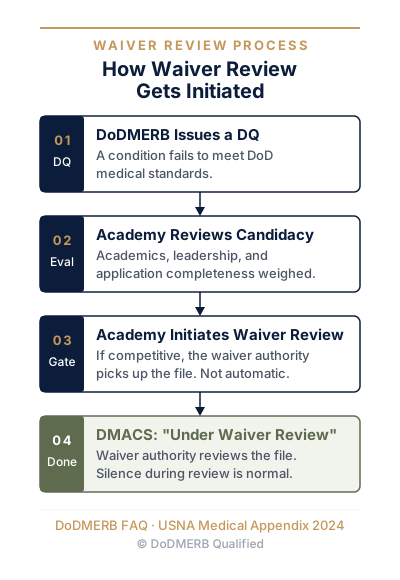
DoDMERB determines qualification. The academy decides whether to pursue a waiver.
How Each Academy Handles Waiver Review Differently
The same DoDMERB disqualification can land your student in waiver review at one academy and nowhere near it at another. Each academy has its own candidacy threshold, its own waiver authority, and its own internal process for deciding who gets reviewed.
USNA: Automatic Consideration for Competitive Candidates
USNA's policy is the most clearly articulated. If your student has a disqualifying condition, they will automatically be considered for a waiver once they are competitive for an appointment or a preparatory program. No request is needed. USNA will consider granting a waiver if both the academic record and medical history suggest the risk of the disqualifying condition is justified by the student's potential as a midshipman and future naval officer.
USMA: Complete Application Required
West Point automatically evaluates every medically disqualified candidate for a waiver based on the nature of the condition and the applicant's qualifications. However, USMA only actively supports waiver review for candidates who are competitive and have submitted a complete application. An incomplete application or uncompetitive whole-candidate score can result in the file being closed before the medical review stage.
USAFA: Limited Grants, Stricter Gate
USAFA's waiver authority is the Academy Command Surgeon, an internal position independent of DoDMERB. The Command Surgeon may grant a limited number of medical waivers and notifies the candidate directly of the final decision. The word "limited" carries weight: USAFA processes fewer waivers relative to its applicant pool than USNA or USMA, and the competitive threshold that triggers review is correspondingly higher.
The table below summarizes the key differences across all three academies:
| Academy | Waiver Authority | Auto-Considered? | Primary Candidacy Gate |
|---|---|---|---|
| USNA | USNA Brigade Surgeon → Superintendent | Yes, if competitive for appointment | Competitive for appointment or prep school |
| USMA | Surgeon recommends → Superintendent grants | Yes (all DQ cases evaluated) | Complete application + competitive standing |
| USAFA | Academy Command Surgeon | No — limited grant authority | Competitive; restricted number of waivers available |
DoDMERB Qualified
Not sure why your student's portal hasn't moved to waiver review?
We evaluate your student's candidacy profile and medical history to help you understand which academies are likely to initiate review and what documentation strengthens the case.
When the Academy Closes Your File Instead
If your student was disqualified but the portal never moved to "under waiver review," that is not necessarily a medical rejection. It may mean the academy decided not to pursue the candidacy, and the medical review never started.
Every academy uses competitive standing as the gate for waiver review. A student with an incomplete application, a thin academic record, or an uncompetitive whole-candidate score will not trigger waiver review, even for a condition that would routinely receive a waiver for a stronger candidate.
How does this look from your side? The DMACS portal stays at "disqualified" with no progression. The academy typically sends a notification that they are not pursuing the candidacy, though not all academies do this proactively. If the application cycle has passed and the portal has not moved, contact the admissions liaison directly to confirm the status.
The distinction between a closed file and a waiver denial matters for next steps. A waiver denial means the academy reviewed the condition and said no. A closed file means the review never reached the medical stage. A closed file points toward strengthening the overall candidacy for reapplication. A waiver denial points toward medical documentation strategy.
What to Do While You Are Under Waiver Review
Once your student is under waiver review, most of the work is out of your hands. The academy's medical authority is reviewing the file. Your role is to stay ready, not to intervene.
Here is what that looks like in practice:
- Monitor DMACS weekly. The waiver authority may submit an Additional Medical Information (AMI) request through the portal. When a request arrives, respond in the exact format specified.
- Keep the application active. Waiver review runs parallel to the rest of the admissions process. Your student should continue pursuing congressional nominations, the Candidate Fitness Assessment, and any remaining steps as if the medical situation will resolve.
- Apply to multiple academies. Each has independent waiver authority. A condition USNA reviews may not trigger review at USAFA. Multiple applications mean multiple independent chances.
- Do not contact DoDMERB to check on status. They cannot accelerate the review and will not share a decision before the academy renders one.
One timeline note: the medical qualification deadline for service academies is generally April 15 of the entry year. If your student is in waiver review approaching that date, contact the admissions office directly.
After reviewing this section, you know what to monitor, what to avoid, and that your student should continue building their candidacy regardless of where the review stands.
How the Review Ends: Approval, Denial, or More Information
Waiver review ends in one of three ways, and each requires a different next step.
An approved waiver clears the medical condition for that academy. The DMACS portal updates and the candidacy continues on its normal track.
An AMI request means the waiver authority needs more documentation before deciding. This is not a denial. Respond through DMACS in the format specified. AMI requests are common for conditions where documentation quality affects the outcome.
A waiver denial means the academy's medical authority reviewed the condition and did not grant approval. This applies only to that academy. If your student is under review at multiple academies, those reviews continue independently. A denial at one academy does not affect the others.
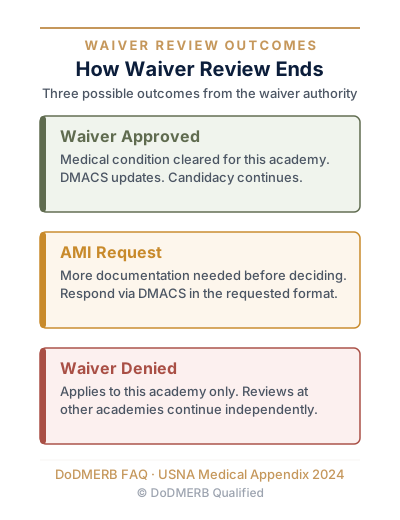
Three possible outcomes of waiver review and what each means for your student's candidacy.
Frequently Asked Questions
Does "under waiver review" mean my student is going to get a waiver?
No. It means the academy is actively reviewing the case. The waiver authority may approve, deny, or request additional information. Waiver review is a positive signal about candidacy standing, but the outcome is not guaranteed.
My student is under waiver review at USNA but not at USMA. Why?
Each academy has independent waiver authority and different candidacy thresholds. USNA automatically considers competitive candidates; USMA requires a complete, competitive application before supporting review. The same candidate can meet one academy's threshold and not another's.
How long does waiver review take?
Reviews range from a few weeks to several months depending on the condition, documentation, and academy workload. The general medical qualification deadline for service academies is April 15 of the entry year. Contact your admissions liaison if the review is still active close to that date.
Should I contact DoDMERB to follow up on the review?
No. DoDMERB cannot speed up the process and will not share the academy's decision before it is rendered. Monitor DMACS for AMI requests or status changes. That is the correct communication channel during this period.
Can my student request a waiver from the academy?
No. The waiver process is initiated by the academy, not the candidate. At USNA, consideration is automatic for competitive applicants. At USMA and USAFA, the academy decides based on candidacy standing. What your student can do is ensure the application is complete and the overall profile is as strong as possible.
My student's portal still shows "disqualified" with no change. What does that mean?
The academy likely has not initiated waiver review. This may reflect candidacy standing, an incomplete application, or a decision to close the file. Contact your admissions liaison directly to get a clear status update. Do not wait for the portal to update on its own if the cycle is nearing its end.