Your student earned the grades, the fitness scores, and the nomination. Now a childhood peanut allergy threatens to unravel everything. The panic is real, and you are not alone.
Food allergies affect roughly 1 in 13 children in the United States. For families pursuing service academies or ROTC scholarships, the fear that a documented allergy will end the process is one of the most common concerns parents bring to us.
A food allergy history does not disqualify your student. A mismanaged DoDMERB process does.
Megan Brown was an AFROTC cadet at Clemson when she was disqualified for a childhood shellfish allergy she had not reacted to in seven years. The Air Force denied her waiver. She transferred to Army ROTC, where she was accepted. Her case occurred before the 2024 Department of the Air Force policy change that broadened food allergy waiver tolerance.
This guide covers what DoDI 6130.03 says about food allergies military qualification, how DoDMERB handles these cases, what makes an oral food challenge valid, how waiver rates differ by branch, and what parents should do starting now. This covers the commissioning pathway (service academies and ROTC) processed through DoDMERB, not enlisted accessions through MEPS.
Key Takeaways
- DoDI 6130.03 only names five allergen categories as disqualifying: fish, crustaceans, shellfish, peanuts, and tree nuts. Milk and egg are NOT listed.
- Disqualification under Section 6.23.g requires all three elements: a listed allergen, food-specific IgE antibody, AND a correlating clinical history
- IgE sensitization without clinical symptoms is NOT disqualifying
- A properly conducted oral food challenge is the single strongest piece of evidence for a food allergy waiver
- DoDMERB does not grant waivers. The commissioning program (academy or ROTC command) decides.
- Branch matters: Marine Corps approves 98% of all-condition waivers, Air Force 65%. The Air Force broadened food allergy waiver tolerance in November 2024.
- Begin allergy evaluation in fall of junior year so documentation is ready before DoDMERB begins
What DoDI 6130.03 Actually Says About Food Allergies
The regulation that governs your student's medical qualification does not say what most parents think it says. Five allergen categories are explicitly named. A three-part test must be met. And two of the most common childhood allergies are not listed at all.
The Five Named Allergens (Section 6.23.g)
DoDI 6130.03-V1 states:
"History of acute allergic reaction to fish, crustaceans, shellfish, peanuts, or tree nuts including the presence of a food-specific immunoglobulin E antibody if accompanied by a correlating clinical history." — DoDI 6130.03-V1, Section 6.23.g
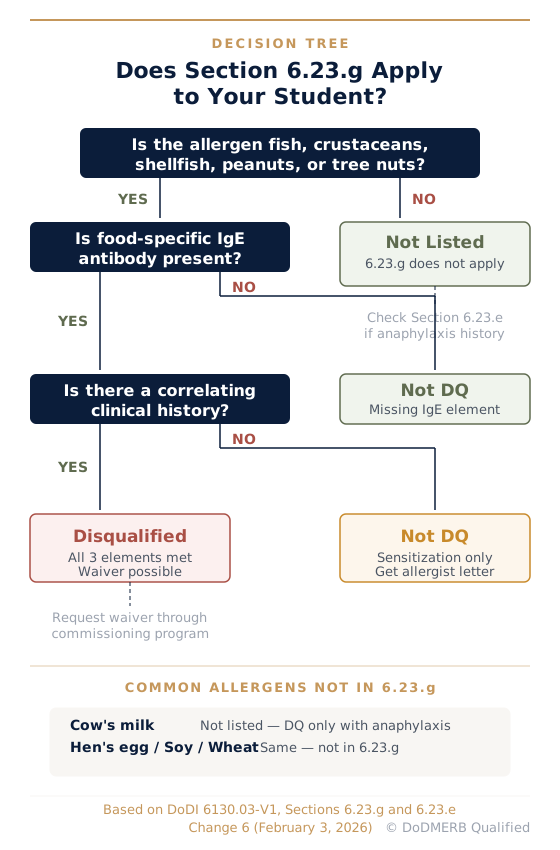
Section 6.23.g establishes a three-part test. All three elements must be present for disqualification:
- The allergen must be one of the five listed categories (fish, crustaceans, shellfish, peanuts, or tree nuts)
- A food-specific IgE antibody must be present
- The IgE result must be accompanied by a correlating clinical history of allergic reaction
If any one element is missing, Section 6.23.g does not apply.
The Milk and Egg Gap
Cow's milk and hen's egg are NOT listed in Section 6.23.g. The regulation names specific allergens, and milk and egg are not among them.
A candidate with a history of milk or egg allergy that caused hives but never anaphylaxis does not meet the food allergy disqualification criterion under 6.23.g. However, anaphylaxis to any food, including milk and egg, triggers disqualification under a separate section:
"History of anaphylaxis other than anaphylaxis to a single medication or medication class." — DoDI 6130.03-V1, Section 6.23.e
| Allergen | Listed in DoDI 6.23.g? | DQ Without Anaphylaxis? | Notes |
|---|---|---|---|
| Peanuts | Yes | Yes, if IgE + clinical history present | Most common DQ trigger for Academy/ROTC applicants |
| Tree nuts | Yes | Yes, if IgE + clinical history present | Includes walnuts, cashews, almonds, pecans, etc. |
| Fish | Yes | Yes, if IgE + clinical history present | Less common in pediatric populations |
| Crustaceans | Yes | Yes, if IgE + clinical history present | Shrimp, crab, lobster |
| Shellfish | Yes | Yes, if IgE + clinical history present | Includes mollusks (clams, oysters, mussels) |
| Cow's milk | No | No | DQ only if anaphylaxis history (Section 6.23.e) |
| Hen's egg | No | No | DQ only if anaphylaxis history (Section 6.23.e) |
| Soy | No | No | DQ only if anaphylaxis history (Section 6.23.e) |
| Wheat | No | No | DQ only if anaphylaxis history (Section 6.23.e) |
IgE Sensitization Is Not the Same as Clinical Allergy
The phrase "if accompanied by a correlating clinical history" is the most important clause in Section 6.23.g. A candidate who tests positive for peanut-specific IgE but eats peanut butter regularly without symptoms has sensitization, not clinical allergy. This is NOT disqualifying.
A blood test showing elevated peanut-specific IgE in a child who eats peanuts daily without symptoms is medically meaningless. An allergist must document this distinction clearly in a letter that references the DoDI 6130.03 standard.
After this step, you should understand whether your student's specific allergen and history meet the three-part test in Section 6.23.g, or whether a different section applies.
How DoDMERB Handles Food Allergy Disqualifications
Every other article you have read about food allergies and the military describes the enlisted pathway through MEPS. Your student is not going through MEPS. The Academy and ROTC pathway runs through DoDMERB, and the process, waiver authority, and timeline are fundamentally different.
DoDMERB Is an Information Conduit, Not a Decision-Maker
DoDMERB processes medical examinations for all Academy and ROTC applicants. It does NOT grant or deny waivers. DoDMERB's role is limited to four functions:
- Collecting medical history via the DD Form 2807-2
- Scheduling physical and eye exams through DODMETS contractors
- Requesting Additional Medical Information (AMI) when the initial submission raises questions
- Forwarding the complete file to the waiver authority for a decision
Approximately 20% of the 30,000 annual DoDMERB applicants (roughly 6,000 candidates) are disqualified. A disqualification is a checkpoint, not a terminal event.
Who Actually Decides the Waiver
The waiver authority is the commissioning program. Not DoDMERB. Not SMWRA (which handles enlisted waivers). Each program has its own medical review process:
- Service Academies: Medical review team at the specific academy
- Army ROTC: U.S. Army Cadet Command Surgeon
- Navy ROTC: Bureau of Navy Medicine and Surgery (BUMED)
- Air Force ROTC: AFROTC Command Surgeon
This distinction matters because each waiver authority applies its own judgment, tolerance thresholds, and needs to the same medical file. A denial from one does not predict denial from another.
The Timeline Trap
The timeline pressure depends entirely on which pathway your student is pursuing. Academy applicants and ROTC scholarship recipients face very different deadlines.
For service academy applicants, medical qualification must be resolved by approximately April 15th of the entry year. A food allergy DQ that triggers a waiver request in March may not be resolved in time. The waiver process requires weeks to months of additional review.
For ROTC scholarship recipients, the timeline is significantly more forgiving. ROTC scholarship winners have until approximately December of their college freshman year to complete medical qualification. That extended runway gives families months of additional time for specialist evaluations, oral food challenges, medication tapering, and waiver processing.
This distinction matters strategically. If your student has a complex allergy history that requires an OFC, medication cessation, or extensive documentation, the ROTC pathway provides more time to build a strong case. Begin the allergy evaluation process in fall of junior year regardless of pathway, but know that an ROTC scholarship gives you substantially more room to work.
Related: What Is DoDMERB? The Complete Guide for Academy and ROTC Families — Understand the full DoDMERB process, timeline, and how medical qualification works for officer candidates.
After this step, you should understand that DoDMERB collects information but does not decide waivers, and that your timeline starts in junior year.
The Oral Food Challenge — What It Is and What Makes It Valid for Military Purposes
A properly conducted oral food challenge is the single strongest piece of evidence your student can present for a food allergy waiver. An improperly conducted one is worthless. The difference comes down to protocol, documentation, and who performs it.
What Happens During an OFC
An oral food challenge (OFC) is a medically supervised test where your student eats gradually increasing amounts of the allergen under clinical observation.
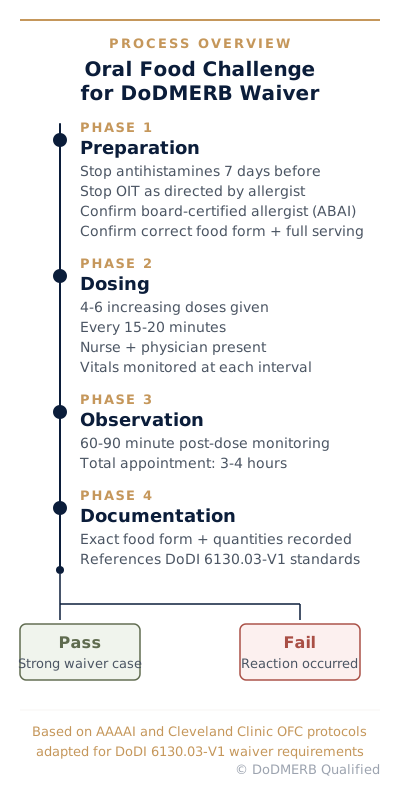
Your student must stop all antihistamines at least 7 days before the test and be healthy on test day with no active illness, fever, or asthma flare. A nurse and physician are present throughout. Four to six increasing doses are given every 15 to 20 minutes. After the final dose, your student stays for a 60 to 90 minute observation period. Total time is 3 to 4 hours.
A pass means no allergic reaction to a full age-appropriate serving. A fail means a reaction occurred during testing.
What Invalidates an OFC for Military Waiver Purposes
An OFC will NOT support a waiver if any of the following occurred:
- Wrong food form was used (peanut oil instead of peanut butter or whole peanut kernels)
- Trace amounts were given instead of a full age-appropriate serving
- Documentation failed to record measured food quantities at each dose
- The candidate was on antihistamines during the challenge
- The candidate was on omalizumab (Xolair) or active oral immunotherapy
- The challenge was not conducted by a board-certified allergist
What a Valid OFC Report Must Include
The allergist's documentation should specify:
- Exact food form used (e.g., whole roasted peanuts, not peanut flour)
- Exact measured quantities at each dose interval
- Total cumulative amount consumed
- Clinical observations at each interval (vital signs, skin, respiratory, GI)
- Final outcome with clear pass or fail designation
- A statement that the challenge was conducted per published protocol standards
The letter should reference DoDI 6130.03-V1 standards and state whether the candidate demonstrated clinical tolerance to a full age-appropriate serving.
OFC Preparation Checklist
Before Scheduling
- Confirm allergist is board-certified (ABAI)
- Discuss military-specific documentation requirements with the allergist
- Confirm the allergist will use the correct food form and full serving size
- Stop antihistamines 7 days before the test date
- Stop any oral immunotherapy as directed by the allergist (weeks to months in advance)
Day of Challenge
- Bring two unexpired epinephrine autoinjectors
- Bring the challenge food as directed
- Confirm student is healthy (no illness, fever, or asthma flare)
- Allow 4 hours for the full process
After the Challenge
- Request the full written report within 2 weeks
- Verify all dose quantities and clinical observations are documented
- Confirm the report references DoDI 6130.03-V1 standards
- Store report securely for DoDMERB submission when requested
After this step, you should know exactly how to prepare for an OFC and what documentation the allergist must produce for military purposes.
DoDMERB Qualified
Not sure where your student's allergy history stands with DoDMERB?
We evaluate your student's specific food allergy history against DoDI 6130.03 standards and help you build the right documentation before the waiver process begins. LTC Kirkland (Ret.) personally reviews each case.
Branch Differences and Waiver Approval Rates
The same food allergy history that gets denied at one service academy can get approved at another. Branch choice matters more than most families realize, and the landscape shifted significantly in late 2024.
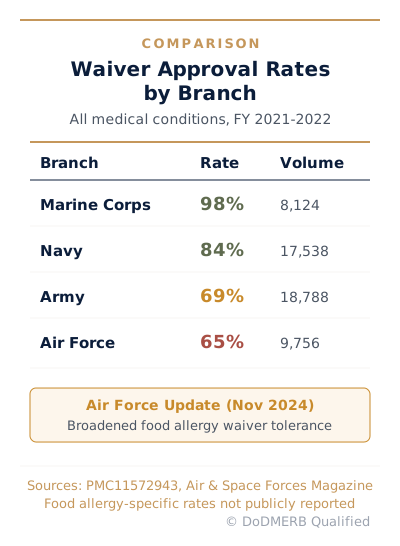
Overall Waiver Approval Rates by Branch (FY 2021-2022)
These rates cover all medical conditions, not food allergies specifically. Food allergy-specific data is not publicly reported by branch. However, these numbers reveal the overall tolerance each service applies to medical waivers.
| Branch | Overall Waiver Approval Rate | Volume (FY 2021-22) | Food Allergy Notes |
|---|---|---|---|
| Marine Corps | 98% | 8,124 waivers | Highest overall approval rate |
| Navy | 84% | 17,538 waivers | Generally favorable for food allergy waivers |
| Army | 69% | 18,788 waivers | Army ROTC described as "reasonable" for food allergy cases |
| Air Force | 65% | 9,756 waivers | Historically strictest, improved significantly in late 2024 |
In FY 2023, 74% of Air Force officer candidate waivers were approved, up from 56% in FY 2021. The trend across all branches is toward more flexibility.
The 2024 Air Force/Space Force Policy Change
Effective November 1, 2024, the Department of the Air Force broadened waiver tolerance for food allergies.
Previously, the Air Force had near-zero waiver probability for candidates with EpiPen-requiring food allergy histories. Under the new policy, mild food allergy cases and candidates with EpiPen-required histories are now waiver-eligible. Anaphylaxis remains disqualifying.
Col. Ian Gregory, head of the Air Force Accessions Medical Waiver Division, stated: "These people are still at risk, but it's felt that the risk is acceptable."
The policy is projected to add approximately 85 additional food allergy recruits per year. Waiver recipients receive an assignment limitation code that restricts special warfare and aviation assignments.
What This Means for Academy vs. ROTC Applicants
Army ROTC has historically been a reasonable path for food allergy waivers, especially for tree-nut cases, when the applicant passes a medically supervised oral food challenge with no reaction. Peanut allergy is treated more cautiously, since peanuts are harder to avoid in field feeding. Navy falls in the middle. Air Force has improved dramatically but still has the lowest base approval rate.
If your student is competitive across multiple programs, apply to more than one. Each branch evaluates independently using the same medical file.
After this step, you should know which branches are most favorable for your student's specific allergy history and have a plan to apply to multiple programs.
Childhood Allergies That Resolve — Outgrown Does Not Mean Forgotten
Your student's toddler-era milk allergy that resolved at age 6 will still appear on the DD Form 2807-2 medical history questionnaire. How you document what happened since then determines whether it becomes a problem or a non-issue.
Resolution Rates by Allergen
Most childhood food allergies resolve before adulthood. The resolution rates vary significantly by allergen.
| Allergen | By Age 4 | By Age 8 | By Age 12 | By Age 16 |
|---|---|---|---|---|
| Cow's milk | 19% | 42% | 64% | 79% |
| Hen's egg | 4% | 26% | 48% | 68% |
| Peanut | ~10% | ~20-25% | — | — |
| Tree nut | Rare | Rare | Rare | Rare |
| Fish / Shellfish | Rare | Rare | Rare | Rare |
Milk and egg are NOT listed in DoDI 6.23.g. A resolved milk or egg allergy without anaphylaxis history is the cleanest possible scenario from a regulatory standpoint.
How to Document Resolution
A resolved allergy still requires proper documentation. Do NOT skip evaluation because the allergy "seems resolved." DoDMERB will ask about any allergy history disclosed on the DD Form 2807-2, and "we stopped worrying about it" is not a medical answer.
Schedule an appointment with a board-certified allergist. Request current skin prick testing and a specific IgE panel. If the results are negative and your student regularly consumes the food without symptoms, ask the allergist for a letter documenting resolution.
If there is residual IgE elevation but no clinical symptoms, the allergist should document the sensitization-only distinction. Positive test, no symptoms, no clinical allergy.
Related: EpiPen and Military Disqualification: What Academy and ROTC Families Need to Know — How an active EpiPen prescription affects DoDMERB qualification and what steps to take before the process begins.
After this step, you should have an allergist evaluation confirming whether your student's childhood allergy has resolved, with documentation ready for DoDMERB if requested.
Complications — OIT, Omalizumab, and Alpha-Gal Syndrome
Three situations routinely blindside families during the DoDMERB process: active oral immunotherapy, omalizumab prescriptions, and a tick-borne allergy most parents have never heard of. Each requires months of advance planning.
Active Oral Immunotherapy (OIT)
OIT gradually desensitizes patients to an allergen through daily consumption of increasing doses. Active OIT invalidates an oral food challenge for military purposes. The military cannot guarantee continued access to maintenance doses in deployed environments, shipboard settings, or austere conditions.
A candidate who passes an OFC while on OIT has demonstrated drug-assisted tolerance, not natural tolerance. To use an OFC for waiver purposes, the candidate must stop OIT, wait weeks to months as directed by the allergist, and then demonstrate tolerance after cessation. Stopping OIT risks losing the desensitization the therapy achieved. This is a high-stakes timing decision that should involve both your allergist and a clear understanding of the DoDMERB timeline.
Omalizumab (Xolair)
The FDA approved omalizumab in 2024 for IgE-mediated food allergy in patients aged 1 and older. It reduces the severity of allergic reactions by blocking IgE antibodies.
For military purposes, omalizumab is disqualifying under DoDI 6130.03-V1, Section 6.30.l. The medication requires subcutaneous injection and refrigeration, both incompatible with military service environments. A candidate cannot pass a valid OFC while the drug is in their system because it masks the immune response the OFC is designed to measure.
Alpha-Gal Syndrome
Alpha-gal syndrome is an acquired allergy to mammalian meat caused by lone star tick bites. It is increasingly common in the southeastern United States and relevant for outdoor-active candidates in that region.
Alpha-gal syndrome is not automatically disqualifying. Between January 2022 and September 2023, military health system records identified 1,080 individuals diagnosed with alpha-gal syndrome, including service members, dependents, and retirees. Most affected service members remain on active duty with dietary modifications. A candidate with alpha-gal should disclose the diagnosis and work with their allergist to document the scope and severity of reactions.
After this step, you should know whether OIT, omalizumab, or alpha-gal syndrome applies to your student and have a transition timeline if needed.
What Parents Should Do Now — A Timeline-Based Action Plan
If your student has any food allergy history and is considering a service academy or ROTC scholarship, the action plan starts now. Not after the DQ letter. Not during senior year. Now.
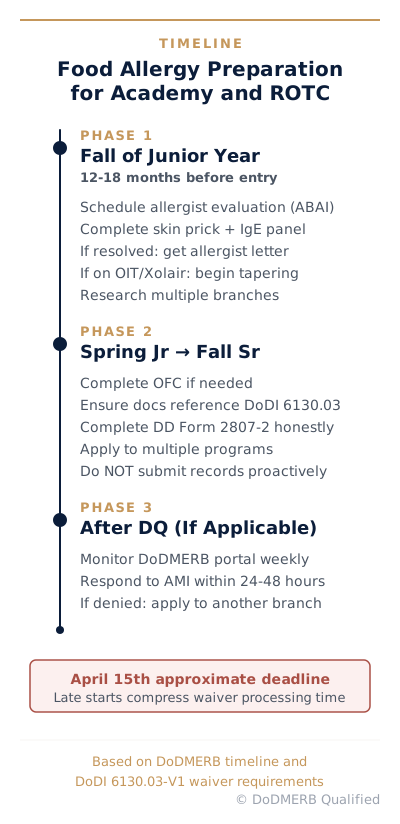
Parent Action Checklist
Phase 1: Fall of Junior Year (12-18 Months Before Entry)
- Schedule evaluation with a board-certified allergist (ABAI-certified)
- Complete current skin prick testing and specific IgE panel
- If allergy resolved: obtain allergist letter documenting current tolerance with testing results
- If allergy active: discuss OFC timing and whether OIT or omalizumab needs to be discontinued
- If on OIT or omalizumab: begin supervised transition off these treatments
- Research commissioning programs across multiple branches
Phase 2: Junior Spring Through Senior Fall
- Complete oral food challenge using correct protocol if needed (see OFC section above)
- Ensure allergist documentation references DoDI 6130.03-V1 standards
- Complete the DD Form 2807-2 honestly and thoroughly when DoDMERB requests it
- Apply to multiple commissioning programs across different branches
- Do NOT submit any medical records to DoDMERB proactively
Phase 3: After DQ (If Applicable)
- Monitor the DoDMERB portal weekly for status updates
- Respond to every AMI request within 24-48 hours
- If one branch denies the waiver, apply to or transfer to another program
After this step, you should have a phase-by-phase checklist with specific actions assigned to your student's current timeline position.
Frequently Asked Questions: Food Allergies and Military Service
Can you join the military with a peanut allergy?
Yes. A peanut allergy is disqualifying under DoDI 6130.03, Section 6.23.g, but waivers are available. The strongest path is a passed oral food challenge. Army ROTC and Navy tend to be more favorable than Air Force, though the Air Force broadened its tolerance in November 2024.
Does a childhood food allergy that resolved still show up on DoDMERB?
Yes. All medical history must be disclosed on the DD Form 2807-2. However, a resolved allergy supported by current negative testing and an allergist letter documenting tolerance is far less likely to result in disqualification.
Is a milk allergy disqualifying for military service?
Milk is NOT listed in DoDI 6130.03, Section 6.23.g. A milk allergy that caused hives but never anaphylaxis does not meet the food allergy DQ criterion. A history of anaphylaxis to milk is disqualifying under Section 6.23.e.
What is the difference between DoDMERB and MEPS for food allergies?
DoDMERB processes Academy and ROTC applicants. MEPS processes enlisted accessions. The waiver authority for DoDMERB applicants is the commissioning program itself, not SMWRA. Different waiver authorities, different tolerance thresholds, different outcomes.
Can you get a waiver for a food allergy to join the Air Force?
Yes, as of November 2024. The Department of the Air Force broadened waiver tolerance for food allergies. Mild and EpiPen-required histories are now waiver-eligible. Anaphylaxis remains disqualifying. Waiver recipients receive an assignment limitation code restricting special warfare and aviation roles.
How long does a food allergy waiver take?
Waiver processing typically takes weeks to months after DoDMERB forwards the file. Academy applicants face an approximate April 15th deadline. ROTC scholarship recipients have until approximately December of their college freshman year, giving significantly more time to complete testing and resolve medical issues.
Does having an EpiPen prescription disqualify you from the military?
An active EpiPen prescription signals an unresolved allergy the prescribing physician considers at risk for anaphylaxis. This triggers DoDMERB scrutiny. The path forward is demonstrating resolution through an oral food challenge and having the allergist confirm the EpiPen is no longer medically necessary.
What is an oral food challenge for military purposes?
An OFC is a medically supervised test where your student eats increasing doses of an allergen under clinical observation. It must use the correct food form, full serving size, and be conducted by a board-certified allergist while off all antihistamines and immunotherapy.
Should I disclose food allergies on the DD Form 2807-2?
Yes. Complete honesty on the medical history form is fundamental. Your student is entering a profession built on integrity, and the DD Form 2807-2 is their first opportunity to demonstrate it. Full disclosure with proper supporting documentation is always the stronger path than omission.
Which military branch is easiest to get a food allergy waiver?
No branch publishes food allergy-specific waiver rates. Based on overall rates, Marine Corps (98%) and Navy (84%) approve more than Army (69%) and Air Force (65%). Army ROTC is widely described as reasonable when supported by a passed oral food challenge. Apply to multiple programs.