Your child earned a congressional nomination, passed the fitness test, and completed the application. Then the orthodontist says braces won't come off until July. Suddenly the entire commissioning path feels like it is in jeopardy.
Braces DoDMERB disqualifications are a timing problem, not a permanent barrier. The regulation is specific, the exceptions are written directly into the disqualification standard, and the path to qualification is clear once you understand how DoDMERB actually handles this internally. Active orthodontic treatment is disqualifying. Retainers are not. A certified completion date before June 1 means no physician review and no DQ at all.
This guide draws on DoDI 6130.03-V1 Section 6.8.g and how DoDMERB actually applies it internally — the questionnaire process, the June 1 threshold, how case managers and physicians divide responsibility, and what makes a DQ reversible.
This guide addresses service academy and ROTC applicants under DoDI 6130.03-V1. Standards can change. Always confirm current requirements with your commissioning program.
Key Takeaways
- Active orthodontic treatment is disqualifying. Braces, Invisalign aligners, and any appliance used for ongoing tooth movement triggers a DQ under DoDI 6130.03-V1 Section 6.8.g.
- The June 1 rule. If the orthodontist certifies completion before June 1, the case manager qualifies outright — no physician review, no DQ.
- Only a physician can disqualify. Case managers cannot issue a DQ. If the completion date is June 1 or later, the case goes to a DoDMERB physician for adjudication.
- ROTC has four-plus more years. There is no June 1 deadline for ROTC. The deadline is commissioning, which for a high school applicant is roughly four years away.
- Retainers are not active treatment. Permanent wire retainers and removable retainers — including evening-wear clear retainers — are explicitly carved out under Section 6.8.g(1).
- DQ reversals happen regularly. If DoDMERB DQs because the completion date was after June 1, and the orthodontist revises the date to before June 1, DoDMERB will reverse the DQ.
What the Regulation Actually Says
DoDI 6130.03-V1 contains a single paragraph that governs every orthodontic disqualification. It is unusually specific — Invisalign is named by brand — and the two exceptions that reverse the DQ are written directly into the same sentence.
DoDI 6130.03-V1 Section 6.8.g
"Current orthodontic appliances (mounted or removable, e.g., Invisalign®) for continued active treatment unless: (1) The appliance is permanent or removable retainer(s); or (2) An orthodontist (civilian or military) provides documentation that: (a) Active orthodontic treatment will be completed before being sworn in to active duty; or (b) All orthodontic treatment will be completed before beginning active duty." — DoDI 6130.03-V1, Section 6.8.g
In plain English: having braces or active Invisalign is disqualifying — unless the student is already in retainer-only phase, or the orthodontist certifies in writing that treatment will be finished before active duty begins.
The Two Exceptions
Exception 1: Retainers. If the student has finished active treatment and transitioned to a permanent wire retainer or a removable retainer, they are not disqualified. The appliance must be for retention, not continued tooth movement. Both permanent and removable retainer types qualify. This is not a waiver — it is a carve-out built into the base standard.
Exception 2: Orthodontist certification. If treatment is still ongoing, a civilian or military orthodontist provides written documentation projecting a completion date before the sworn-in date. The letter must come from the treating orthodontist; a general dentist's letter does not satisfy the requirement.
How DoDMERB Handles Braces at the Exam
DoDMERB does not immediately issue a DQ when braces are found. There is a protocol built for exactly this situation.
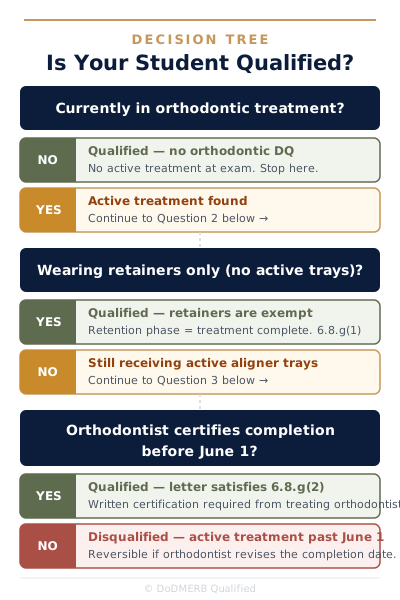
When the DoDMERB contractor exam reveals braces or active Invisalign treatment, the case manager follows an established algorithm. The case manager sends the applicant an orthodontic questionnaire — an addendum to the standard DoDMERB medical history forms — that the applicant takes to their orthodontist to complete.
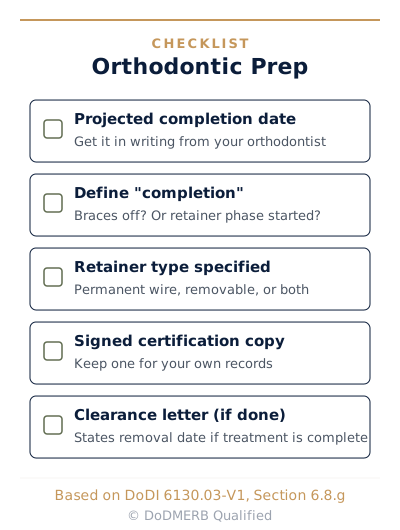
The questionnaire captures the treatment type, the planned retainer type, and — most critically — the projected completion date. Once the orthodontist fills it out and returns it, the case manager reviews it against a single threshold: June 1.
If the certified completion date is before June 1, the case manager qualifies the exam at their level. No physician review. No DQ. If the exam is otherwise clean, the case manager resolves it without escalation.
If the certified completion date is June 1 or later, the case is sent to a DoDMERB physician for adjudication. That physician review will typically result in a DQ.
This is why the date on the orthodontist's questionnaire is the entire pivot point of the evaluation.
The June 1 Deadline: What It Is and Why It Exists
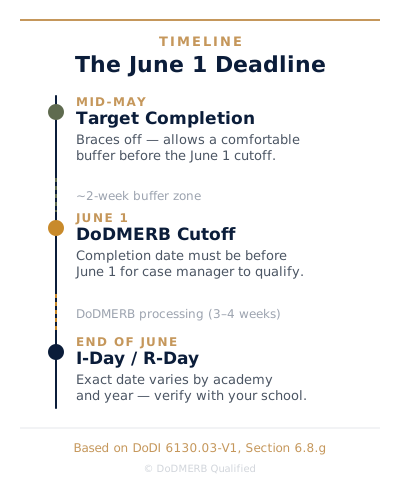
June 1 is not an arbitrary number. DoDMERB consulted with the service academies to reach a consensus on a workable administrative cutoff. The result was June 1.
Technically, applicants do not come onto active duty until I-Day or R-Day, which falls at the end of June and varies by academy and year. Under the regulation, treatment only has to be complete before swearing in — not before June 1. But the academies do not want a cadet arriving on induction day with braces still on. There is no time during the summer training period to manage orthodontic care, and the on-base capability for adjustments typically does not exist.
The June 1 cutoff gives approximately three to four weeks of buffer before the end-of-June induction window. That gap allows the orthodontist to make final adjustments and still complete treatment before I-Day or R-Day arrives.
Do not pull braces off the week before the DoDMERB exam to avoid the questionnaire. The system has a mechanism to handle active braces — and the exam is months before I-Day, leaving time to work the timeline properly.
Related: DoDMERB Exam: What to Expect
When June 1 Is Not Quite the Line in the Sand
Physician clinical judgment applies in borderline cases. This is one of the most important nuances in the entire process, because it reflects how the DoDMERB physician's role actually works.
If the orthodontist certifies a completion date of June 3, June 4, or June 5 — a few days past the cutoff — the case goes to a DoDMERB physician. That physician has training, experience, and clinical judgment that a case manager does not.
Experienced DoDMERB physicians have qualified applicants whose orthodontist certified completion on June 3, 4, or 5. The reasoning: if orthodontic treatment is the only thing standing between a fully qualified applicant and a clear DoDMERB result, a physician can look at the full picture and qualify rather than forcing an unnecessary waiver process over a matter of days.
The calculus changes immediately if other disqualifying conditions exist. If a student also has a recent ACL surgery and a history of depression, the orthodontic date being a few days past June 1 does not need to be softened — the case will go to the waiver authorities regardless, and the physician may as well apply the standard as written.
DQ Reversal: When the Orthodontist Changes the Date
If DoDMERB issues a DQ because the certified completion date was after June 1, it is not necessarily final. This reversal path has worked in many cases.
The scenario: the orthodontist initially certifies a completion date of, say, June 15. DoDMERB DQs. The family talks to the orthodontist, who reviews the treatment plan and determines that the timeline can be compressed — braces could come off by May 15 with some schedule adjustments. A revised questionnaire comes back to DoDMERB with the new date. DoDMERB reverses the DQ and qualifies.
DoDMERB has to take the orthodontist's word on the treatment plan. End dates are projections. Orthodontists can accelerate timelines when there is a clinical reason to do so. If the revised date is credible and falls before June 1, the process resolves cleanly.
The applicant will have signed an attestation — included in the original questionnaire — confirming they understand that orthodontic treatment must be completed before swearing in to active duty. That attestation remains in the file regardless of the qualification outcome.
Invisalign: Phase Is What Matters
Invisalign is explicitly named in DoDI 6130.03-V1 Section 6.8.g — unusual specificity for a regulation that typically avoids brand names. Active clear aligner treatment is disqualifying under the same standard as traditional braces.
Invisalign has two distinct clinical phases, and they are treated differently.
Active treatment phase: The patient wears a series of custom aligners 20 to 22 hours per day, switching to new trays on a schedule as teeth move toward the target alignment. Receiving new trays — even described as "fine-tuning" after the initial series — is still active treatment. Finishing the initial set of trays does not mean active treatment is done.
Retention phase: Once the orthodontist determines the teeth have reached their alignment goal, the patient moves to retainers. These are worn initially full-time, then evenings only. They may look identical to active trays — clear Vivera-style retainers are common. The clinical distinction is that no further tooth movement is being prescribed. Once the orthodontist transitions the patient to evening-only retainer wear, treatment is considered complete for DoDMERB purposes.
The DQ standard does not apply once the patient is in retainers. Get the orthodontist to confirm the phase in writing before the DoDMERB exam.
DoDMERB Qualified
Not sure if your student's orthodontic timeline clears DoDMERB?
DoDMERB Qualified reviews treatment plans against Academy and ROTC deadlines so your family has a clear answer before the exam — and knows what to do if the date is close.
ROTC Has Four More Years
The June 1 rule is a service academy rule. ROTC operates on an entirely different timeline.
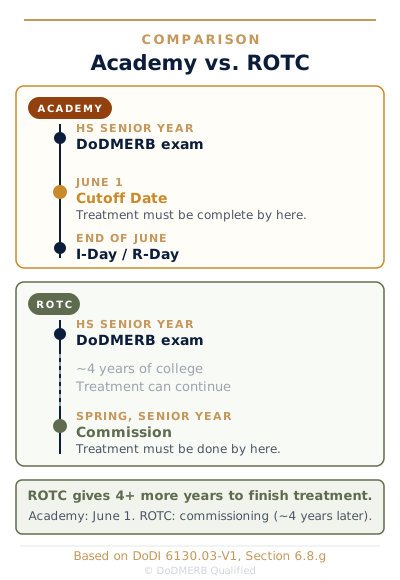
For ROTC applicants, the orthodontic standard is the same — treatment must be complete before being sworn in to active duty — but the deadline is commissioning, which for a high school applicant is roughly four years away at the end of their MS-4 year. There is no June 1 calendar date to hit.
A high school senior with braces and a typical 18 to 24-month treatment plan will finish well before their senior year of college. ROTC applicants effectively have four additional years of orthodontic runway compared to service academy candidates.
The practical implication is significant. A student who would be DQ'd for a service academy purely on the orthodontic timeline has no barrier at all through ROTC. The DoDMERB exam is the same process. Only the completion deadline differs.
What Happens If Braces Are On at I-Day or R-Day
Qualification and induction are two separate events. A student can be medically qualified by DoDMERB based on an orthodontist letter certifying completion by June 1 — and then show up at I-Day still wearing braces.
That student will almost certainly be a turn-back. The academy will send them home and ask them to return the following summer when treatment is actually finished.
The attestation the student signed during the orthodontic questionnaire process is relevant here. It states explicitly that the student understands orthodontic treatment must be complete before active duty. Arriving at induction with hardware still on violates the terms under which DoDMERB qualified them.
This situation is preventable. The June 1 deadline exists partly to give the orthodontist three to four weeks to complete treatment before the end-of-June induction window. If DoDMERB qualified your student based on a May completion date, hold the orthodontist to it.
Wisdom Teeth: A Separate Standard, and a Simpler One
Wisdom teeth are governed by DoDI 6130.03-V1 Section 6.8.h, separate from the orthodontic standard. The language is brief and the threshold is high.
"The presence of wisdom teeth (third molars), if currently symptomatic." — DoDI 6130.03-V1, Section 6.8.h
Having wisdom teeth is not disqualifying. Having impacted wisdom teeth on an X-ray that cause no symptoms is not disqualifying. The DQ requires current, active symptoms: pain, gum swelling or bleeding, partial eruption causing discomfort, or related infection.
If wisdom teeth are removed before the DoDMERB exam, there is no Section 6.8.h issue at all. A history of third molar extraction without complications does not disqualify.
Families often ask about reporting: what if wisdom teeth become symptomatic or are removed after the student is already medically qualified? Technically, any change in medical condition should be reported to DoDMERB. But in practice, DoDMERB typically finds out after the fact — when the oral surgeon's clearance memo arrives — and case managers do not make it an issue.
The reason is practical: the standard outcome of a wisdom teeth extraction is full clearance within seven to ten days. Going through the formal process of a DQ and remedial review only to restore qualification a week later creates unnecessary administrative burden. The case manager receives the oral surgeon's clearance memo, notes it in the file, and moves on.
What DoDMERB does not want is a student with actively symptomatic wisdom teeth who avoids treatment out of fear of losing qualified status. If the clinical standard of care calls for removal, the student should get it done and provide the clearance memo when available.
Frequently Asked Questions
Will braces disqualify my child from DoDMERB?
Active braces are listed as a disqualifying condition under DoDI 6130.03-V1 Section 6.8.g. But the regulation's built-in exceptions allow qualification even with braces still on — as long as the orthodontist can certify a completion date before June 1. The DQ only becomes final if that date cannot be established.
When do braces need to be off for a service academy?
Treatment must be complete before June 1 of the reporting year. Target mid-May to build in a buffer. I-Day and R-Day fall at the end of June and vary by academy and year — June 1 is the administrative cutoff DoDMERB uses, not I-Day itself.
Does Invisalign count as braces for DoDMERB?
Yes. Invisalign is explicitly named in DoDI 6130.03-V1 Section 6.8.g. Active clear aligner treatment is disqualifying under the same standard as traditional braces. The distinction is between active treatment and the retention phase. Evening-wear retainers — including clear Invisalign-style retainers — are not active treatment.
Are retainers disqualifying?
No. Permanent wire retainers and removable retainers fall under Exception 1 of Section 6.8.g. Once the orthodontist transitions the patient to a retainer, active treatment is done. Get the transition date documented in writing.
What if braces come off after June 1 but before I-Day?
This depends on when the documentation reaches DoDMERB. A completion date past June 1 typically triggers a physician-level review and likely a DQ for the service academy path. The first step is to ask the orthodontist whether the timeline can be compressed to before June 1. The second step, if it cannot, is to evaluate the ROTC path, which has no June 1 deadline.
Can DoDMERB waive a braces DQ?
DoDMERB does not issue waivers — the service academies and ROTC programs do. For braces specifically, the cleaner path is not a waiver but a DQ reversal: get the orthodontist to revise the completion date to before June 1. If that is not possible, some academy waiver authorities may consider cases where treatment is projected to finish shortly after I-Day, but this is not guaranteed and should not be the primary plan.
Do I need to remove wisdom teeth before DoDMERB?
No. Asymptomatic wisdom teeth, including impacted ones visible on X-ray, are not disqualifying under Section 6.8.h. If wisdom teeth are currently causing pain, swelling, or infection, they should be addressed before the exam. If removal happens after qualification, obtain a clearance memo from the oral surgeon and provide it to DoDMERB when available.
Should my student start Invisalign instead of traditional braces to finish faster?
Invisalign can offer a shorter treatment window for mild to moderate cases, but the decision should be based on clinical need, not DoDMERB strategy. If timing is a concern, ask the orthodontist whether the existing treatment plan can be accelerated — sometimes the answer is yes, and that is a simpler path than switching methods.
Have questions about your student's orthodontic timeline and DoDMERB? Contact DoDMERB Qualified.