Roughly 20% of DoDMERB's ~45,000 annual applicants receive a disqualification each year, about 6,000 candidates. Many of those start as a simple remedial request.
A remedial is a question, not an answer. And even a disqualification is rarely the end of the road.
Key Takeaways
- A remedial means DoDMERB needs more information before making a decision. It is not a negative finding.
- A disqualification means a specific medical standard was not met, but waivers exist and are regularly granted.
- DoDMERB does not grant waivers. The commissioning program (academy or ROTC branch) decides.
- Remedial responses are typically processed within 15 business days. Waiver reviews take several additional months.
- Air Force ROTC waiver consideration is not automatic. The detachment commander must request it.
- The April 15 deadline applies to academy candidates. ROTC scholarship recipients have until approximately December of their freshman year.
Remedial vs. Disqualification: The Core Difference
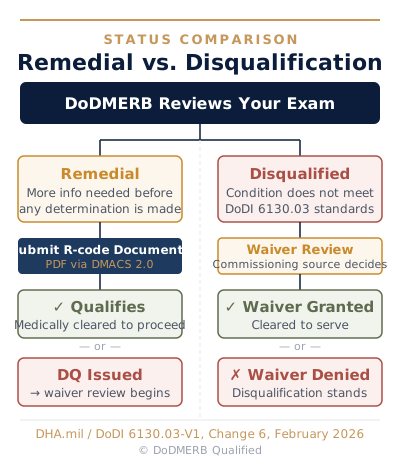
A remedial and a disqualification are fundamentally different actions. One asks a question, the other delivers an answer.
What a Remedial Means
DoDMERB needs additional information before it can make a medical determination. The official DHA.mil definition: "If additional medical information or service is needed to make a determination, your status is set to Remedial."
"Remedials are those consult(s), test(s), and/or information (records, statements, questionnaires, etc) DoDMERB requests to render a MEETS or does NOT meet medical standards OR are requested by the waiver authorities (through DoDMERB to the applicants) for them to evaluate before they render their waiver decisions." — Lawrence Mullen, Deputy Director, DoDMERB
It is not a negative finding. Administrative remedials require records, written statements, or questionnaires. Examples include R190.00 (copies of all treatment and hospitalization records) and R252.11 (food allergy questionnaire). Medical remedials require a specialist evaluation, completed free through a DoDMERB-contracted provider (Option 1) or through a private provider at the candidate's expense (Option 3). An example is R264.00, which requires a new complete blood count with indices.
What a Disqualification Means
A disqualification is issued when a current diagnosis or verified past medical history does not meet the standards outlined in DoDI 6130.03-V1. There are 594 total DQ codes, each tied to a specific condition or finding.
A DQ is a medical determination, not a final admissions decision. Waivers exist and are granted regularly for conditions including asthma, ACL reconstruction, and mental health history.
You now know exactly what each status means and why a remedial is not a disqualification.
What to Do When Your Candidate Gets a Remedial
The remedial letter tells you exactly what DoDMERB needs. Your job is to respond completely and quickly.
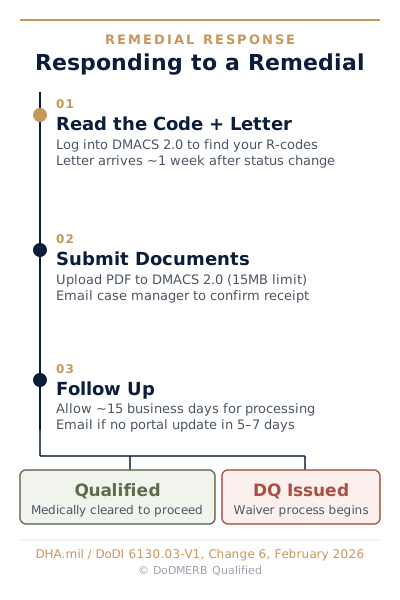
Read the Remedial Code and Letter
Log into the DMACS 2.0 portal to see the specific R-codes listed under your candidate's status. Look each one up below to understand exactly what is being asked for.
The remedial letter typically arrives within about one week of the status change. It specifies the exact format, date range, or type of evaluation needed. If the portal shows no specific codes yet, wait for the letter before acting.
Look Up Your Remedial Code
All 453 DoDMERB remedial (R) codes. Search by code number or by what is being asked for.
453 codes
Your DoDMERB letter is the authority. This list was captured from DoDMERB in April 2025 and is provided to help you understand what a code is asking for. Codes and wording can change. Always follow the exact instructions in your own letter and DMACS portal, and contact DoDMERB directly if the two disagree.
Codes that read "requires a physician's appointment" mean someone has to be seen. Codes that read "does not require a physician's appointment" mean you are only sending paperwork you may already have. Sorting your codes into those two buckets first tells you which items need scheduling and which you can send this week.
Gather and Submit What's Requested
For an administrative remedial, collect the treatment records, write any requested statements, and complete the specified questionnaires. For a medical remedial, schedule through a DoDMERB-contracted provider (Option 1, free) or choose your own provider (Option 3, at the candidate's expense).
Submit all documents via DMACS 2.0 as a miscellaneous upload. Use PDF format, with a 15MB limit per file.
Follow Up if the Portal Goes Quiet
Allow approximately 15 business days for processing after submission. If the portal has not changed within 5 to 7 business days, email your case manager. Possible outcomes after review: Qualified, or a DQ is issued.
Related: DoDMERB Waiver Process: Complete Guide
You've submitted your remedial response and know when to follow up.
What to Do When Your Candidate Gets a Disqualification
A disqualification means DoDMERB found a condition that doesn't meet current medical standards. It does not mean your candidate can't serve.
DoDMERB Does Not Grant Waivers
This is the most misunderstood part of the process. DoDMERB makes the medical determination. The commissioning program, whether a service academy or an ROTC branch, decides whether to grant a waiver. Waiver consideration depends on how competitive the candidate is overall: academics, fitness scores, and leadership experience all factor in.
How Waiver Review Works by Program
Each commissioning source handles waivers differently. The table below summarizes the key differences.
| Service | Waiver Authority | Automatic? | Notes |
|---|---|---|---|
| Army ROTC | Cadet Command Surgeon | Yes | Most flexible program for waivers |
| Navy ROTC | BUMED | Yes | Generally reasonable consideration |
| Air Force ROTC | AFROTC Command Surgeon | Conditional | Detachment commander must first decide to request the waiver |
| Service Academies | Varies by academy | Competitive only | USNA: BUMED, USAFA: Command Surgeon, USMA: Command Surgeon + Admissions |
"Automatic consideration" does not mean automatic approval. It means the waiver authority reviews the case without the candidate needing to request it.
The most common path: a remedial is issued, the candidate submits records, DoDMERB issues a DQ, and the waiver process begins. Waivers have been granted for conditions parents assumed were disqualifying with no recourse, including asthma, history of suicidal ideation, peanut allergy, and ACL reconstruction. The waiver authority weighs the whole candidate, not just the medical file.
DoDMERB Qualified
Got a disqualification letter? Do not panic.
Our free guide explains why 70-87% of waiver-referred applicants get approved, and the 5 mistakes that hurt your chances.
DoDMERB Qualified
Not sure what your candidate's disqualification means for their waiver chances?
DoDMERB Qualified helps families understand their candidate's specific DQ code and navigate the waiver process with clarity.
You understand who grants waivers and how the process differs by program.
Realistic Timelines for Remedials, Disqualifications, and Waivers
The DoDMERB process is slower than parents expect, and silence from the portal is normal, not a bad sign.
Key Timeline Benchmarks
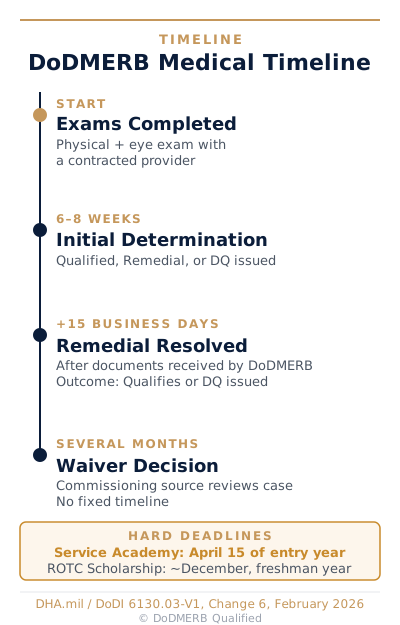
- Exam to initial determination: 6 to 8 weeks.
- Remedial response processing: Approximately 15 business days after DoDMERB receives materials.
- Waiver review: Several additional months beyond the DQ determination. There is no fixed timeline.
- Academy hard deadline: April 15 of the entry year for medical qualification.
- ROTC scholarship recipients: Approximately December of their college freshman year, which provides significantly more time.
If the portal has not changed within 5 to 7 business days after your remedial submission, email your case manager. A wait of 5 or more weeks with no movement is common, but worth a polite follow-up. If your candidate is approaching the April 15 academy deadline, escalate with both the case manager and the admissions office.
Related: What is DoDMERB? Complete Guide for Parents
You have realistic timeline expectations and know when silence warrants follow-up action.
Frequently Asked Questions
Does a remedial mean my candidate is going to be disqualified?
No. A remedial means DoDMERB needs more information before making any determination. The outcome can be Qualified or Disqualified. Many remedials resolve favorably once the requested records or evaluations are submitted.
What does AMI mean on the DoDMERB portal?
AMI stands for "Additional Medical Information." It indicates a remedial status. Your candidate needs to submit additional documents or complete further evaluation before DoDMERB can render a determination.
Who pays for remedial evaluations?
Administrative remedials (records, questionnaires) are paid by the candidate, usually at minimal cost. Medical remedials can be completed free through a DoDMERB-contracted provider (Option 1) or at the candidate's expense through a private provider (Option 3).
Can a disqualification be overturned?
Yes. The commissioning program can grant a medical waiver that overrides the DQ. DoDMERB makes the medical finding but does not have the final say on whether your candidate can serve.
How long does a waiver take?
There is no fixed timeline. Waivers typically take several additional months beyond the initial DQ determination. ROTC candidates generally have more time than academy applicants.
What are DoDMERB remedial codes?
R-codes are alphanumeric identifiers that specify exactly what DoDMERB needs. R190.00 requests treatment records, R264.00 requests a complete blood count, and R252.11 requests a food allergy questionnaire. Each code maps to a specific document or evaluation. There are 453 active remedial codes, and you can search all of them above by code number or keyword.
Does every disqualified candidate get a waiver review?
Not always. Army and Navy ROTC automatically consider waivers for disqualified candidates. Air Force ROTC requires the detachment commander to initiate the request. Service academies generally review waivers only for competitive candidates.
What is the deadline for resolving a DoDMERB medical issue?
For service academy candidates, medical qualification must be resolved by April 15 of the entry year. ROTC scholarship recipients have until approximately December of their college freshman year. These deadlines apply to the entire process, including any waiver review.