Your student takes a daily omeprazole, and now a DoDMERB exam is on the calendar. A quick search for "GERD DoDMERB" returns a wall of forum posts suggesting that any reflux diagnosis kills the application. That is wrong.
The standard does not disqualify GERD itself. It disqualifies GERD with specific complications. The distinction matters enormously, and most families never learn it until after a disqualification they may not have needed to receive.
This article walks through DoDI 6130.03 Section 6.12.a line by line, explains the five scenarios that actually trigger a disqualification, covers the practical reality of how DoDMERB handles controlled reflux, and gives you a records checklist that can prevent weeks of unnecessary remedials.
Key Takeaways
- Controlled GERD on a standard PPI dose with no complications is not disqualifying. DoDMERB qualifies these applicants routinely.
- DoDI 6130.03 Section 6.12.a targets GERD with complications: stricture, dysphagia, Barrett's esophagus, persistent symptoms despite medication, or extraesophageal complications like reactive airway disease.
- Barrett's esophagus is a hard disqualification because it is a precancerous condition.
- Fundoplication surgery is disqualifying within 6 months. After the 6-month window, the path to qualification opens if recovery is uncomplicated.
- Extraesophageal complications (chronic sinusitis, dental erosion, reactive airway disease caused by reflux) count as severity evidence most families overlook.
- DoDMERB is the medical qualification system for officer commissioning programs (service academies and ROTC), not enlisted accessions through MEPS.
What DoDI 6130.03 Actually Says About GERD
Section 6.12.a of DoDI 6130.03-V1 (Change 6, February 3, 2026) governs esophageal disease for military medical qualification. The disqualifying standard for GERD reads:
"History of Gastro-Esophageal Reflux Disease, with complications, including, but not limited to: (a) Stricture. (b) Dysphagia. (c) Recurrent symptoms or esophagitis despite maintenance medication. (d) Barrett's esophagus. (e) Extraesophageal complications such as: reactive airway disease; recurrent sinusitis or dental complications; unresponsive to acid suppression."
The operative phrase is "with complications." GERD without the complications listed in (a) through (e) does not fall under this disqualifying standard. This is the single most misunderstood point in the entire GERD and DoDMERB conversation.
The surgical correction standard adds a second trigger under Section 6.12.a(2):
"History of surgical correction (e.g., fundoplication) for Gastro-Esophageal Reflux Disease within 6 months or with complications."
Two triggers here: surgery within the past 6 months, or surgery with complications regardless of timing.
After this section, you understand the exact regulatory language governing GERD and DoDMERB qualification.
The Critical Distinction: Controlled Reflux vs. Complicated GERD
Most applicants with GERD fall into a straightforward category: occasional heartburn, managed with a proton pump inhibitor like omeprazole or lansoprazole, no complications on endoscopy, no surgical history, no extraesophageal symptoms. This is controlled reflux.
Physicians familiar with the DoDMERB review process consistently describe this pattern: applicants with controlled reflux on standard medication, no complications, and normal function are almost always qualified. The regulation targets reflux that has progressed to the point of causing measurable damage or resisting treatment. A student who takes a standard PPI, has no complications, and functions normally in school and athletics is not the candidate this standard is designed to screen out.
The confusion arises because GERD appears in the DoDI as a named condition. Families read "History of Gastro-Esophageal Reflux Disease" and stop before the comma. Everything after that comma — "with complications, including, but not limited to" — defines the actual disqualification threshold.
After this section, you know that controlled GERD on medication is routinely qualified by DoDMERB.
The Five Scenarios That Create a Real Problem
When GERD does lead to a disqualification, it falls into one of these five categories. Each represents a complication that signals the reflux has progressed beyond simple management.
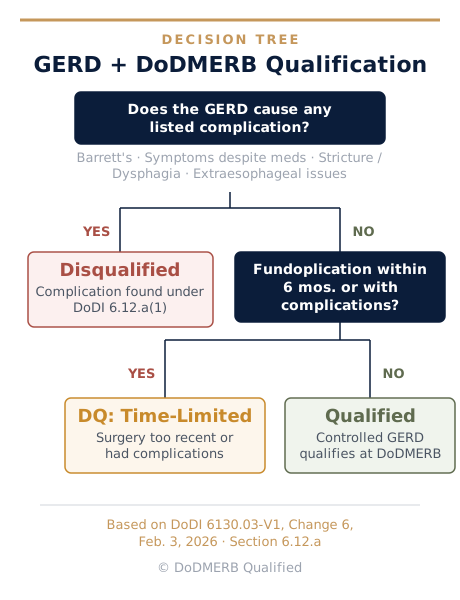
Use this decision tree to identify which GERD scenario applies to your student before the DoDMERB exam.
1. Barrett's Esophagus
Barrett's esophagus is a change in the lining of the lower esophagus caused by chronic acid exposure. Normal esophageal tissue is replaced by intestinal-type tissue, a process called intestinal metaplasia. It is diagnosed by endoscopy with biopsy.
Barrett's is a precancerous condition: it increases the risk of esophageal adenocarcinoma, which is why DoDMERB treats it as a firm disqualifier. It also requires ongoing endoscopic surveillance, with frequency determined by the presence and grade of dysplasia. That monitoring requirement alone creates a conflict with military service in austere environments.
2. Recurrent Symptoms Despite Maintenance Medication
Section 6.12.a(1)(c) targets reflux that does not respond to appropriate therapy. If your student is on a PPI at standard or escalated doses and continues to have breakthrough symptoms, recurrent esophagitis on endoscopy, or requires frequent medication adjustments, this qualifies as complicated GERD.
The military concern is operational. The three readiness criteria that drive accession standards are: sudden incapacitation risk, conditions requiring significant recurring care, and anything that prevents sustained vigorous activity in field environments or requires medications unavailable in the field. Reflux that keeps flaring despite medication hits the second and third concerns directly. PPIs may not be readily available in deployed environments, and a service member whose condition requires ongoing GI management creates a readiness liability.
3. Stricture or Dysphagia
An esophageal stricture is a narrowing of the esophagus, often caused by chronic inflammation from reflux. Dysphagia is difficulty swallowing. Both indicate that reflux has caused structural damage to the esophagus.
Strictures sometimes require dilation procedures and ongoing monitoring. Dysphagia can interfere with the ability to eat rapidly and adequately in field conditions. Either finding on the medical record flags the case under Section 6.12.a(1)(a) or (1)(b).
4. Extraesophageal Complications
This is the category most families miss entirely. GERD can cause problems beyond the esophagus, and DoDI 6130.03 explicitly names three:
- Reactive airway disease caused by reflux (acid aspiration triggering bronchospasm)
- Recurrent sinusitis from reflux reaching the upper airway
- Dental complications from chronic acid exposure (enamel erosion)
Section 6.12.a(1)(e) adds a critical qualifier: these extraesophageal complications must be "unresponsive to acid suppression." If your student had reflux-triggered reactive airway symptoms that resolved completely with PPI therapy, that is a different clinical picture than ongoing respiratory or sinus problems despite treatment.
The overlap between GERD-triggered reactive airway disease and primary asthma creates a diagnostic nuance. If your student has both a GERD history and an asthma-like presentation, the evaluating physician needs to determine whether the airway symptoms are reflux-mediated or independent.
Related: Asthma and DoDMERB
5. Fundoplication Within 6 Months
Fundoplication is the primary surgical treatment for GERD. The Nissen fundoplication wraps the top of the stomach around the lower esophageal sphincter to prevent acid reflux. It is performed when medical management fails or when a patient prefers a surgical solution.
Surgery within the past 6 months is disqualifying because the long-term stability of the result has not yet been established. Post-surgical complications — dysphagia, wrap failure, gas bloat syndrome — typically declare themselves within this window. After 6 months with no complications, the surgery itself is no longer the barrier. However, if the surgery resulted in complications at any point, Section 6.12.a(2) applies regardless of timing.
For families whose student had a fundoplication more than 6 months ago with an uncomplicated recovery: the path to qualification is open, but you will need documentation proving surgical success and current symptom control.
Related: Appendectomy and DoDMERB (abdominal surgery timing and documentation parallels)
After this section, you can identify which GERD scenarios are genuinely disqualifying and which are not.
What DoDMERB Does in Practice
DoDMERB is the medical qualification authority for officer commissioning programs: the five federal service academies, ROTC scholarship programs, and other commissioning sources. It is not MEPS, which handles enlisted accession physicals. The standards, processes, and review personnel are different.
When a DoDMERB applicant discloses a GERD history or current PPI use on the medical history form (DD Form 2807-2), the reviewing physician evaluates the disclosure against Section 6.12.a. Here is what typically happens based on the clinical picture:
Controlled GERD, no complications: The reviewer sees a GERD diagnosis managed with standard medication, no surgical history, no endoscopic complications. In most cases, this results in qualification without a remedial. If the reviewer wants confirmation, they may issue a remedial requesting GI records or a physician statement confirming the absence of complications.
GERD with a concerning history: If the medical history suggests prior complications, escalating treatment, surgical history, or extraesophageal symptoms, the reviewer issues a remedial requesting specific records. These typically include endoscopy reports, pathology results, treatment history, and a current physician statement.
GERD leading to disqualification: If the submitted records confirm one of the five complication scenarios above, the determination is a disqualification under Section 6.12.a with the specific subsection cited.
After this section, you understand how DoDMERB processes GERD cases and the difference between DoDMERB and MEPS.
Records to Gather Before Your Student's DoDMERB Exam
Physicians familiar with the DoDMERB review process recommend organizing records into three categories before responding to any remedial. Families who walk in with this package ready avoid multiple remedial rounds.
Primary clinical records matter more than summaries. Do not submit patient-portal printouts unless the remedial request expressly allows them. Obtain complete endoscopy reports, pathology results, and full clinical notes from the provider's office.
Diagnostic Tests
- Endoscopy reports (EGD), including date and findings
- Biopsy and pathology reports (confirms presence or absence of Barrett's, esophagitis grade, eosinophilic infiltrates)
- Imaging studies if performed (CT, MRI, barium swallow)
- Lab reports related to GI workup
- pH monitoring or impedance study results, if performed
Treatment History
- Complete medication list with dosages, start dates, and current status
- Documentation of medication response (symptom control on current regimen)
- Operative reports and surgical follow-up notes if fundoplication or other GI surgery occurred
- Records of any procedures (esophageal dilation, repeat endoscopies)
Stability and Function
- Recent clinical notes from the treating gastroenterologist or primary care physician documenting current symptom control
- Physician statement confirming no activity restrictions and ability to participate in school and athletics
- Documentation of no emergency department visits or hospitalizations for GI symptoms
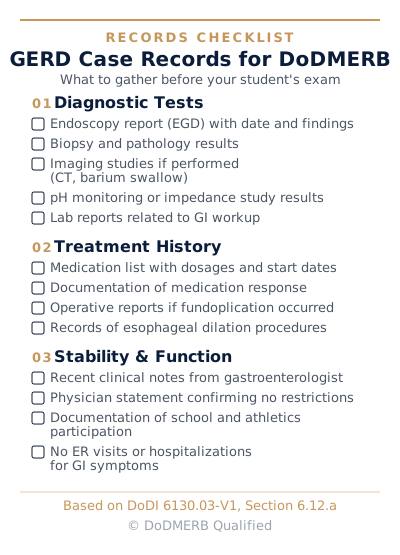
After this section, you have a complete records checklist for your student's GERD case.
DoDMERB Qualified
Your student has GERD and a DoDMERB exam coming up.
LTC Kirkland reviews GI condition cases and can help you determine whether controlled reflux creates a real obstacle before your student's exam.
The Bottom Line
GERD is one of the most common GI conditions in the applicant population, and it is one of the most frequently misunderstood in the DoDMERB context. The regulation does not disqualify reflux. It disqualifies reflux that has caused specific, documented complications.
If your student has controlled GERD:
- Confirm no history of Barrett's esophagus, stricture, or dysphagia
- Confirm no extraesophageal complications (reactive airway disease, sinusitis, dental erosion from reflux)
- Confirm current medication controls symptoms without breakthrough episodes
- Gather the records package outlined above before the DoDMERB exam
- Disclose the GERD diagnosis honestly on the medical history form
If your student has complicated GERD or a fundoplication history:
- Identify which specific subsection of 6.12.a applies
- Gather complete records documenting the complication, treatment, and current stability
- Understand that a disqualification may occur, but a waiver is a separate process through the commissioning program
- Contact DoDMERB Qualified to have LTC Kirkland review the case before the exam
The families who run into trouble are not the ones whose student takes a daily PPI. They are the ones who did not know that Barrett's on a biopsy from three years ago, or reflux-triggered asthma documented in the pediatric record, would resurface during medical qualification review.
Knowing the standard before the exam is the advantage.
Frequently Asked Questions
Is GERD disqualifying for military service?
GERD alone is not disqualifying under DoDI 6130.03. The standard targets GERD with specific complications: stricture, dysphagia, Barrett's esophagus, recurrent symptoms despite medication, or extraesophageal complications. Controlled GERD on a standard PPI without complications is routinely qualified by DoDMERB.
Can my student take a PPI (omeprazole, lansoprazole) and still pass DoDMERB?
Yes. Daily PPI use for GERD does not trigger a disqualification. DoDMERB evaluates whether the GERD has caused complications, not whether your student takes medication for it. A student on a standard PPI dose with controlled symptoms and no complications is in a strong position.
What is Barrett's esophagus and why is it a hard disqualification?
Barrett's esophagus is a condition where chronic acid exposure causes the normal esophageal lining to be replaced by intestinal-type tissue. It is classified as a precancerous condition because it increases the risk of esophageal adenocarcinoma. Barrett's requires ongoing endoscopic surveillance, and the precancerous classification makes it disqualifying under Section 6.12.a(1)(d) regardless of current symptoms.
My student had a fundoplication. Are they automatically disqualified?
Not automatically. Fundoplication is disqualifying if it occurred within the past 6 months or if it resulted in complications. If the surgery was more than 6 months ago and the recovery was uncomplicated, the path to qualification is open. You will need operative reports, follow-up records, and a physician statement documenting successful outcome and current symptom control.
Does DoDMERB test for GERD during the physical exam?
DoDMERB does not perform endoscopies or GI-specific testing at the exam. GERD typically enters the review process through the medical history form (DD Form 2807-2), where your student discloses the diagnosis and any medications. The reviewer then evaluates the disclosure and may request additional records through a remedial.
What is the difference between DoDMERB and MEPS for GERD evaluation?
DoDMERB handles medical qualification for officer commissioning programs: service academies, ROTC scholarships, and other commissioning sources. MEPS handles enlisted accession physicals. Both use DoDI 6130.03 as the governing standard, but the review processes, personnel, and waiver pathways are different. This article addresses the DoDMERB pathway specifically.
Can my student get a waiver for GERD-related disqualification?
If DoDMERB disqualifies your student under Section 6.12.a, the commissioning program (academy admissions or ROTC detachment) can request a medical waiver from the service medical authority. DoDMERB does not grant waivers. The waiver decision depends on the specific complication, the severity, the treatment outcome, and the service's assessment of future risk. Complete documentation of stability and function strengthens any waiver request.
My student's reflux causes asthma-like symptoms. How does DoDMERB handle that?
Reflux-triggered reactive airway disease falls under Section 6.12.a(1)(e) as an extraesophageal complication. The key qualifier is whether these symptoms are "unresponsive to acid suppression." If PPI therapy resolved the airway symptoms, the clinical picture is different from ongoing reflux-mediated bronchospasm despite treatment. Your student's records should clearly document whether the airway symptoms are reflux-mediated and whether acid suppression therapy resolved them. A pulmonologist and gastroenterologist may both need to weigh in.