One kidney stone in high school can feel like a small footnote, right up until it lands on a DoDMERB medical history. Then the question becomes whether a stone your student already passed and forgot about can stall a service academy appointment or an ROTC scholarship.
The honest answer is that kidney stones and DoDMERB qualification comes down to timing, count, size, and whether a procedure was ever needed. A single stone passed years ago is a very different case from a recent one, multiple current stones, or a pattern of stones. The standard is built to separate a one-time event from a stone former.
This guide explains exactly what the DoDMERB kidney stone standard says, why the military treats stones the way it does, the line between a single episode and a recurring problem, and what to document.
Key Takeaways
- Kidney stones are disqualifying under DoDI 6130.03 when the stone is recent, current, multiple, bilateral, recurrent, or ever required a procedure.
- A single stone passed more than 12 months ago, with no stone left on imaging, is the most favorable scenario.
- The core concern is a stone striking downrange, where sudden pain can be incapacitating and urology care may not be available.
- There is roughly a 15 to 20 percent chance of a second stone within 12 months of the first.
- Current imaging showing no retained stones is often the single most useful document a family can have ready.
Do Kidney Stones Disqualify You From DoDMERB?
A history of kidney stones is disqualifying only in specific situations, not automatically. The standard lists five triggers, and a case that hits any one of them is disqualifying. Miss all five, and a past stone may not stand in the way.
Read the list carefully, because the difference between qualifying and disqualifying often sits in the details. A single small stone passed 18 months ago, with clean imaging since, hits none of the five. A stone passed last month, a stone still sitting in the kidney, or a stone that once needed a procedure to remove hits one of them.
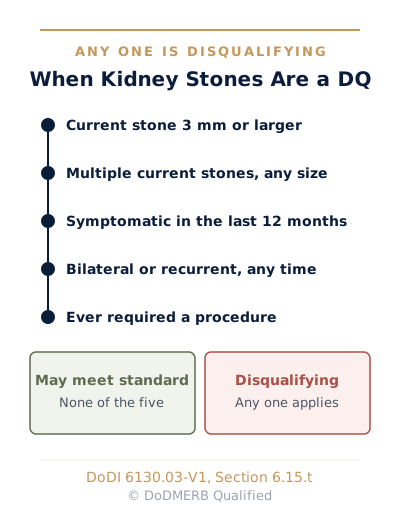
The takeaway for most families is that time and resolution matter. The further a single episode recedes past the 12 month mark, and the cleaner the follow-up imaging, the stronger the picture.
You can look up how a stone history is coded using the DoDMERB disqualification codes tool. Even a coded disqualification is the start of a review, not the end of the road.
Why DoDMERB Cares About Kidney Stones
A kidney stone is not dangerous because of what it is. It is dangerous because of when and where it can strike. Passing a stone can be sudden and severely painful, and that pain can be incapacitating.
Put that in an operational setting. A cadet in the field, on a ship, or somewhere without ready access to a urologist can go from fully functional to doubled over in a matter of hours. The stone itself is treatable. The problem is a timeline the military cannot control and a location where care may be days away.
Recurrence is the other half of the concern. There is roughly a 15 to 20 percent chance of a second stone within 12 months of the first. That statistic is the reasoning behind the 12 month symptomatic window in the standard. A stone is not just a past event. It is a signal about future risk.
DoDMERB Qualified
Not sure whether your student's stone history clears the 12 month window?
We read the actual imaging and stone history against the DoDMERB standard, so you know where your student stands before anything reaches a reviewer's desk.
One Stone vs a Stone Former: Where the Line Sits
The standard draws a hard line between a single unlucky episode and a body that keeps making stones. A first, isolated stone that passes and does not come back is the most favorable case. Recurrent stones, bilateral stones, or stones needing a procedure point to something that needs a closer look.
Some people simply form stones. When a reviewer sees recurrent or bilateral stones, the question shifts from the stone to the cause. Known risk factors include genetics, a diet high in sodium or animal protein, low calcium intake, obesity or metabolic syndrome, gout, and hyperparathyroidism. These are worth investigating for any repeat stone former, because the underlying driver is what raises the risk of another episode.
What to Document for a Kidney Stone History
A past stone is a story, and the records have to tell it completely. Saying the stone passed and everything is fine does not carry weight on its own. Specific documents do. The list is short.
Records to keep ready
- A current imaging study (CT or ultrasound) showing no retained stones
- Stone analysis results, if the stone was ever captured and tested
- Urology or nephrology notes, including any metabolic workup for a repeat former
- A clear record of timing and recurrence, and confirmation that your student is back to unrestricted activity
Full, honest disclosure on the DD Form 2807-2 is the strong path, not a risk. These are the medical forms of a future officer, and an accurate, well-documented account is exactly what reviewers are looking for. Leaving a stone off the form is what creates problems later.
One timing note. If a workup or a clean follow-up scan is needed, ROTC scholarship applicants generally have more runway to complete it than service academy applicants, whose medical qualification has a firmer spring deadline. Keep records organized at home so they are ready if a Remedial request arrives, rather than bringing them to the exam itself.
Related: For how a disqualification becomes a reviewed decision, see the DoDMERB Waiver Process guide.
Frequently Asked Questions
Does one kidney stone disqualify you from DoDMERB?
Not by itself. A single stone becomes disqualifying only if it was symptomatic within the last 12 months, is still present, was 3 mm or larger, or ever required a procedure. A single small stone passed more than a year ago, with clean imaging since, may hit none of the disqualifying triggers.
I passed a kidney stone last year. Is that a problem?
It depends on the exact timing. A stone that was symptomatic within the previous 12 months meets a disqualifying criterion. Once you are past that window with no retained stones on imaging and no recurrence, the picture is much stronger. Documentation of the date and a clean follow-up scan matter.
What counts as a stone "requiring a procedure"?
Any intervention beyond passing the stone naturally, such as lithotripsy, ureteroscopy, or stent placement. A history of a stone that needed one of these is disqualifying under the standard, regardless of how long ago it happened, because it signals a stone the body could not clear on its own.
Does a current small kidney stone disqualify you?
A current stone of 3 mm or larger is disqualifying, as are current multiple stones of any size. A reviewer looks at the most recent imaging. This is why a current scan showing no retained stones is such an important document for a past stone former.
Are recurrent or bilateral stones treated differently?
Yes. A history of recurrent stones or bilateral stones is disqualifying at any time, not just within 12 months. That pattern suggests a stone former, so a metabolic workup identifying and addressing the cause becomes an important part of the picture.