A varicocele shows up on a sports physical or the DoDMERB exam, and suddenly a years-long plan feels like it is unraveling. It is one of the most common findings in teenage boys, appearing in roughly 10 to 15 percent of adolescents, and about 8 in 10 are on the left side and completely harmless.
That last detail matters, because a varicocele and DoDMERB qualification is not a simple yes or no. The medical standard was written with the common, benign version in mind, and it carves out a clear path for it. The side it is on, whether it causes symptoms, and whether it has affected the testicle all change the answer.
This guide explains exactly when a varicocele meets the DoDMERB standard, why left-sided and right-sided are treated so differently, what happens if the exam finds a mass, and what to keep on hand.
Key Takeaways
- A left-sided varicocele that is asymptomatic, smaller than the testes, reducible, and without testicular atrophy meets the DoDMERB standard. It is not a disqualification at all.
- A right-sided varicocele is disqualifying, because an isolated right-sided one is rare and the cause has to be ruled out.
- The concern behind the standard is not the varicocele itself. It is what a varicocele might be hiding, and whether it affects function.
- If the exam finds a scrotal mass, DoDMERB usually orders a scrotal ultrasound. That is a routine next step, not a rejection.
- A disqualification is not a denial. Disqualifications are reviewed, and ROTC applicants in particular have runway to resolve a workup.
Does a Varicocele Disqualify You From DoDMERB?
Here is the direct answer: a left-sided varicocele that is small, painless, reducible, and has not damaged the testicle meets the standard. Everything else in the varicocele category is disqualifying, though a disqualification can still be reviewed.
The standard spells out a narrow carve-out. A varicocele meets the DoDMERB standard only when every one of these is true:
Read that as a gate with four locks. All four have to open. A left-sided varicocele that causes pain fails the second lock. A left-sided varicocele that has shrunk the testicle fails the fourth. A right-sided one fails the first no matter how mild it is.
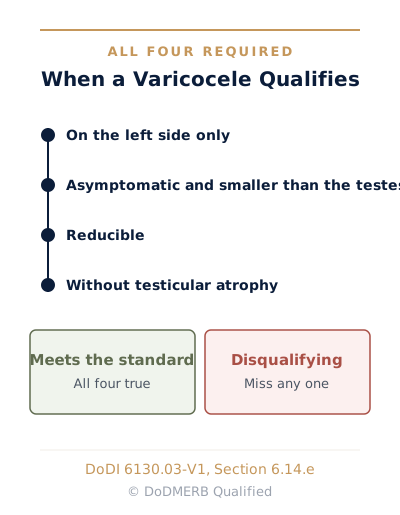
The good news for most families is that the common presentation, a small left-sided varicocele found by chance with no symptoms, walks straight through all four. If that is your student, this may never rise to a disqualification in the first place.
You can look up how any finding is coded using the DoDMERB disqualification codes tool, and remember that even a coded disqualification is the start of a review, not the end of the road.
What a Varicocele Is, and Why Size and Symptoms Matter
A varicocele is nothing more exotic than a varicose vein, in a different location. The veins that drain the scrotum develop faulty valves, so blood pools instead of flowing back toward the heart against gravity. The result is a soft enlargement of the veins around the testicle, often described as feeling like a small bag of worms.
Most cause no trouble at all. When they do, the problems are specific: aching or pain, reduced testicle size over time, or, in some men, an effect on fertility because the pooled blood raises the local temperature.
Those exact problems are why three of the four carve-out criteria exist. The standard is not arbitrary. Each lock maps to a real concern.
| Carve-out criterion | The concern it screens for |
|---|---|
| Asymptomatic | Ongoing pain that could limit training or need care |
| Smaller than the testes | A large varicocele more likely to progress or cause damage |
| Reducible | A vein that empties when lying down behaves benignly |
| No testicular atrophy | Proof the varicocele has not already harmed the testicle |
Seen this way, the standard is really asking one question. Is this a small, quiet finding, or is it something that is already affecting the body?
DoDMERB Qualified
Not sure whether your student's varicocele meets all four criteria?
We review the actual exam findings and records against the DoDMERB standard, so you know where your student stands before anything reaches a reviewer's desk.
Left-Sided vs Right-Sided: Why the Side Changes Everything
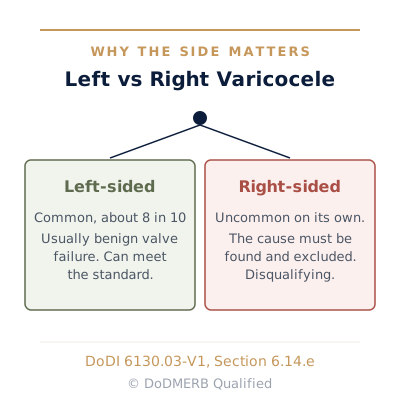
The single most important fact about a varicocele and DoDMERB is which side it is on. Left-sided is common and usually benign. An isolated right-sided varicocele is uncommon, and that rarity is precisely the problem.
The reason is plumbing. The left and right testicular veins drain into different places at different angles, so the left side is far more prone to the simple valve failure that causes an ordinary varicocele. Roughly 8 in 10 varicoceles are left-sided for this anatomical reason, and the usual cause is nothing more than those worn-out valves.
A right-sided varicocele is different. Because it is so uncommon on its own, its appearance raises a question the medical side has to answer: what is causing it? In some cases the answer is a mass or a blood clot pressing on the vein. That possibility, not the varicocele, is why the standard draws a hard line at left-side-only.
The military is not treating every varicocele as the same thing. It is distinguishing between a small, relatively benign finding and something that could be functionally significant, or a sign of something else.
What Happens if the DoDMERB Exam Finds a Scrotal Mass
Finding a scrotal mass on the exam is common, and it does not mean the exam has gone wrong. The examiner will usually give an impression on the spot, often "this looks like a varicocele" or "this may be a spermatocele," because varicoceles are relatively easy to recognize by feel.
An exam impression is not a diagnosis. Since there is no definitive answer from touch alone, DoDMERB will typically send your student for a scrotal ultrasound to confirm what it is. If the ultrasound turns up something that needs a closer look, your student is referred to their own doctor for further evaluation.
Two points cut through most of the panic here. DoDMERB itself does not run the ultrasound and does not perform a urinalysis. It relies on the exam, your student's answers on the DD Form 2807-2 health history, and records generated by outside providers. And an ultrasound referral is a normal step in confirming a benign finding, not evidence of a serious problem.
How to Document a Varicocele for DoDMERB
If a varicocele is ever questioned, the records have to prove it is the benign kind. Saying "he is fine now" does not carry weight. The documentation does. The good news is that the list is short and specific.
Records to keep ready
- The urologist or primary-care note describing the varicocele, including which side it is on, its size relative to the testicle, and whether it is reducible
- Any scrotal ultrasound report
- A current statement that your student is asymptomatic, with no testicular pain and no testicular atrophy
- For a right-sided or symptomatic finding, the workup that identified and excluded any underlying cause
Full, honest disclosure on the DD Form 2807-2 is the strong path, not a risk. These are the medical forms of a future officer, and an accurate, well-documented account is exactly what reviewers are looking for. A vague or incomplete story is what slows cases down.
One timing note. If a right-sided or symptomatic varicocele needs a urology workup, ROTC scholarship applicants generally have more runway to complete it than service academy applicants, whose medical qualification has a firmer spring deadline. Build the evaluation into the calendar early either way.
Related: For how a disqualification becomes a reviewed decision, see the DoDMERB Waiver Process guide.
Frequently Asked Questions
Is a left-sided varicocele automatically disqualifying?
No. A left-sided varicocele meets the DoDMERB standard as long as it is asymptomatic, smaller than the testes, reducible, and has not caused testicular atrophy. When all four are true, it is not a disqualification at all. If any one fails, it becomes disqualifying and moves to review.
Why is a right-sided varicocele disqualifying when a left one is not?
An isolated right-sided varicocele is uncommon, so its cause has to be found and ruled out. In some cases the underlying cause can be a mass or a blood clot. The disqualification is really about excluding that possibility, not about the varicocele itself.
Does varicocele surgery help or hurt my DoDMERB case?
It depends on the current findings and the records, not on the surgery alone. The standard looks at whether the varicocele is now left-sided, small, painless, reducible, and free of atrophy. If surgery was done, keep the operative note and follow-up records. Do not assume an operation is required to qualify.
Will my student need a scrotal ultrasound?
Often, yes, if a mass is felt on the exam. DoDMERB usually orders the ultrasound to confirm the finding, and it is performed by an outside provider rather than by DoDMERB. It is a routine confirmation step, not a sign of a serious problem.
Is the military worried about fertility?
Not directly. The standard focuses on whether the varicocele is symptomatic or has damaged the testicle, which is why atrophy and pain are in the criteria. Fertility is part of the broader medical picture a urologist considers, but the DoDMERB question is whether the finding meets the standard.