Your child fainted once at a ceremony. The ER said it was vasovagal syncope. Now you're reading about DoDMERB and wondering if one blackout just ended everything.
This is one of the most emotionally charged, least-understood areas of the DoDMERB medical qualification process. Fainting — medically called syncope — falls under the heart chapter of DoDI 6130.03, and there are three separate regulatory hooks that can catch it. Parents assume a single faint is an automatic disqualification. It is not. But the outcome depends entirely on one distinction: whether the episode was clearly vasovagal with a known trigger and a clean workup, or whether it remains unexplained in the medical record.
This guide walks through the exact regulatory language, the four scenarios DoDMERB evaluates, the documentation that determines your outcome, and what to write on the DoDMERB form. Every recommendation applies to service academy and ROTC commissioning applicants.
Key Takeaways
- POTS is the hardest fainting-related diagnosis to waive. It is very difficult, if not impossible, to waive due to incapacitation risk under field conditions.
- A single vasovagal faint with a clear trigger is explicitly excluded from disqualification under DoDI 6130.03, Section 6.11.t — but only if the workup is normal and the episode is documented as vasovagal by a physician.
- Three separate regulatory sections can catch a fainting history. Recurrent syncope (6.11.t), unexplained cardiopulmonary symptoms (6.11.u), and POTS (6.11.v) each operate independently.
- The 24-month clock for recurrent syncope requires being off all medication. Meeting the time requirement alone is not enough if your student is still on treatment.
- What you write on the DoDMERB form matters as much as the medical records. A vague description turns a benign event into an unexplained episode that triggers a DQ.
What the DoDMERB Standard Actually Says About Fainting
The regulation addresses fainting in three separate paragraphs within the cardiovascular chapter. Each one functions independently, which means a single fainting history can be evaluated against multiple criteria. Understanding all three is essential because DoDMERB reviewers check each one.
Section 6.11.t — Recurrent Syncope
"History of recurrent syncope or presyncope, including black out, fainting, loss or alteration of level of consciousness (excludes single episode of vasovagal reaction with identified trigger such as venipuncture) unless it has not recurred during the last 24 months while off all medication for treatment of this condition." — DoDI 6130.03-V1, Section 6.11.t
In plain English: recurrent fainting or near-fainting is disqualifying. The regulation makes one explicit exception — a single vasovagal episode with an obvious trigger like a blood draw. If your student has had only one episode, and it was clearly vasovagal, this section does not apply.
For anyone with recurrent episodes, the standard requires two conditions to be met simultaneously: no recurrence for 24 months, AND off all medication used to treat the condition during that entire period. Meeting one without the other does not satisfy the standard.
Section 6.11.u — Unexplained Cardiopulmonary Symptoms
"Unexplained cardiopulmonary symptoms (including, but not limited to, syncope, presyncope, chest pain, palpitations, and dyspnea on exertion) in the last 12 months." — DoDI 6130.03-V1, Section 6.11.u
This is the catch-all. If a fainting episode happened within the past 12 months and the medical record does not clearly explain why it happened, this section disqualifies. The word "unexplained" is doing heavy lifting here. A faint that was never worked up, or was worked up but never formally characterized by a physician, falls into this category.
Unexplained cardiopulmonary symptoms are one of the most common DQs in the heart section. The reason is straightforward: many families never get a follow-up cardiology evaluation after a single faint. Without that documentation, the episode stays unexplained.
Section 6.11.v — POTS
"History of Postural Orthostatic Tachycardia Syndrome (POTS) or syndrome of inappropriate sinus tachycardia (IST)." — DoDI 6130.03-V1, Section 6.11.v
This is the most serious of the three. POTS is a standalone disqualifier with no built-in exception or timeline pathway. There is no "24 months symptom-free" language here. A POTS diagnosis in the medical record triggers an automatic DQ.
After this section, you understand all three regulatory hooks that can catch a fainting history. Next: the distinction that determines whether your student's episode is a problem.
The Most Important Distinction: One Episode vs. a Pattern
Everything about your student's DoDMERB outcome comes down to whether the fainting episode was a single, clearly explained event or part of a recurring pattern. The regulation draws this line explicitly. Understanding which side your student falls on determines whether you are preparing documentation for qualification or building a waiver case.
What Makes a Faint "Clearly Vasovagal"
The DoDI makes an exception for "a single episode of vasovagal reaction with identified trigger such as venipuncture." But the regulation does not define what constitutes a clearly vasovagal episode beyond the blood draw example. Based on how DoDMERB reviewers evaluate these cases, three elements must be present:
1. A known physiological trigger. Heat exposure, prolonged standing, blood draw, pain, dehydration, or emotional distress. A fainting episode at a hot outdoor ceremony after standing for 90 minutes has a clear trigger. A fainting episode while sitting in a cool classroom does not.
2. A normal cardiac workup. At minimum, a normal EKG. Ideally, an echocardiogram showing no structural heart disease and no arrhythmia. The workup must demonstrate that the heart is structurally and electrically normal.
3. A physician characterization. A cardiology note or ER physician note that explicitly documents the episode as vasovagal syncope. This is the document that ties the case up with a bow. Without this characterization, the episode is medically unexplained — and 6.11.u applies.
The Risk of No Follow-Up
Here is where families get into trouble. A teenager faints at a parade. Parents take them to the ER. The ER runs an EKG, says everything looks fine, and sends them home. No cardiology referral. No formal characterization in the discharge summary. Two years later, the DoDMERB form asks about fainting history. The ER records say "syncope, EKG normal, discharged" — but no physician ever documented it as vasovagal.
That missing characterization turns a benign event into an unexplained symptom. If it happened within 12 months, it triggers 6.11.u. Even outside that window, it creates ambiguity that can generate a Remedial request or a DQ under 6.11.t if the reviewer interprets the records as insufficiently explained.
When One Episode Becomes "Recurrent"
The regulation does not define a specific number for "recurrent." Two episodes can constitute a pattern. If your student fainted once at age 14 and once at age 16, that is recurrent syncope under 6.11.t. The 24-month clock and medication-free requirement both apply.
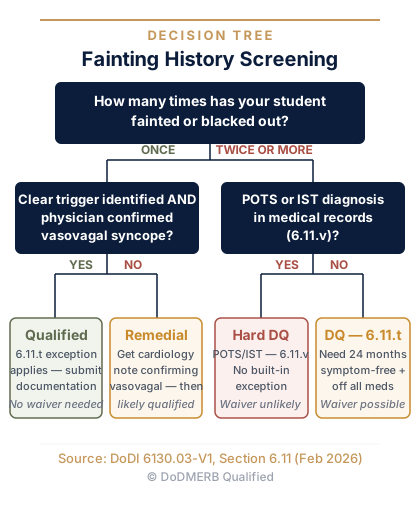
After this section, you can identify whether your student's fainting history falls under the single-episode exception or the recurrent pattern. Next: the four specific scenarios and how each plays out.
Four Scenarios DoDMERB Sees — and How Each Plays Out
Every fainting case that crosses a DoDMERB reviewer's desk falls into one of four categories. Your student's documentation, diagnosis, and timeline determine which one applies. Here is what to expect for each.
Scenario 1: Single Faint, Clear Trigger, Normal Workup
Your student fainted once. There was an obvious trigger — standing in heat, a blood draw, a painful injury. The ER visit produced a normal EKG. A cardiologist or ER physician documented the episode as vasovagal syncope. No medications were prescribed. No recurrence.
Expected outcome: Qualified at the DoDMERB level. No waiver needed. The regulation explicitly excludes this scenario under 6.11.t. As long as the documentation is complete, this is the best-case result.
What can go wrong: Missing cardiology characterization. If no physician documented it as vasovagal, DoDMERB may issue a Remedial requesting clarification. Getting that documentation retroactively — even years later — is possible but adds weeks to your timeline.
Scenario 2: Multiple Fainting Episodes, No Clear Diagnosis
Your student has fainted two or more times. There may or may not be identified triggers. No POTS diagnosis. No arrhythmia identified. The episodes are characterized as recurrent syncope.
Expected outcome: Disqualified under 6.11.t. To become eligible, your student must meet both conditions simultaneously: 24 months with no recurrence AND off all medication used to treat the condition during that entire period. The clock starts from the last episode or the last day of medication, whichever is later.
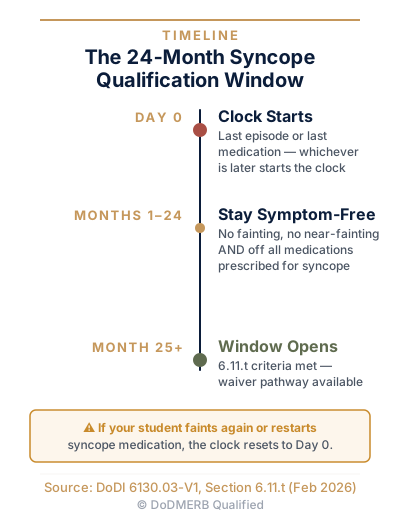
What can go wrong: Families assume the clock starts from the last episode but forget that the student was on fludrocortisone, midodrine, or increased salt/fluid prescriptions. If any medication was prescribed for syncope management, the student must be off it for the full 24 months.
Scenario 3: POTS Diagnosis
Your student received a formal POTS diagnosis, typically confirmed by a tilt-table test showing an excessive heart rate increase upon standing (30+ bpm within 10 minutes, or over 120 bpm).
Expected outcome: Disqualified under 6.11.v. Waiver is extremely unlikely. POTS is very difficult, if not impossible, to waive. The reasoning is physiological: POTS causes an inappropriate heart rate and blood pressure response to postural changes. Under military field conditions — heat, dehydration, physical exertion, body armor, limited access to hydration — this creates a sudden incapacitation risk that cannot be mitigated by documentation or treatment history.
What families need to know: This is not a documentation problem that can be solved with better records. The services have drawn a hard line because the underlying physiology is fundamentally incompatible with the physical demands of military service. If your student has a POTS diagnosis, DoDMERB Qualified can review the case, but families should prepare for the likelihood that this is a permanent barrier to commissioning.
Scenario 4: Fainting from an Arrhythmia (WPW or SVT)
Your student fainted and the workup identified Wolff-Parkinson-White syndrome (WPW), supraventricular tachycardia (SVT), or another arrhythmia as the cause. The student underwent catheter ablation to correct the electrical pathway.
Expected outcome: Waverable. Post-ablation cases can qualify if three conditions are met: the ablation procedure is documented in the operative report, no symptoms have recurred since the procedure, and a normal ECG is documented at least 3 months post-ablation. This is one of the more favorable waiver scenarios because the ablation addresses the root cause.
What can go wrong: Insufficient follow-up documentation. The waiver authority needs the operative report from the ablation, the post-procedure ECG showing normal conduction, and documentation of the symptom-free interval. Missing any piece delays or blocks the waiver.
After this section, you know which scenario applies to your student. Next: the documentation you need to gather before the DoDMERB exam.
The Documentation That Determines Your Outcome
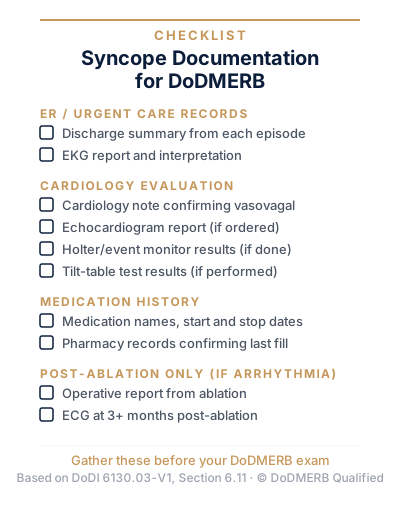
The difference between a qualified status and a disqualification often comes down to whether the right paperwork exists before the DoDMERB exam. The documentation should include ER records, primary clinical notes, imaging reports, and a cardiology note — and the cardiology note is the single most important document.
Having these records organized and ready prevents the most common delay: a Remedial request that adds 3 to 6 weeks to your timeline while you scramble to locate documents from hospitals and specialists on short notice.
ER and Urgent Care Records
- Discharge summary from the episode(s)
- EKG report and interpretation
- Any lab results ordered during the visit
- Physician notes documenting the circumstances (trigger, duration, recovery)
Cardiology Evaluation
- Cardiology consultation note with explicit characterization of the episode (vasovagal, neurocardiogenic, etc.)
- Echocardiogram report (if ordered) confirming no structural heart disease
- Holter monitor or event monitor results (if ordered)
- Tilt-table test results (if performed)
Primary Care Follow-Up
- Follow-up visit notes documenting no recurrence
- Any referral letters to or from specialists
Medication History
- List of any medications prescribed for syncope management (fludrocortisone, midodrine, beta-blockers, increased salt tablets)
- Dates of medication start and stop
- Pharmacy records confirming discontinuation dates (critical for the 24-month clock)
Post-Ablation Documentation (Scenario 4 Only)
- Operative report from the ablation procedure
- Post-procedure ECG (at least 3 months after ablation)
- Electrophysiology follow-up notes confirming no recurrence
DoDMERB Qualified
Need help organizing your student's syncope documentation?
DoDMERB Qualified reviews your medical records and identifies gaps before they become Remedial requests. One consultation can save weeks of delay.
After this section, you have a complete checklist of every document to gather. Next: realistic waiver expectations for each scenario.
Waiver Reality: What to Expect by Scenario
Not every fainting history requires a waiver. The best outcome is qualification at the DoDMERB level — no waiver process at all. Here is what to realistically expect based on your student's scenario.
Qualification Without a Waiver
| Scenario | Requirements | Expected Outcome |
|---|---|---|
| Single vasovagal faint + clear trigger + normal workup + cardiology characterization | Complete documentation submitted with exam | Qualified at DoDMERB level |
| Single faint > 12 months ago + full workup | Normal cardiac evaluation, physician characterization | Qualified at DoDMERB level |
Waiver Required
| Scenario | Requirements | Waiver Likelihood |
|---|---|---|
| Recurrent syncope + 24 months symptom-free + off all meds | Full cardiac workup, documented medication discontinuation, no recurrence | Moderate — depends on completeness of workup and number of episodes |
| Post-ablation arrhythmia (WPW/SVT) | Operative report + normal ECG 3+ months post-ablation + no symptoms | High — ablation addresses root cause |
| Recurrent syncope + still on medication | Cannot meet 6.11.t exception criteria | Very low — active treatment = active condition |
Waiver Unlikely
| Scenario | Why |
|---|---|
| POTS diagnosis | Physiological instability under field conditions; incapacitation risk cannot be mitigated |
| Recurrent unexplained syncope + incomplete workup | Without a diagnosis, the waiver authority has no basis for assessing future risk |
| Multiple episodes within past 24 months | Does not meet time-based exception criteria |
Related: DoDMERB Waiver Process: Complete Guide
After this section, you know whether your student needs a waiver and how likely it is to succeed. Next: exactly what to write on the DoDMERB form.
What to Write on the DoDMERB Form
The DoDMERB medical history form asks your student to describe any fainting episodes in their own words. What they write here matters as much as the medical records. The guidance is direct: describe what happened in detail as best you can, and what the workup showed. Don't just say "fainted once" with no context.
The Right Way
"Fainted once while standing in the sun for approximately 90 minutes at a high school graduation ceremony, June 2023. Was transported to [Hospital Name] Emergency Department. EKG was normal. Echocardiogram was normal. Diagnosed as vasovagal syncope by cardiologist Dr. [Name] at [Practice Name]. No recurrence since the episode. No medications prescribed."
This description accomplishes four things: identifies the trigger (prolonged standing in heat), documents the workup (EKG and echo), names the diagnosing physician (cardiology characterization), and confirms no recurrence or treatment.
The Wrong Way
"Fainted once. Don't know why. It was a long time ago."
This description accomplishes nothing. It provides no trigger, no workup, no diagnosis, and no follow-up. DoDMERB will issue a Remedial requesting exactly the information that should have been on the form.
Key Principles for the Form
Be specific about the trigger. Heat, blood draw, prolonged standing, pain, dehydration. Name it. A known trigger is what separates a vasovagal episode from an unexplained one.
Name the tests and results. "EKG normal, echocardiogram showed no structural abnormality." This tells the reviewer the workup was done and was clean.
Name the diagnosing physician. "Diagnosed as vasovagal syncope by Dr. [Name], cardiologist." This tells the reviewer that a qualified specialist characterized the episode.
State whether medications were prescribed. If no medications were ever prescribed, say so explicitly. If medications were prescribed and discontinued, state the medication name and the date of discontinuation.
Disclose everything. Do not omit a fainting episode because it "wasn't a big deal." Medical records surface throughout the process — when physicians submit records in response to Remedials, when a waiver workup pulls prior documentation, or when a specialist's notes reference earlier history. An undisclosed episode discovered later creates an integrity issue that is far worse than the medical issue itself. Integrity is foundational to officer qualification. An honest, well-documented disclosure is always the right approach.
Related: What is DoDMERB? Complete Guide for Parents
After this section, you know exactly what to write and how to frame the disclosure. Next: answers to the most common questions.
FAQ
Does one fainting episode automatically disqualify me from DoDMERB?
No. DoDI 6130.03-V1, Section 6.11.t explicitly excludes a single vasovagal episode with an identified trigger like a blood draw. The key is documentation: a normal cardiac workup and a physician's note characterizing the episode as vasovagal. Without that documentation, even a single episode can be flagged as unexplained under Section 6.11.u.
What is vasovagal syncope and why does it matter for DoDMERB?
Vasovagal syncope is a temporary loss of consciousness caused by a sudden drop in heart rate and blood pressure, usually triggered by heat, prolonged standing, pain, or emotional stress. It matters for DoDMERB because the regulation specifically exempts a single vasovagal episode with an identified trigger from the recurrent syncope disqualification. This is the one fainting scenario that can qualify without a waiver.
My child fainted at school last year. Does the 12-month rule apply?
If the episode happened within the past 12 months and remains unexplained in the medical record, Section 6.11.u applies. The fix is documentation, not time. Get a cardiology evaluation that characterizes the episode and confirms a normal cardiac workup. Once the episode is explained and documented as vasovagal, the 12-month catch-all no longer applies.
What is POTS and can it be waived for service academy admission?
POTS (Postural Orthostatic Tachycardia Syndrome) causes an excessive heart rate increase when standing, often with dizziness, fainting, and fatigue. It is disqualifying under Section 6.11.v with no built-in exception. It is very difficult, if not impossible, to waive because the condition creates incapacitation risk under military field conditions — heat, dehydration, and physical exertion.
How many times do you have to faint for it to be "recurrent" under the DoDMERB standard?
The regulation does not specify a number. Two episodes constitute a pattern and trigger the recurrent syncope standard under Section 6.11.t. The exception for a single vasovagal episode exists precisely because one event with a clear trigger is clinically different from repeated events.
My child fainted once from a blood draw. Is that the vasovagal exception?
Yes — a blood draw (venipuncture) is the specific trigger example named in the regulation. This is the clearest case for the single-episode exception under Section 6.11.t. You still need documentation: ER or clinic notes from the episode, a normal EKG if one was performed, and confirmation that no medications were prescribed and no recurrence occurred.
What cardiology documentation does DoDMERB need for a syncope history?
DoDMERB needs a cardiology consultation note that explicitly characterizes the episode (vasovagal, neurocardiogenic, arrhythmia-related, etc.), an EKG report, and an echocardiogram report if one was ordered. The cardiology note should confirm that the cardiac workup was normal and that the episode is considered benign. This single document is what a former DoDMERB physician calls the note that "ties it up with a bow."
Can fainting from WPW (Wolff-Parkinson-White syndrome) be waived?
Yes. WPW-related fainting is one of the more favorable waiver scenarios because catheter ablation provides a definitive fix. The waiver authority needs the operative report from the ablation, a normal ECG documented at least 3 months post-procedure, and no recurrence of symptoms. Once the accessory pathway is destroyed and normal conduction is confirmed, the risk is eliminated.
What if fainting happened more than 2 years ago and my child has been fine since?
If it was a single vasovagal episode with documentation, your student should qualify at the DoDMERB level regardless of when it happened. If it was recurrent syncope, the 24-month symptom-free and medication-free window works in your favor. Gather all records from the original episodes and any follow-up, and ensure there is a clear characterization of the diagnosis.
Should my child disclose a fainting episode if it wasn't diagnosed?
Yes. Always disclose. Medical records surface throughout the DoDMERB and waiver process — when physicians respond to Remedial requests, when a workup pulls prior specialist notes, when cardiology records arrive during waiver review. An episode that surfaces without your prior disclosure creates an integrity problem that is far more damaging than the medical issue itself. Disclose the episode honestly, describe the circumstances, and note whether follow-up care was obtained. If no workup was done at the time, consider getting a cardiology evaluation now so you have documentation to submit when a Remedial is issued.