Up to 72% of children will have a heart murmur detected at some point during their pediatric years. Fewer than 1% of those murmurs turn out to be pathologic.
If you are reading this, one of two things happened. Your student disclosed a murmur history on the DoDMERB medical history form, or the DoDMERB examining physician heard a murmur during the physical exam. Both paths lead to the same question: does a heart murmur and DoDMERB qualification conflict with each other? Parents facing this situation for the first time almost always assume the worst, and that assumption is almost always wrong.
The short answer: it depends entirely on one test. The echocardiogram with color flow Doppler determines whether the murmur is physiologic (innocent) or pathologic (structural). A normal echo with no symptoms means your student qualifies. A pathologic finding under DoDI 6130.03-V1 Section 6.11 means a disqualification, with the possibility of a waiver.
This article covers why murmurs are common, what DoDMERB does when it finds one, what the echo needs to show, and the specific disqualification thresholds that matter.
Key Takeaways
- Up to 72% of children have a murmur at some point. Fewer than 1% are pathologic.
- A heart murmur triggers a remedial (echocardiogram request), not an automatic disqualification.
- A normal echo with no symptoms means DoDMERB qualifies the murmur as physiologic. No waiver is needed.
- DoDI 6130.03-V1 Section 6.11 lists specific conditions that ARE disqualifying, including MVP with mild or greater mitral regurgitation, moderate or severe tricuspid/mitral/pulmonic regurgitation, and bicuspid aortic valve with any stenosis or regurgitation.
- Aortic regurgitation is uniquely strict: even mild aortic regurgitation triggers a disqualification, while other valves require moderate or severe levels. Being a disqualification does not make it hard to waive, though — isolated mild aortic regurgitation is generally waived favorably, because it rarely progresses to needing intervention within the initial service commitment.
- DoDMERB does NOT grant waivers. The commissioning program (academy or ROTC) decides.
Why Heart Murmurs Are So Common in Young Applicants
Heart murmurs in young people are overwhelmingly normal. That sentence alone should lower your blood pressure before you read any further.
The American Heart Association estimates that one-third to three-quarters of children ages 1 through 14 will have an innocent murmur detected at some point during routine exams. An innocent murmur, also called a physiologic or functional murmur, is simply the sound of turbulent blood flow through a structurally normal heart. It is not a disease. It is not a defect. It is the auditory equivalent of hearing water rush through healthy plumbing.
The most common innocent murmur in children is the Still's murmur. It produces a vibratory, musical sound best heard at the lower left sternal border. It characteristically changes with position, often disappearing entirely when the patient sits up or stands. DoDMERB examiners are trained to recognize this presentation.
When a DoDMERB examiner hears a murmur, they evaluate it against these characteristics. If the murmur sounds innocent but the examiner cannot confirm it with auscultation alone, they order an echocardiogram. This is conservative medicine, not a red flag.
The applicant population matters here. These are 17- and 18-year-olds who are physically active, often multi-sport athletes. Cardiac pathology serious enough to disqualify is uncommon in this group.
How DoDMERB Discovers and Handles a Heart Murmur
There are two discovery paths for a heart murmur, and both lead to the same destination.
Path 1: your student endorses a murmur history on the medical history form (DD Form 2807-2). This means they checked "yes" when asked about heart murmur history. Your student is applying for a commission as a military officer. Accurate medical disclosure reflects the integrity expected of that path.
Path 2: the DoDMERB examining physician detects a murmur during auscultation at the physical exam. The examiner documents the finding and notes its characteristics.
Both paths trigger the same next step: remedial code R102.00. This is DoDMERB's formal request for additional cardiac information. It is not a disqualification. It is a request for more data.
R102.00 requires two things: a transthoracic echocardiogram with color flow Doppler, and a completed DD Form 2374 from a cardiologist.
Here is what happens after the remedial is issued:
- Your student receives a remedial letter or portal notification through DMACS 2.0
- Schedule the echo with a cardiologist. Request a transthoracic echocardiogram with color flow Doppler specifically.
- The cardiologist completes DD Form 2374 with the echo findings
- Submit the echo report and DD Form 2374 through DMACS 2.0
- A DoDMERB physician reviews the results and issues a determination
If your student already has an echocardiogram from within the past 12 months, you can submit that instead of scheduling a new one. This can save significant time.
The remedial adds time to the process, but time is not a disqualification. Think of it as DoDMERB gathering the information it needs to make a proper determination.
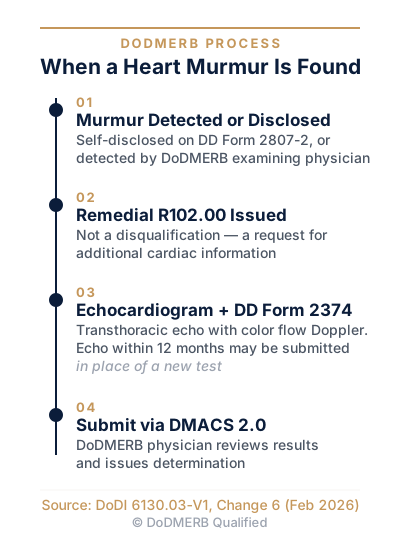
Both discovery paths — self-disclosure and examiner detection — lead to the same four-step process.
Related: DoDMERB Remedial vs. Disqualification Explained
The Echocardiogram: The One Test That Decides Everything
The transthoracic echocardiogram with color flow Doppler is the definitive diagnostic tool for evaluating heart murmurs in the DoDMERB process. No other test carries the same weight for this determination.
Color flow Doppler maps the direction and velocity of blood flow across every heart valve. It quantifies regurgitant jet size on a clinical scale: trace, mild, moderate, or severe. It identifies structural abnormalities including valve thickening, prolapse, stenosis, and septal defects. It shows DoDMERB exactly what the heart looks like and how it functions.
There are two outcomes:
Outcome A: The echo shows a structurally normal heart with no significant regurgitation or stenosis. Your student has no cardiac symptoms. DoDMERB designates the murmur as physiologic. Result: QUALIFIED.
Outcome B: The echo reveals valvular pathology that falls under DoDI 6130.03-V1 Section 6.11. Result: DISQUALIFIED. A waiver is possible but is a separate process decided by the commissioning program, not DoDMERB.
The vast majority of applicants with childhood innocent murmurs land at Outcome A. The echo confirms what the examining physician suspected: the heart is structurally normal, and the murmur is benign.
The cardiologist's report on DD Form 2374 must include the echo interpretation, the presence or absence of structural abnormality, the degree of any regurgitation (trace, mild, moderate, or severe), and a clinical assessment.
One important tip: ensure the cardiologist uses precise language on the form. If regurgitation is trace or trivial, the report should say "trace" specifically. A report that says "mild regurgitation" when the finding is actually trace could place your student on the wrong side of a disqualification threshold.
This determination is governed by DoDI 6130.03-V1, Change 6, February 3, 2026, Section 6.11.
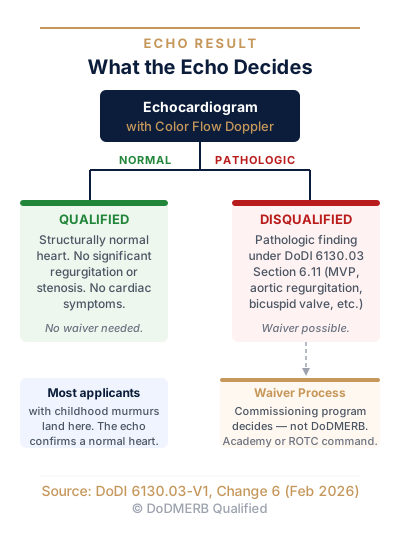
The echo result determines everything. Most applicants with childhood murmurs land on the left.
DoDI 6130.03 Disqualification Criteria for Valvular Heart Conditions
Section 6.11 of DoDI 6130.03-V1 governs all valvular heart conditions for military medical qualification. These are the specific thresholds DoDMERB physicians apply when reviewing your student's echocardiogram.
Valvular repair or replacement (6.11.a):
"History of valvular repair or replacement." — DoDI 6130.03, Section 6.11.a
Any surgery to repair or replace a heart valve is disqualifying regardless of current functional status.
Valvular conditions on echocardiogram (6.11.b):
"History of the following valvular conditions as listed in the current American College of Cardiology and American Heart Association guidelines and evidenced by echocardiogram within the last 12 months..." — DoDI 6130.03, Section 6.11.b
The echocardiogram must be within the past 12 months. Older studies do not satisfy this requirement. The following table summarizes the disqualification thresholds by valve and condition:
| Condition | DQ Threshold |
|---|---|
| Pulmonic regurgitation | Moderate or severe |
| Tricuspid regurgitation | Moderate or severe |
| Mitral regurgitation | Moderate or severe |
| Aortic regurgitation | Mild, moderate, or severe (no minimum threshold) |
| Mitral valve prolapse with MR | Mild or greater regurgitation |
| MVP with symptoms or medication | Any cardiopulmonary symptoms OR medical therapy |
Bicuspid aortic valve (6.11.c):
"Bicuspid aortic valve with any degree of stenosis or regurgitation or aortic dilatation." — DoDI 6130.03, Section 6.11.c
This is the strictest threshold in Section 6.11. Any stenosis, any regurgitation (including trace), or any aortic dilatation associated with a bicuspid aortic valve is disqualifying.
All valvular stenosis (6.11.d):
"All valvular stenosis." — DoDI 6130.03, Section 6.11.d
Any degree of stenosis in any heart valve is disqualifying. These thresholds exist because military service demands a heart that can sustain extreme physical stress without risk of sudden cardiac events.
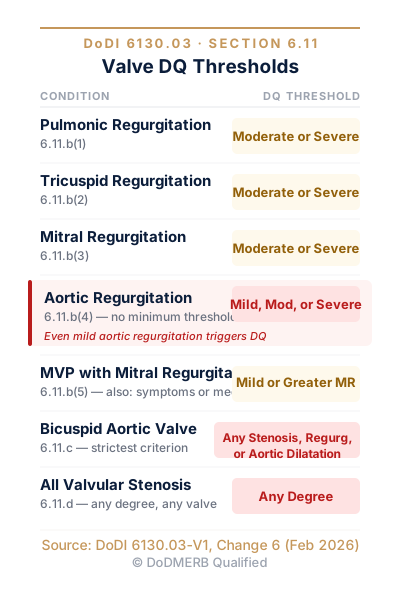
Aortic regurgitation stands apart — the only valve where mild severity triggers a disqualification under DoDI 6130.03-V1 Section 6.11.
Related: DoDMERB Waiver Process: Complete Guide
Mitral Valve Prolapse, Bicuspid Aortic Valve, and Edge Cases
Mitral valve prolapse and bicuspid aortic valve generate the most parent questions because the disqualification lines are counterintuitive.
Approximately 0.7% of healthy teens ages 13 to 19 have echocardiographic evidence of MVP. That sounds low, but across thousands of academy and ROTC applicants each year, MVP cases appear regularly in the DoDMERB pipeline.
Here is the key distinction. MVP alone, with no mitral regurgitation, no cardiopulmonary symptoms, and no medication, is NOT listed as disqualifying under Section 6.11. The condition only becomes disqualifying when MVP is associated with one of three factors listed in 6.11.b(5): mild or greater mitral regurgitation, cardiopulmonary symptoms, or medical therapy specifically for the condition.
The "trace" question comes up frequently. Trace regurgitation sits below mild on the clinical grading scale. DoDI 6.11.b specifies "mild or greater" as the disqualifying threshold. A cardiologist report documenting "trace mitral regurgitation" is clinically different from one that says "mild mitral regurgitation." The exact language on DD Form 2374 directly determines the outcome. About 35.7% of teens with MVP have associated mitral regurgitation, so roughly 1 in 3 MVP applicants will face the 6.11.b(5)(a) threshold.
Bicuspid aortic valve is governed by 6.11.c, the strictest criteria in the entire valvular section. The word "any" appears three times: any degree of stenosis, any regurgitation, or any aortic dilatation. This includes trace aortic insufficiency. There is no minimum threshold.
Waivers for bicuspid aortic valve and true valvular stenosis exist but are among the hardest cardiac waivers to obtain (isolated mild aortic regurgitation, discussed above, is the more favorably waived exception). The commissioning program (academy superintendent's office or ROTC command) decides. Athletic performance history and a favorable cardiologist opinion on functional capacity can support a waiver case, but families should have realistic expectations.
DoDMERB Qualified
Your student's echo shows a valvular finding. What does it actually mean for their commissioning path?
LTC Kirkland reviews DoDMERB heart condition cases and can help you understand whether a waiver is realistic before you invest time pursuing one.
The Bottom Line: What the Echo Tells You
The entire heart murmur question in DoDMERB comes down to a three-step decision tree.
-
Murmur detected or disclosed on medical history. DoDMERB issues remedial code R102.00 requesting an echocardiogram with color flow Doppler and DD Form 2374.
-
Echo shows a structurally normal heart with no significant valvular pathology and no cardiac symptoms. DoDMERB designates the murmur as physiologic. Your student is QUALIFIED. No waiver needed.
-
Echo reveals pathology that falls under DoDI 6130.03-V1 Section 6.11. Your student is DISQUALIFIED. A waiver is possible but difficult, and the commissioning program decides.
The vast majority of applicants with childhood innocent murmurs land at step 2. The echo confirms the heart is structurally normal, the remedial is closed, and the DoDMERB process moves forward.
What to Do Now
- If your student has an echocardiogram from within the past 12 months, gather it. You may not need a new one.
- If scheduling a new echo, request a transthoracic echocardiogram with color flow Doppler specifically.
- Ensure the cardiologist completes DD Form 2374 with precise language on regurgitation grade (trace, mild, moderate, or severe).
- If the echo is normal, submit promptly via DMACS 2.0. There is no reason to delay.
- If the echo shows a finding, identify exactly which Section 6.11 criterion applies before deciding next steps.
One final point: DoDMERB does NOT grant waivers. If your student receives a disqualification for a cardiac condition, the academy admissions office or ROTC battalion initiates the waiver review. Contact them directly to understand the timeline and what supporting documentation they need.
Frequently Asked Questions
These are the five questions parents ask most after learning about a heart murmur in the DoDMERB process.
Can my child be disqualified for a heart murmur they've had since childhood?
Only if the echocardiogram reveals structural pathology listed under DoDI 6130.03-V1 Section 6.11. An innocent childhood murmur paired with a normal echo results in a qualified designation. Murmur history alone does not trigger a disqualification.
What is DoDMERB remedial code R102.00?
R102.00 is DoDMERB's formal request for an echocardiogram with color flow Doppler and a completed DD Form 2374 from a cardiologist. It is not a disqualification. It is a request for additional diagnostic information. Most applicants with innocent murmurs complete the remedial and receive a qualified designation once results are submitted.
Does DoDMERB accept an echocardiogram my student already has?
Yes, if the echocardiogram was performed within the past 12 months. Submit the existing report along with a completed DD Form 2374 when you respond to the R102.00 remedial rather than scheduling a new test.
Is mitral valve prolapse automatically disqualifying for DoDMERB?
No. MVP alone is not disqualifying. MVP becomes disqualifying under DoDI 6130.03-V1 Section 6.11.b(5) when it is associated with mild or greater mitral regurgitation, cardiopulmonary symptoms, or medical therapy specifically for the condition. MVP with no regurgitation, no symptoms, and no medication does not appear in the disqualification criteria.
Who grants a medical waiver if my student is disqualified for a heart condition?
The commissioning program, not DoDMERB. The academy superintendent's office or ROTC command initiates and decides on medical waivers. DoDMERB determines medical qualification status only. Contact your student's admissions counselor or ROTC cadre directly to begin the waiver conversation. See the DoDMERB Waiver Process article for the full process.