Your student sought help for depression, and now you are wondering whether that decision disqualified them from a service academy or ROTC scholarship. It did not. A depression history DoDMERB disqualification is not automatic, and it is not permanent.
Among enlisted Army behavioral health waiver applicants between 2016 and 2020, 46% were approved. A 2021 RAND Corporation study of enlisted Army recruits found that those granted mental health waivers were not uniformly riskier than their peers — and in some cases performed better. Depression history is a regulatory hurdle, not a career-ending diagnosis.
Key Takeaways
- Depression triggers a DQ under five specific conditions in DoDI 6130.03, not automatically for any history of treatment
- The 36-month lookback on symptoms or treatment is the most common trigger, and the clock runs from the DoDMERB exam date
- Adjustment disorder vs. depressive disorder determines whether a 6-month or 36-month lookback applies
- Waivers are approved regularly with proper documentation, and waivered candidates perform on par with peers
What Actually Disqualifies: Depression DQ Criteria and the 36-Month Rule
Most families assume any depression diagnosis is disqualifying. The regulation lists five specific triggers, and only one needs to apply.
DoDI 6130.03 Section 6.28.f governs depressive disorder disqualification. Here is the verbatim standard:
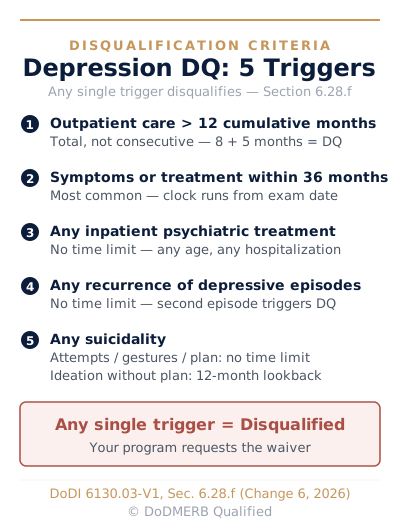
"Depressive disorder if: (1) Outpatient care including counseling required for longer than 12 cumulative months; (2) Symptoms or treatment within the previous 36 months; (3) The applicant required any inpatient treatment in a hospital or residential facility; (4) Any recurrence; or (5) Any suicidality (in accordance with Paragraph 6.28.m.)" (DoDI 6130.03, Section 6.28.f)
In plain terms, your child is disqualified if any one of these five conditions is true:
- Cumulative outpatient care exceeded 12 months. This counts total time in therapy or counseling, not consecutive months. Eight months of therapy, a break, then five more months equals 13 months cumulative.
- Any symptoms or treatment within the past 36 months. This is the most common trigger. A single therapy session 30 months ago counts.
- Any inpatient psychiatric treatment. No time limit. A hospitalization at age 12 still applies at age 18.
- Any recurrence. A second depressive episode at any point creates a separate DQ, regardless of when it happened.
- Any suicidality. This includes attempts, gestures, ideation with a plan (no time limit), or any suicidal ideation within the previous 12 months.
The 36-Month Lookback Deep Dive
The 36-month rule is the trigger most families can plan around. The clock runs from the DoDMERB exam date, not the application date. For academy applicants, the exam typically happens the summer before senior year. For ROTC candidates, the timing varies by program.
What counts toward the 36-month window: therapy appointments, counseling sessions, active prescriptions, and any treatment documented in medical records. What does not count: pastoral counseling, informal school guidance conversations not documented in medical records, and peer support groups without clinical oversight.
A separate 36-month rule exists under Section 6.28.w for psychotropic medications. Even if the depression itself resolved years ago, any antidepressant prescription within 36 months of the exam date triggers an independent DQ.
After this section, you should be able to identify which of the five DQ triggers applies to your child's specific history.
Adjustment Disorder vs. Depressive Disorder: The Diagnosis That Changes Everything
The difference between two diagnosis codes can mean a 6-month wait versus a 36-month wait. Most parents do not know which diagnosis is in their child's medical records, and that single detail shapes the entire DoDMERB pathway.
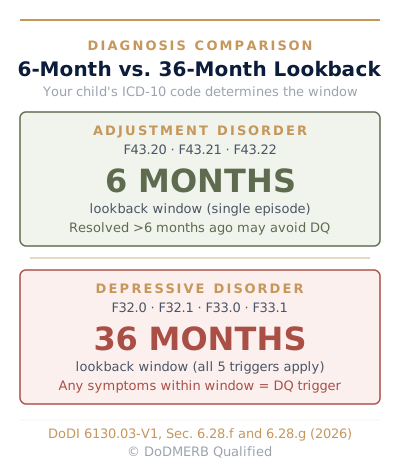
Adjustment Disorder (Section 6.28.g): 6-Month Lookback
Adjustment disorder is commonly diagnosed for situational depression triggered by a specific event: a parental divorce, a cross-country move, the death of a family member. The DoDI standard reads:
"History of a single adjustment disorder if treated or symptomatic within the previous 6 months, or any history of chronic (lasting longer than 6 months) or recurrent episodes of adjustment disorders." (DoDI 6130.03, Section 6.28.g)
A single episode that ended more than 6 months before the DoDMERB exam, with no recurrence, may not trigger a disqualification at all.
Depressive Disorder (Section 6.28.f): 36-Month Lookback
Major depressive disorder (MDD), persistent depressive disorder, and dysthymia all fall under the 36-month standard. The full five-trigger framework from Section 6.28.f applies. Any recurrence creates a DQ regardless of when the episodes occurred.
Check the Diagnosis Code
The answer is in your child's records. Pull the ICD-10 code from therapy or provider documentation:
| Factor | Adjustment Disorder | Depressive Disorder |
|---|---|---|
| ICD-10 Codes | F43.20, F43.21, F43.22 | F32.0, F32.1, F33.0, F33.1 |
| DoDI Section | 6.28.g | 6.28.f |
| Lookback Period | 6 months (single episode) | 36 months |
| Recurrence Impact | Any recurrence = DQ (no time limit) | Any recurrence = DQ (no time limit) |
| Typical Scenario | Situational response to a specific stressor | Persistent mood disorder without clear situational trigger |
Related: ADHD and DoDMERB: Waiver Guide for Parents
After this section, you should know your child's exact diagnosis code and which DoDI section governs their case.
How Your Child's Treatment History Affects Their Case
A candidate who saw a therapist for 10 sessions faces a fundamentally different situation than one who was prescribed an SSRI or hospitalized. Where your child falls on the treatment spectrum determines the complexity of the waiver path.
Therapy Without Medication
Therapy-only treatment is subject to Section 6.28.f or 6.28.g depending on the diagnosis, but it avoids the separate psychotropic medication DQ under Section 6.28.w entirely. A candidate who had brief therapy with no formal depressive disorder diagnosis, and whose treatment ended more than 36 months before the exam, may not trigger any DQ criteria. This is the cleanest scenario. The candidate must still disclose the history honestly on the DoDMERB questionnaire.
Medicated (SSRIs, SNRIs)
Medication introduces a second, independent DQ trigger. Section 6.28.w disqualifies any candidate with a psychotropic medication prescription within the previous 36 months, regardless of the underlying diagnosis.
"History of prescription with psychotropic medication within the previous 36 months, unless a shorter period is authorized in another standard." (DoDI 6130.03, Section 6.28.w)
A candidate prescribed Zoloft for six weeks two years ago faces DQ under both 6.28.f (symptoms/treatment within 36 months) and 6.28.w (psychotropic medication within 36 months). Two separate DQ codes on the same history.
Hospitalization and Suicidality
Inpatient psychiatric treatment triggers Section 6.28.y with no time limit. A hospitalization at any age remains on the record.
Suicidality is governed by Section 6.28.m:
"History of suicidality, including: (1) Suicide attempt(s); (2) Suicidal gesture(s); (3) Suicidal ideation with a plan; or (4) Any suicidal ideation within the previous 12 months." (DoDI 6130.03, Section 6.28.m)
Attempts, gestures, and ideation with a plan carry no time limit. Suicidal ideation without a plan has a 12-month lookback. The treating provider's documentation of the specific nature of the ideation matters enormously. Waivers are still possible even in these cases with properly documented packages.
After this section, you should understand where your child's treatment history falls on the spectrum and which DQ codes may apply.
Branch-Specific Waiver Rates and the 2026 Army Policy Shift
Waiver rates vary significantly by branch, and a January 2026 Army policy change may shift the landscape for depression waivers. Each branch's Surgeon General operates independently with different risk tolerances. A waiver denied by one branch can still be approved by another.
Army (46% Approval, 2016-2020)
The Army has the highest published behavioral health waiver approval rate among enlisted recruits — 46% approved between 2016 and 2020 (Walter Reed Army Institute of Research data). In January 2026, Secretary Driscoll decentralized waiver authority back to 2-star and 3-star commanders at Army Recruiting Command, reversing a 2020 directive that required Secretary-level sign-off. Faster processing times are expected for both enlisted and officer commissioning pathways.
Navy/Marine Corps and Air Force/Space Force
Neither the Navy nor Air Force publishes mental health waiver approval rates. Navy is generally considered more conservative. For AFROTC, the detachment commander must request the waiver, which then goes to the Air Education and Training Command Surgeon General.
USAFA has stated publicly that "prolonged, recurrent, or more severe diagnoses are unlikely to be considered waivable." Single-episode, fully resolved cases have the strongest prospects across all branches.
The Multi-Program Strategy
Each commissioning program has its own waiver authority. A DQ from the Air Force Academy does not affect a waiver request at West Point, the Naval Academy, or any ROTC program. Applying to multiple sources is one of the most effective strategies for candidates with depression history.
| Branch | Published Waiver Rate | 2026 Policy Changes | Notes |
|---|---|---|---|
| Army / USMA / Army ROTC | 46% enlisted recruits (2016-2020) | Driscoll directive decentralized authority | Most accommodating for mental health |
| Navy / USNA / NROTC | Not published | No announced changes | Generally more conservative |
| Air Force / USAFA / AFROTC | Not published | No announced changes | Detachment commander must initiate |
| Marine Corps | Not published | No announced changes | Falls under Navy medical authority |
DoDMERB Qualified
Not sure where your child's depression history stands with DoDMERB?
We evaluate your student's specific diagnosis, treatment timeline, and documentation against each branch's standards, so you stop guessing and start building the right file.
After this section, you should know which branches offer the strongest waiver prospects for your child's situation.
Documentation and Next Steps
The difference between a denied waiver and an approved one often comes down to documentation. Families who prepare before the DoDMERB exam consistently have stronger outcomes.
Essential Documents Checklist
Medical Records
- Complete therapy/counseling records with dates, session counts, and diagnosis codes
- Prescription history: medication names, dosages, start dates, stop dates
- Pharmacy records confirming last fill date for any psychotropic medication
- Hospital discharge summaries (if any inpatient treatment occurred)
- Supervised tapering documentation (if medication was discontinued)
Provider Documentation
- Provider letter addressing: diagnosis context, treatment summary, reason treatment ended, current stability, and fitness opinion
- Independent psychiatric evaluation from a provider with military background (if DQ is anticipated)
Functional Evidence
- Academic transcripts showing performance during and after treatment
- Athletic or extracurricular records demonstrating sustained high performance
The Provider Letter
Complete primary clinical records are the most important part of a depression waiver package — reviewers use them to judge whether the diagnosis was bona fide and whether the condition truly resolved, and a summary letter alone is weak. A strong provider letter is an important supplement to those records, not a substitute. It must address: the context of the diagnosis, why treatment concluded (not simply "patient stopped attending"), a current stability assessment, and an opinion on fitness for a high-stress military environment. Providers with military background or familiarity with DoDMERB standards write the most effective letters.
Where You Are Determines What to Do
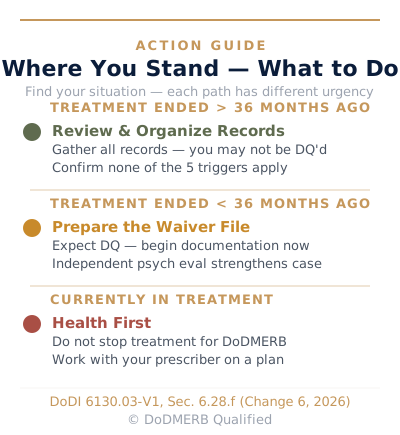
Treatment ended more than 36 months ago. Gather and organize all records at home. If cumulative outpatient care was under 12 months with no recurrence, hospitalization, or suicidality, your child may not be disqualified at all.
Treatment ended less than 36 months ago. Expect a DQ and prepare for the waiver process. Start assembling the documentation checklist immediately. An independent psychiatric evaluation from a military-background provider strengthens the package significantly.
Currently in treatment. Do not stop treatment for DoDMERB. Your child's health comes first. Work with the treating provider on an appropriate long-term plan.
Related: DoDMERB Waiver Process: Complete Guide
After this section, you should have a concrete action plan based on where your child currently stands in the treatment timeline.
Frequently Asked Questions
Can my child get into a service academy with depression history?
Yes. Between 2016 and 2020, 46% of enlisted Army behavioral health waivers were approved (Walter Reed Army Institute of Research data). A 2021 RAND study of enlisted Army recruits found that waivered candidates were not uniformly riskier than peers — and in some cases performed better. The key factors are timing, documentation, and the specific diagnosis.
Does therapy without medication still disqualify?
It can. If therapy occurred within 36 months under a depressive disorder diagnosis, Trigger 2 of Section 6.28.f applies. However, therapy-only treatment avoids the separate psychotropic medication DQ under Section 6.28.w, which simplifies the waiver path.
What is the difference between the 6-month and 36-month lookback?
Adjustment disorder (Section 6.28.g) carries a 6-month lookback for a single resolved episode. Depressive disorder (Section 6.28.f) carries a 36-month lookback. The ICD-10 diagnosis code in your child's records determines which standard applies. F43.x codes fall under the shorter window.
Does my child have to disclose depression on the DoDMERB questionnaire?
Always. Full disclosure is a baseline expectation for future military officers. Accurate reporting with strong supporting documentation is the standard. Integrity in the medical screening process reflects the same integrity expected throughout a military career.
Does an antidepressant prescription trigger a separate disqualification?
Yes. Section 6.28.w independently disqualifies any candidate with a psychotropic medication prescription within the previous 36 months. This applies even if the depression itself resolved years ago. A candidate can face DQ under both 6.28.f and 6.28.w simultaneously.
What if depression recurs during the application process?
Recurrence is a separate DQ trigger under Section 6.28.f(4), and it applies with no time limit. Your child's health must come first. Never defer necessary mental health treatment for DoDMERB. If a recurrence happens, work with the treating provider to document treatment and resolution thoroughly.