A psoriasis diagnosis does not automatically end your child's service academy or ROTC dreams. If your student was diagnosed with psoriasis at any point in childhood or adolescence, the fear of disqualification is real. But the regulation contains a carve-out that most families never learn about until it is too late to use it properly.
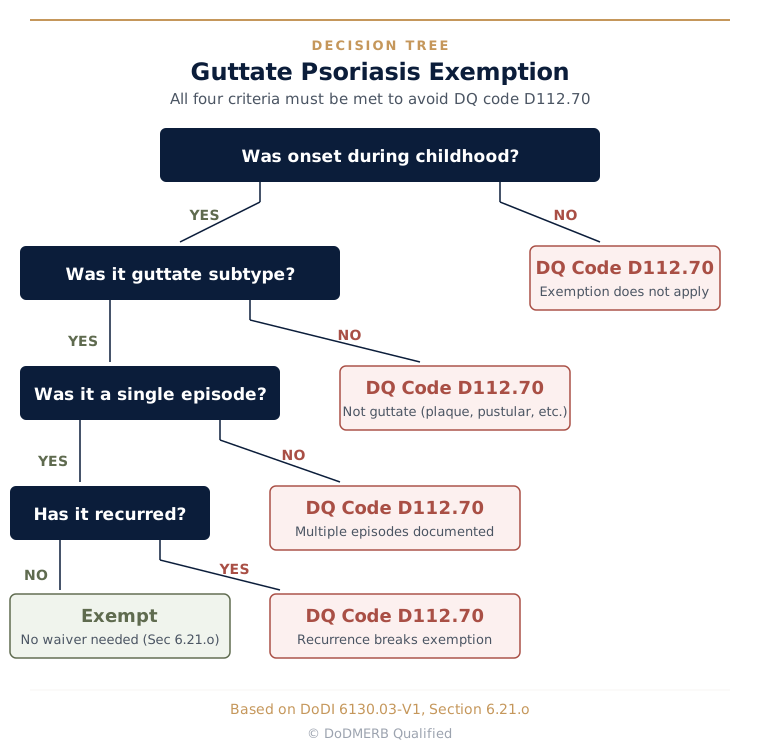
DoDI 6130.03 explicitly exempts one form of psoriasis from disqualification: non-recurrent childhood guttate psoriasis. Every other type, including chronic plaque psoriasis, is disqualifying under the dermatological standards. The difference between psoriasis and DoDMERB qualification comes down to clinical subtype, recurrence history, and how your dermatologist documents it.
Your student's path forward depends on three questions. Was the diagnosis guttate or plaque? Did it recur? What medications were prescribed? Section 6.21.w creates a second, independent disqualification for immunosuppressant medications that catches even guttate-exempt candidates.
Key Takeaways
- Non-recurrent childhood guttate psoriasis is explicitly exempted from disqualification under DoDI 6130.03, Section 6.21.o
- Chronic plaque psoriasis is disqualifying (DQ code D112.70), but waivers are available at some branches
- Biologic medications create an independent disqualification under Section 6.21.w, even if the psoriasis itself qualifies for the guttate exemption
- Branch policies vary significantly: USAFA classifies psoriasis as a "systemic disease" and bars waivers, while Navy and Army evaluate cases individually
- Documentation from a dermatologist before the DoDMERB exam determines whether your student's case is coded as exempt or disqualified
What DoDI 6130.03 Actually Says About Psoriasis
The disqualification standard for psoriasis is one sentence long, and every word in it matters. Most families read it once and assume their child is disqualified. A closer look reveals a deliberate exemption that changes the outcome for a specific subset of candidates.
The Verbatim Standard: Section 6.21.o
DoDI 6130.03-V1, Section 6.21.o states:
"History of psoriasis excluding non-recurrent childhood guttate psoriasis."
That single sentence contains two operative clauses. The first clause disqualifies. The second clause exempts.
What "Non-Recurrent Childhood Guttate" Actually Means
Break the exemption phrase into its four components:
- "Excluding" means the exemption is built into the standard itself. Your student does not need a waiver if they meet all four criteria. They are simply not disqualified.
- "Non-recurrent" means the condition occurred once and did not return. A single episode followed by complete resolution. If your student had a second flare, even a mild one, the exemption no longer applies.
- "Childhood" means onset before adulthood. The regulation does not define a specific age cutoff, but clinical literature and DoDMERB reviewers interpret this as onset during the pediatric years.
- "Guttate" means the specific clinical subtype characterized by small, drop-shaped lesions. Not plaque. Not pustular. Not inverse. Only guttate.
All four criteria must be met simultaneously. Miss one and the exemption collapses.
Why This Distinction Changes Everything
The DQ code assigned to psoriasis is D112.70. If your student's records clearly document a single episode of childhood guttate psoriasis with no recurrence, the examiner should not apply this code. Vague records force the examiner to default to the disqualifying interpretation.
After this section, you should understand the exact regulatory language and know whether your student's psoriasis subtype potentially qualifies for the guttate exemption.
The Medication Trap: Section 6.21.w and Immunosuppressant Disqualification
Your student's psoriasis may qualify for the guttate exemption, but their treatment history can disqualify them independently. This is the double-DQ scenario that blindsides families who focus exclusively on the psoriasis diagnosis itself.
The Second Disqualification Nobody Mentions
Section 6.21.w establishes a separate standard that applies to any dermatologic condition, not just psoriasis:
"History of any dermatologic condition severe enough to warrant use of systemic steroids for greater than 2 months, or any use of other systemic immunosuppressant medications."
"Any use" of systemic immunosuppressant medications. No duration threshold. No minimum dosage. A single prescription fills the criterion.
Which Medications Trigger Section 6.21.w
Biologic medications commonly prescribed for moderate-to-severe psoriasis fall squarely under Section 6.21.w. These include adalimumab, etanercept, ustekinumab, secukinumab, and other TNF inhibitors or interleukin blockers. Methotrexate and cyclosporine also qualify as systemic immunosuppressants.
Systemic steroids such as prednisone trigger the standard only if prescribed for longer than two months. Topical steroids, phototherapy, and topical non-steroidal treatments generally do not trigger Section 6.21.w.
How Treatment History Affects Guttate-Exempt Candidates
If your student's guttate psoriasis was treated with topical corticosteroids alone, Section 6.21.w is unlikely to apply. If a dermatologist prescribed systemic medications, the treatment history must be evaluated separately from the diagnosis. Audit every prescription before the DoDMERB exam to identify potential 6.21.w exposure.
After this section, you should be able to identify whether your student's treatment history creates an independent medication-based disqualification separate from the psoriasis diagnosis itself.
Guttate vs Plaque Psoriasis: Why the Clinical Distinction Drives the DoDMERB Outcome
The difference between guttate and plaque psoriasis is not academic. It determines whether your student walks through an exemption or faces a waiver process. DoDMERB examiners rely on the clinical subtype documented in your student's medical records to decide which regulatory pathway applies.
Childhood Guttate Psoriasis: The Exemption Path
Guttate psoriasis presents as small, drop-shaped scaly papules typically 2 to 6 millimeters in diameter. The lesions appear primarily on the trunk and proximal extremities. In children, onset is frequently triggered by a streptococcal throat infection occurring two to four weeks prior.
The prognosis data cited in Section 2 favors candidates. Strep-triggered guttate psoriasis carries the best prognosis for non-recurrence, which is the exact criterion DoDI 6130.03 requires for exemption.
Chronic Plaque Psoriasis: The Waiver Path
Plaque psoriasis presents as larger, well-demarcated erythematous plaques with silvery scale, typically on the knees, elbows, and lower back. Unlike guttate, plaque psoriasis is persistent and lifelong in most cases. There is no exemption for plaque psoriasis under Section 6.21.o.
Candidates with plaque psoriasis receive DQ code D112.70 and must pursue a waiver. The waiver outcome depends on current disease activity, treatment requirements, and branch-specific policies covered in the next section.
Psoriatic Arthritis: The Compounding Disqualifier
Psoriatic arthritis affects approximately 30% of psoriasis patients. It is independently disqualifying under the musculoskeletal standards in DoDI 6130.03 and cannot be waived through the dermatological pathway. Candidates with both conditions face two separate disqualifications under two separate regulatory sections, each requiring its own waiver.
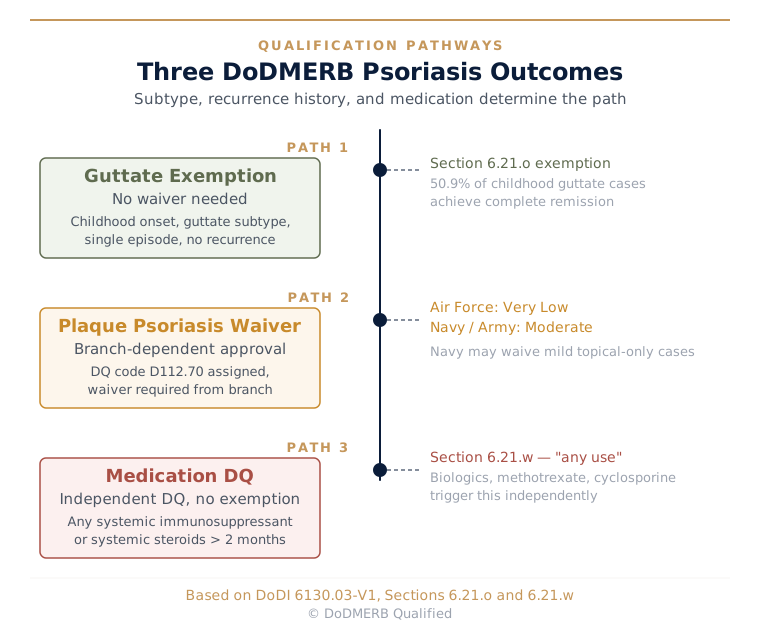
After this section, you should know which clinical subtype applies to your student and whether the exemption path, the waiver path, or a compounding-DQ scenario is in play.
Branch-Specific Psoriasis Policies for Academies and ROTC
Not all branches evaluate psoriasis waivers the same way. The DoDI 6130.03 standard is uniform across services, but waiver authority and institutional appetite for granting waivers vary significantly. Your student's target branch shapes the realistic probability of a favorable outcome.
Air Force: The Hardest Path
USAFA explicitly classifies psoriasis as a "systemic disease," which places it in a higher-risk category for waiver consideration. This classification effectively bars most psoriasis waivers for Air Force Academy candidates. AFROTC follows the same medical standards.
Navy and Marines: Topical-Only Cases Have a Chance
The Navy may waive mild psoriasis cases controlled exclusively by topical steroids. USNA and NROTC candidates with documented mild disease, no systemic medication history, and clear current skin exams have a moderate probability of waiver approval. The Marines follow Navy medical standards for commissioning.
Army: Case-by-Case Reality
West Point and AROTC evaluate psoriasis waivers on a case-by-case basis with no blanket prohibition. The Army weighs current functional status and treatment burden more heavily than diagnosis history alone.
| Branch | Academy Policy | ROTC Policy | Waiver Likelihood |
|---|---|---|---|
| Air Force / USAFA | Bars waivers ("systemic disease") | AFROTC same standard | Very Low |
| Navy / USNA | May waive mild topical-only cases | NROTC similar | Moderate |
| Army / West Point | Case-by-case evaluation | AROTC case-by-case | Moderate |
| Marines | Case-by-case, Navy medical standards | N/A | Moderate |
After this section, you should know which branches offer a realistic waiver path for your student's specific psoriasis profile.
The Documentation Playbook: What Your Dermatologist Letter Must Include
The documentation your dermatologist produces before the DoDMERB exam is the single most influential variable in your student's outcome. A well-constructed dermatologist letter can establish guttate exemption eligibility or build a compelling waiver case. A vague or incomplete letter forces the DoDMERB reviewer to default to the disqualifying interpretation.
Timing: Why You Document Before the Exam, Not After
Schedule a dermatologist evaluation before the DoDMERB exam, not after a disqualification. Proactive documentation gives the examiner evidence to support the guttate exemption at first review. Reactive documentation after a DQ adds months to the timeline.
The Evidence Checklist
Medical Records
Gather all records from every provider who evaluated or treated the psoriasis, including pediatricians, dermatologists, and urgent care visits. Pull pharmacy records separately to identify every prescription filled.
Photography
Collect clinical photographs from the initial episode showing lesion morphology. Current photographs of clear skin demonstrate resolution.
Lab Work
Strep titers or throat culture results from onset strengthen the guttate diagnosis. ASO (antistreptolysin O) titers directly support the strep-triggered guttate classification.
What the Dermatologist Letter Must Say
The letter must explicitly address all ten of the following elements:
- Specific diagnosis: guttate psoriasis, not "psoriasis" or "psoriasis NOS"
- Age at onset: confirms childhood presentation
- Triggering event: streptococcal infection or other identified trigger
- Number of episodes: confirms a single episode with no recurrence
- Date of last episode: establishes the duration of remission
- Complete treatment history with durations: every medication, route, and length of use
- Current skin exam findings: documents clear skin on physical examination
- Prognosis for recurrence: physician's clinical opinion on likelihood of future flares
- Statement on functional limitations: confirms no limitations for military service
- Physician credentials: board certification, fellowship training, and any military medical background
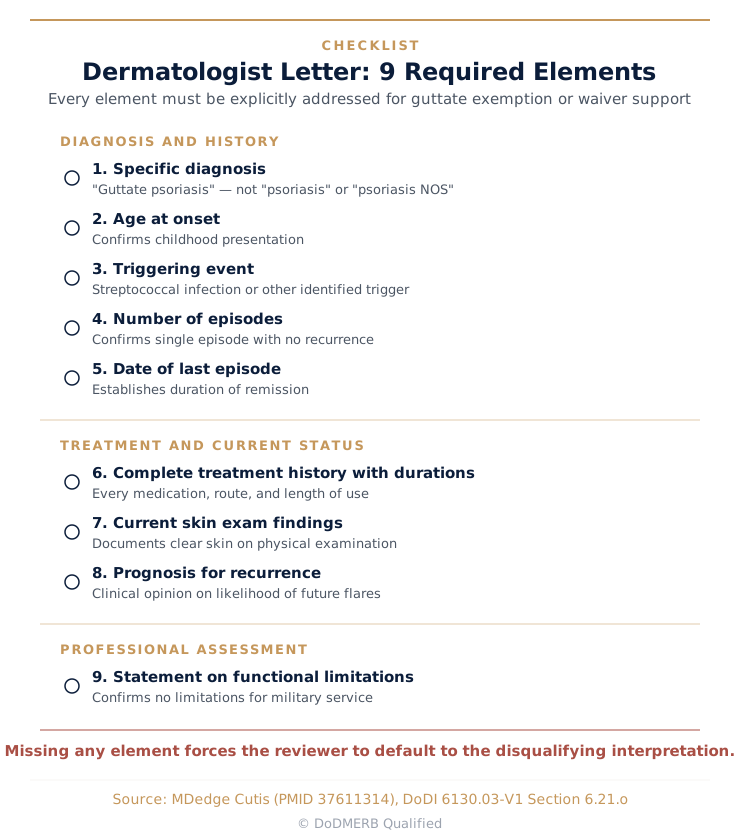
After this section, you should have a clear checklist for dermatologist documentation and understand why the letter must be completed before the DoDMERB exam.
DoDMERB Qualified
Unsure if your student's psoriasis history qualifies for the guttate exemption?
We evaluate your student's specific diagnosis, treatment history, and documentation against DoDI 6130.03 standards, so you have a clear path before the DoDMERB exam.
DoDMERB vs MEPS: Why Academy and ROTC Candidates Face a Different Process
If you are researching psoriasis waivers online, most of what you find applies to the wrong system. Academy and ROTC candidates go through DoDMERB. Enlisted recruits go through MEPS. The medical standards in DoDI 6130.03 are the same, but the waiver authorities, review processes, and approval rates differ.
Two Systems, Two Standards
DoDMERB serves the service academies, ROTC programs, and certain scholarship candidates. The waiver authority rests with each academy superintendent or ROTC command, not with MEPS or USMEPCOM. Your student's waiver request goes to decision-makers who evaluate officer candidates specifically, not to the enlisted processing system.
At DoDMERB Qualified, we work exclusively with academy and ROTC families.
Why Enlisted Waiver Data Misleads Academy Families
Enlisted waivers consider different role requirements, deployment profiles, and institutional risk tolerances than officer accession waivers.
After this section, you understand why your student's DoDMERB process is distinct from the enlisted MEPS pipeline and why enlisted waiver data should not inform your expectations.
Frequently Asked Questions
Can my child join a military academy with psoriasis?
It depends on the subtype. Non-recurrent childhood guttate psoriasis is explicitly exempted under DoDI 6130.03. Chronic plaque psoriasis is disqualifying but potentially waiverable depending on the branch and disease severity.
Is guttate psoriasis disqualifying for DoDMERB?
Not if it meets all four exemption criteria: childhood onset, guttate subtype, single episode, and no recurrence. If any criterion is unmet, standard disqualification under D112.70 results.
Does using a biologic medication for psoriasis disqualify my child?
Yes. Section 6.21.w disqualifies "any use of other systemic immunosuppressant medications" with no duration threshold. A single course of a biologic creates an independent disqualification separate from the psoriasis diagnosis.
Can USAFA waive psoriasis?
USAFA classifies psoriasis as a "systemic disease" and effectively bars waivers. The Air Force Academy is the most restrictive branch for psoriasis candidates. Navy and Army offer more realistic waiver paths.
Should we see a dermatologist before or after the DoDMERB exam?
Before. A dermatologist letter documenting guttate exemption criteria or building a waiver case is far more effective when presented proactively. Waiting until after a DQ adds months to the timeline.
Does psoriatic arthritis affect DoDMERB qualification?
Yes. Psoriatic arthritis is independently disqualifying under the musculoskeletal standards in DoDI 6130.03. It creates a compounding disqualification for candidates who also have psoriasis.
Should we disclose psoriasis history on the DoDMERB questionnaire?
Yes. Full disclosure is essential. Inconsistencies discovered later during remedial requests, provider records submitted during the waiver process, or documentation from dermatologist letters can create serious credibility problems. Omitting a documented condition risks permanent disqualification for fraudulent appointment.