Thirty-five percent of patients clinically diagnosed with pneumonia had a negative chest X-ray. If the "pneumonia" in your student's medical chart was never confirmed on imaging, it may not count at all under DoDMERB rules.
DoDI 6130.03 contains two separate pneumonia disqualification criteria, and most families confuse them. Section 6.10.c is a simple timing issue: pneumonia within the previous three months. Section 6.10.d triggers a medical investigation: two or more episodes within 18 months after the 13th birthday. The two rules look nothing alike, carry different consequences, and require completely different responses.
Approximately 20% of DoDMERB applicants receive a disqualification each year, roughly 6,000 students. A DQ is not a denial. Officer candidate waiver approval rates have trended upward in recent years. This article breaks down both pneumonia rules, explains what actually qualifies as "pneumonia" in DoDMERB's eyes, and gives you the documentation playbook for each scenario.
Key Takeaways
- 35% of clinical pneumonia diagnoses had a negative chest X-ray. If your student's episode was never confirmed on imaging, it may not meet the DoDI standard for "infectious pneumonia."
- The 3-month rule (6.10.c) is the easiest respiratory DQ to clear. It resolves with time, not medical workup.
- Episodes before age 13 do not count toward the recurrent pneumonia threshold, regardless of number or severity.
- Bronchitis and upper respiratory infections are not pneumonia under DoDI 6130.03. They do not count toward the two-episode rule.
- If asthma is identified as the underlying cause of recurrent pneumonia, your student faces two separate disqualifications (6.10.d and 6.10.e), both of which must be addressed in the waiver packet.
- Officer candidate waiver approval rates have trended upward in recent years. A DQ is not a denial.
The 3-Month Rule — When Timing Is All That Matters
Section 6.10.c is the most common pneumonia DQ trigger and the easiest one to clear. This rule is purely time-based. Once three months pass from resolution, it drops away completely.
"Infectious pneumonia within the previous 3 months." — DoDI 6130.03, Section 6.10.c
The standard is straightforward. If your student had pneumonia and three months have elapsed before the DoDMERB exam, this criterion does not apply. No workup required. No waiver needed.
Timing typically works in the applicant's favor. DoDMERB exams are triggered in the summer or fall of senior year, and processing takes six to eight weeks after the exam date. A student who had pneumonia in winter or spring of junior year has usually cleared the three-month window before any physician reviewer sees the file.
Consider the tighter scenario: your student had pneumonia in August and the DoDMERB exam is in September. DoDMERB issues a DQ per the regulation. But by the time the physician reviewer processes the file (another six to eight weeks), the 90-day mark has likely passed. DoDMERB then issues a remedial requesting confirmation of resolution from the primary care provider. If the student is clear, they qualify at the DoDMERB level.
The practical takeaway: if pneumonia occurred more than three months before the exam, this rule does not apply. If it falls within three months, treat it as a temporary hold, not a permanent barrier. The DQ resolves once the window closes and the treating physician confirms full resolution.
The Recurrent Pneumonia Rule — Two Episodes, Bigger Stakes
Section 6.10.d is the rule that triggers a real medical investigation, and it is the one where documentation strategy matters most.
"History of recurrent (2 or more episodes within an 18-month period) infectious pneumonia after the 13th birthday." — DoDI 6130.03, Section 6.10.d
Three conditions must ALL be met for this rule to apply:
- Two or more episodes of infectious pneumonia
- Both episodes within an 18-month period
- Both episodes after the 13th birthday
If any one of those conditions is missing, 6.10.d does not trigger. Episodes before age 13 do not count, no matter how many or how severe. Two episodes 19 months apart do not qualify. A single episode, regardless of severity, does not meet the threshold.
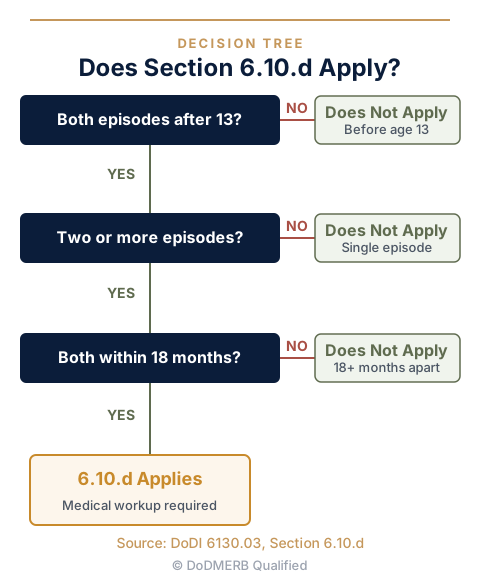
All three conditions must be met simultaneously. Miss one and the rule does not apply.
Why does this rule exist? Waiver authorities are not concerned about pneumonia itself. They want to know whether recurrent pneumonia signals something underlying: asthma, immune deficiency, or a structural lung issue. The question is whether the pattern reflects bad luck or a condition that would affect military readiness. As one prominent pediatric pulmonologist noted in a 30-year retrospective, he had "never observed recurrent bacterial pneumonia in an otherwise normal child." The vast majority of cases traced to hypersecretory asthma, where excess bronchial secretions created radiographic densities misread as consolidation.
| 3-Month Rule (6.10.c) | Recurrent Rule (6.10.d) | |
|---|---|---|
| Trigger | Single episode within 3 months | 2+ episodes in 18 months |
| Age Requirement | None | After age 13 |
| Nature | Time-based only | Triggers investigation |
| Resolution | Clears with time | Requires workup |
| Waiver Path | PCM confirmation of resolution | Specialist evaluation, underlying cause |
Related: Respiratory Conditions and DoDMERB
Was It Really Pneumonia? Why the Official Diagnosis Matters
This is the most important distinction most families miss: not every respiratory illness labeled "pneumonia" actually qualifies as pneumonia under DoDI 6130.03.
The regulation uses the term "infectious pneumonia." In practice, whether an episode counts turns on whether the medical record actually documents pneumonia (typically radiographic infiltrates or consolidation on chest X-ray), not just a clinical label. Bronchitis and upper respiratory infections do not produce infiltrates. They do not count.
Here is the clinical distinction:
- Pneumonia infects the lung tissue itself (the alveoli) and produces infiltrates or consolidation visible on chest X-ray.
- Bronchitis inflames the airways (bronchial tubes) and typically shows a clear X-ray or minor airway thickening. No infiltrates.
- Upper respiratory infection (URI) involves the upper airway only. No lung involvement whatsoever.
The 35% statistic matters here. In peer-reviewed research, 35% of patients clinically diagnosed with pneumonia had a negative chest X-ray. The medical literature confirms it is "nearly impossible to determine based on clinical grounds" whether a respiratory illness is bronchitis or pneumonia without imaging. Clinical diagnosis and radiological diagnosis do not always align, and it is the radiological finding that determines whether an episode counts under DoDI 6130.03.
This means the label in your student's chart may not tell the full story. A physician who wrote "pneumonia" based on clinical symptoms alone, without ordering imaging, may have documented a diagnosis that does not meet the DoDI standard.
Pull the medical records for every episode labeled "pneumonia." Look for two things: a chest X-ray report and whether infiltrates or consolidation were documented. If no imaging was done or the imaging was negative, that episode may not count toward the 6.10.d threshold. A clarifying letter from the treating physician can formalize this distinction.
What Waiver Authorities Really Want to Know
For recurrent pneumonia under 6.10.d, the waiver decision comes down to a single question: is there an underlying condition that would affect military readiness?
The most common underlying causes of recurrent pneumonia in teenagers, drawn from peer-reviewed pediatric pulmonology research:
- Asthma or airway hyperresponsiveness: 15.9% to 79% of cases, depending on the study
- Aspiration-related causes: 14% to 48%
- Immune deficiency: 10% to 16.5%
- Structural abnormalities (congenital malformations, ciliary dyskinesia): a smaller percentage
In a hospital survey of nearly 3,000 children, only 8% met the criteria for recurrent pneumonia, and 92% of those had an identifiable underlying illness. The clinical literature strongly suggests that true recurrent bacterial pneumonia in an otherwise healthy teenager is rare. Most cases trace to asthma, where excess bronchial secretions create radiographic densities that mimic consolidation.
A pulmonologist evaluation should address each of these possibilities. The narrative letter from the specialist needs to cover whether asthma has been ruled out (or documented as controlled and medication-free), whether immune function is normal, whether pulmonary function testing is normal, and whether any structural abnormality exists. The letter should conclude with a clear statement: underlying cause identified or ruled out, current lung function normal, no barrier to vigorous physical activity.
The compound DQ risk is real. If a pulmonologist identifies asthma as the underlying cause of recurrent pneumonia, your student faces two disqualifications: 6.10.d (recurrent pneumonia) and 6.10.e (airway hyperresponsiveness after age 13). Both must be addressed in the waiver packet. Start with current pre/post-bronchodilator spirometry and complete clinical records. DoDMERB or the waiver authority will request a methacholine challenge if needed.
Related: DoDMERB Methacholine Challenge Test: What Waiver Authorities Are Actually Looking For
The worst case is uncommon but worth noting. If the workup reveals a primary immunodeficiency such as CVID or complement deficiency, that condition may not be waiverable. It is a retention disqualifier. But most recurrent pneumonia in otherwise healthy teenagers traces to asthma, which is waiverable with proper documentation.
DQ Is Not Denial — How the Waiver Process Works
The most common emotional mistake parents make is treating a disqualification as a final answer. It is not. A DQ is the start of a process, and the waiver authority, not DoDMERB, makes the final call.
Three terms that mean three different things:
- DQ (disqualification): DoDMERB determines the applicant does not currently meet the medical standard per DoDI 6130.03.
- Waiver: The commissioning source (academy or ROTC program) reviews the full file and decides whether to grant an exception.
- Denial: The waiver authority declines to grant the exception. This is the actual end of the road for that program.
DoDMERB does not make waiver decisions. Each commissioning source has its own waiver authority:
- Army ROTC: Cadet Command Surgeon, Fort Knox
- Navy: Bureau of Navy Medicine and Surgery (BUMED)
- Air Force ROTC: AETC Surgeon General
- Each academy has its own separate waiver authority
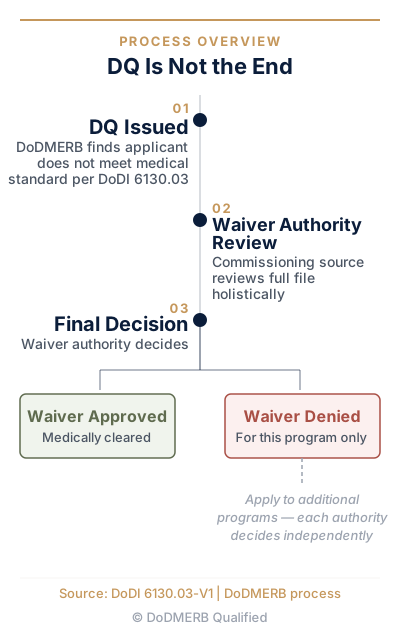
DoDMERB determines qualification status. The commissioning source — not DoDMERB — decides whether to grant a waiver.
Waivers are initiated by the commissioning source for applicants who are competitive for an appointment or scholarship. The applicant does not request a waiver directly. A strong overall application is the prerequisite for a waiver being considered.
Five factors drive waiver approval: the condition itself, severity, recency, competitiveness of the overall application, and service-specific force needs. For resolved pneumonia with proper documentation, all five factors typically favor approval.
The trend supports this. Officer candidate waiver approval rates have trended upward in recent years, and a DQ is only the beginning of that process.
For more on the distinction between remedials and disqualifications, see our DoDMERB Remedial vs. Disqualification guide.
DoDMERB Qualified
Trying to understand where your student's pneumonia history puts them?
Our team reviews the full medical picture and advises on the documentation strategy before a Remedial arrives.
Your Documentation Checklist
Convert anxiety into organized action. The documentation you need depends on which rule applies to your student's situation.
For a Single Episode (Section 6.10.c)
- Medical records from the pneumonia episode (diagnosis, treatment, resolution)
- Chest X-ray report from the episode (if available)
- Follow-up visit documentation confirming full recovery
- Physician letter confirming complete resolution, no residual findings, no current treatment
- Note confirming the episode date vs. DoDMERB exam date (greater than 3 months)
For Recurrent Pneumonia (Section 6.10.d)
- Records from every episode (including chest X-ray report for each)
- Confirmation that each episode had documented radiographic infiltrates (if not, physician clarification letter)
- Pulmonologist evaluation and narrative letter addressing underlying cause
- Pulmonary function test results
- If asthma found: current control documentation, medication history, pre/post-bronchodilator spirometry, and challenge test results if requested
- If immune workup done: immunoglobulin levels, lymphocyte subsets, complement studies
- Evidence of wellness periods between episodes (normal growth, normal exam findings)
Academy vs. ROTC — How Timing Changes the Equation
The timeline difference between academy and ROTC programs directly affects your waiver strategy.
Academy applicants face a compressed schedule. The DoDMERB exam happens in the fall of senior year. If a DQ is issued, the waiver review must be completed by approximately April 15. For a recurrent pneumonia case requiring specialist workup, pulmonary function testing, and a narrative letter, that timeline is tight.
ROTC applicants typically have more runway. The waiver deadline extends to December of the freshman year. That extra time can be the difference between a rushed, incomplete packet and one that addresses every question the waiver authority will ask.
The strategic takeaway: apply to multiple programs across services. Each waiver authority makes independent decisions. A "no" from one does not affect the others. ROTC's longer timeline can serve as a safety net when the academy timeline is too compressed for a full recurrent pneumonia workup.
One DoDMERB exam covers all applications. Exams are valid for two years (extended to four after contracting), so a single exam serves both academy and ROTC applications simultaneously.
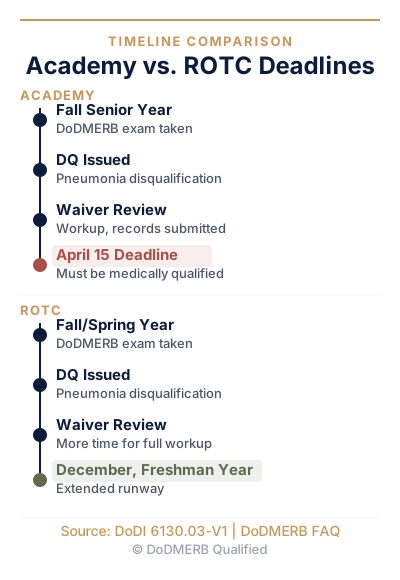
Academy applicants have a compressed window from fall exam to April 15. ROTC applicants have until December of their freshman year.
The Bottom Line
-
A single pneumonia episode more than 3 months before the exam is typically not a barrier. This is the easiest respiratory DQ to clear.
-
Even within the 3-month window, the DQ resolves with time. A physician confirmation of resolution is all that is needed once the window closes.
-
Recurrent pneumonia (2+ episodes, 18 months, after age 13) triggers a deeper investigation. The waiver path is clear: document the underlying cause (or its absence), demonstrate current health, and submit specialist records.
-
Check the records. Bronchitis and URI do not count. If an episode was labeled "pneumonia" without imaging confirmation, it may not meet the DoDI standard.
-
A DQ is not a denial. Officer candidate waiver approval rates have trended upward in recent years.
-
Apply to multiple programs. Each waiver authority decides independently.
Pneumonia is a navigable DoDMERB problem. The families who struggle are the ones who do not understand what the waiver authority is actually evaluating. Now you do.
At DoDMERB Qualified, we work with families whose students have respiratory histories requiring a structured waiver approach. LTC Robert Kirkland (Ret.), our lead consultant, walks families through the documentation strategy and waiver preparation process. DoDMERB Consulting engagements start at $800.
Contact us about DoDMERB Consulting →
Frequently Asked Questions
My son had pneumonia once at age 15. Does that automatically disqualify him?
No. A single episode does not trigger the recurrent rule (6.10.d). If it was more than 3 months before the DoDMERB exam, 6.10.c does not apply either. Disclose it honestly, keep records organized, and expect that a single resolved episode is typically not a barrier at the DoDMERB level.
Does bronchitis count the same as pneumonia for the two-episode rule?
No. DoDI 6130.03 uses the term "infectious pneumonia," which requires radiographic infiltrates on chest X-ray. Bronchitis inflames the airways, not the lung tissue, and shows no infiltrates on imaging. It does not count toward the 6.10.d threshold.
Do pneumonia episodes before age 13 count?
No. Section 6.10.d explicitly applies only "after the 13th birthday." Episodes before age 13 do not count regardless of number or severity.
My daughter had pneumonia in January and her DoDMERB exam is in March. What should we do?
Gather full documentation of recovery and keep it ready. When DoDMERB issues a remedial, respond with the physician's confirmation of complete resolution. By the time a physician reviewer sees the file (six to eight weeks after the exam), the 3-month window has typically closed.
What is the difference between a DQ and a denial?
A DQ means DoDMERB found the applicant does not currently meet the medical standard. A denial means the waiver authority reviewed the case and declined to grant an exception. A DQ is the beginning of a process. A denial is the outcome of that process. Many DQ'd applicants receive waivers.