Your student's eczema cleared up years ago, but the prescription that treated it may still disqualify them from a service academy or ROTC scholarship. DoDMERB does not evaluate eczema DoDMERB cases based on current skin condition. It evaluates treatment history. A prescription filled at age 12 can trigger a disqualification at 17, even with clear skin.
Eczema carries an approximate 26% waiver approval rate, compared to 84% for orthopedic injuries. Whether this becomes a roadblock depends on what was prescribed, when, and whether lesions are visible at exam.
One parent we worked with at DoDMERB Qualified learned their student's single course of Dupixent at age 13 triggered a permanent disqualification code. No lookback window. No waiting it out. The DQ was immediate.
Key Takeaways
- Three separate DQ codes can trigger from eczema history (D111.10, D111.11, D112.20), each with different lookback windows
- The 36-month lookback applies to prescription topical treatment. Systemic immunosuppressants like Dupixent have NO time limit.
- Dupixent (dupilumab) triggers D112.20 permanently, even if used once years ago
- OTC moisturizers and hydrocortisone 1% do NOT trigger disqualification
- Waiver approval rates vary significantly by branch. USAFA is the strictest for skin conditions.
- Proper dermatologist documentation is the single biggest controllable factor in a waiver decision
How Eczema Triggers a DoDMERB Disqualification: Codes, Criteria, and Treatments
A single eczema history can trigger up to three DoDMERB disqualification codes simultaneously. Each code has different lookback windows, different treatment triggers, and different waiver implications. Understanding which code applies to your student is the first step in building an effective response.
The Three Disqualification Codes
D111.10 (Section 6.21.d) covers atopic dermatitis and eczema directly:
"History of atopic dermatitis or eczema requiring treatment other than over-the-counter hydrocortisone or moisturizer therapy in the last 36 months or with active lesions or residual hyperpigmented or hypopigmented areas at the time of the entrance examination." — DoDI 6130.03, Section 6.21.d
This is the most common eczema DQ code. It triggers from either prescription treatment within 36 months OR visible skin findings at the exam.
D111.11 (Section 6.21.e) covers recurrent non-specific dermatitis, which catches contact and dyshidrotic eczema patterns:
"History of recurrent or chronic non-specific dermatitis within the last 24 months, including contact (irritant or allergic) or dyshidrotic dermatitis requiring treatment other than over-the-counter medication." — DoDI 6130.03, Section 6.21.e
This code has a shorter 24-month lookback but applies to broader dermatitis diagnoses that may overlap with eczema.
D112.20 (Section 6.21.w) covers systemic treatment and carries no time limit:
"History of any dermatologic condition severe enough to warrant use of systemic steroids for greater than 2 months, or any use of other systemic immunosuppressant medications." — DoDI 6130.03, Section 6.21.w
This is the most serious code. Any use of a systemic immunosuppressant, ever, at any age, triggers D112.20.
Treatment Classification
| Treatment | DQ Code Triggered | Lookback Period |
|---|---|---|
| OTC hydrocortisone 1%, moisturizers | None | N/A |
| Phototherapy, wet wraps | None | N/A |
| Prescription topical steroids | D111.10 | 36 months |
| Tacrolimus (Protopic), pimecrolimus (Elidel) | D111.10 | 36 months |
| Dupilumab (Dupixent) | D112.20 | No time limit |
| JAK inhibitors (Cibinqo, Rinvoq) | D112.20 | No time limit |
| Cyclosporine, methotrexate, azathioprine | D112.20 | No time limit |
| Systemic steroids >2 months | D112.20 | No time limit |
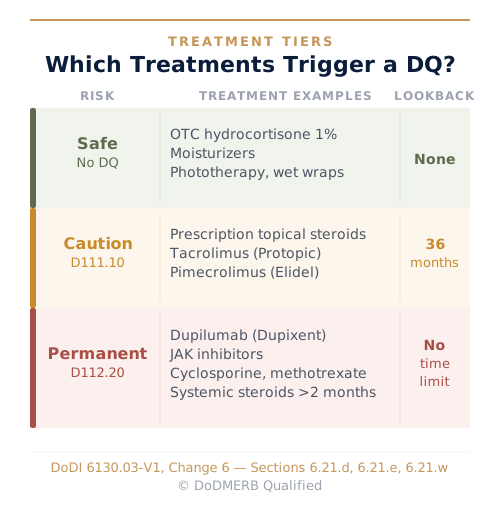
After this section, you can identify which DQ code(s) apply to your student's treatment history.
Why the Military Disqualifies for Eczema
The military does not care what eczema looks like today. It cares what happens when someone with an eczema history receives a smallpox vaccine in a desert deployment zone.
Eczema Vaccinatum
Smallpox vaccination is required for certain military deployments. In individuals with a history of atopic dermatitis, even resolved cases, the smallpox vaccine can cause eczema vaccinatum. This is a life-threatening disseminated vaccinia infection that spreads across areas of skin previously affected by eczema. It is the core historical rationale behind the military's strict eczema disqualification standard.
Deployment Environment
Operational conditions compound the risk. Extreme heat, prolonged wear of body armor creating friction zones, limited hygiene in field environments, and sustained physiological stress all trigger eczema flares. Biologics like Dupixent require cold-chain refrigeration, making them impractical for sustained field operations.
The Evolving Debate
Military medical researchers are pushing for updated standards. A 2024 paper in Military Medicine (Russell et al., PMID 38607726) argued that dupilumab controls atopic dermatitis so effectively that current policy should be revised to allow deployment. The researchers noted that the medication's efficacy may actually reduce operational risk compared to untreated or undertreated eczema. Current DoDI standards have not yet incorporated this perspective.
Related: For a complete walkthrough of the waiver process from disqualification to final decision, see the DoDMERB Waiver Process: Complete Guide.
After this section, you understand the operational rationale behind eczema disqualification and the evolving medical debate.
Resolved Childhood Eczema vs. Active or Recently Treated Eczema
Your student had eczema at age 8, used a prescription cream for a year, and has not had a flare since. Whether they are clear at 17 depends on three questions.
Scenario 1: Resolved, No Prescription in 36+ Months, No Visible Skin Changes
Prescription topical treatment stopped more than 36 months ago. No active lesions, no residual pigmentation, no systemic immunosuppressant history. Should not trigger D111.10. Disclose the history on DD Form 2807-2; the timeline falls outside the lookback window.
Scenario 2: Clear Skin, but Residual Pigmentation at Exam
Faint hyper- or hypopigmented patches remain from old lesions. D111.10 triggers on visible findings alone, regardless of treatment timeline. Prepare a dermatologist letter confirming post-inflammatory hyperpigmentation, not active disease, before the exam.
Scenario 3: Any Systemic Immunosuppressant History
Any use of dupilumab (Dupixent), JAK inhibitors, cyclosporine, methotrexate, azathioprine, or systemic steroids >2 months triggers D112.20. No lookback window. A waiver is required.
Scenario 4: Active Symptoms, OTC-Only Treatment, Visible Lesions at Exam
OTC moisturizers only, no prescription in over 36 months. If visible lesions are present at exam, D111.10 triggers on findings alone. Timing the exam during a clear-skin period is legitimate and common.
Self-Assessment Checklist
- Has your student used any prescription eczema treatment in the last 36 months?
- Are there visible lesions or pigmentation changes on the skin?
- Has your student ever used a systemic immunosuppressant (Dupixent, JAK inhibitor, cyclosporine, methotrexate, systemic steroids >2 months)?
All three "no" means your student's eczema history is unlikely to trigger a DQ code. Any "yes" means preparation should begin before the exam.
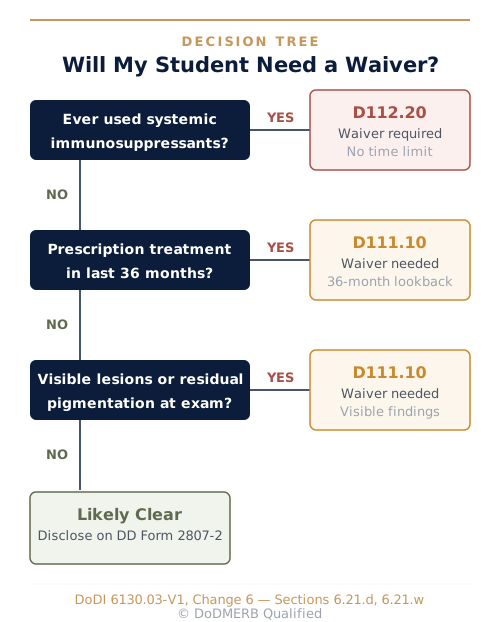
After this section, you can determine which scenario matches your student and whether a waiver will be needed.
Eczema Waiver Rates by Branch and How ROTC Differs from Service Academies
The same eczema history can get waived at one program and denied at another. Branch matters significantly, and the structural difference between ROTC and service academy waiver processes creates a real strategic advantage.
Branch-by-Branch Waiver Tendencies
| Program | Waiver Authority | Eczema Waiver Tendency |
|---|---|---|
| USAFA (Air Force Academy) | USAFA Surgeon | Strictest. Near-blanket bar for systemic treatment history. |
| USMA (West Point) | Academy Surgeon | Moderate. Reviews holistically, considers full picture. |
| USNA (Naval Academy) | BUMED | Moderate. Case-by-case evaluation. |
| Army ROTC | Cadet Command Surgeon, Fort Knox | Most flexible. Highest approval rates for skin conditions. |
| AF ROTC (scholarship) | AETC/SG | Follows USAFA tendencies. Stricter than Army ROTC. |
The overall eczema waiver approval rate sits at approximately 26%. Individual branch rates vary, with Army ROTC at the higher end and USAFA at the lower end.
ROTC Structural Advantage
There is a critical procedural difference between ROTC and service academy waiver processing. When a ROTC scholarship applicant receives a DQ, their file is automatically forwarded to the waiver authority for review. Every disqualified ROTC candidate gets a waiver review.
Service academies work differently. A disqualified candidate's file is forwarded to the waiver authority only if the academy determines the candidate is academically competitive enough to warrant the review. An academically borderline candidate with eczema may never have their waiver considered.
Multi-Program Strategy
A waiver denial at one program does not affect applications to other programs. Each branch evaluates independently using its own waiver authority. Students should apply broadly and understand that the same documentation package works across all applications.
After this section, you understand how branch selection and program type affect your student's waiver chances.
Waiver Strategy: Documentation, Timing, and Next Steps
The waiver authority has never met your student. The documentation package is your student's entire case.
Dermatologist Fitness-for-Duty Letter
The most important document. Must come from a board-certified dermatologist (MD or DO only) and address four areas: current skin status (no active lesions), complete treatment history with medications and dates, prognosis (low recurrence risk), and fitness-for-duty statement referencing military demands (body armor, heat, field hygiene).
Complete Treatment Timeline
Build from pharmacy records, not memory. Every prescription, provider, and date. For systemic immunosuppressants, document the medication, duration, outcome, and last dose. Gaps raise suspicion.
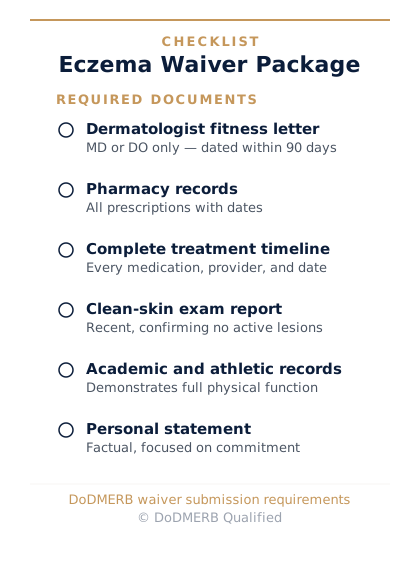
Waiver Documentation Checklist
- Dermatologist fitness-for-duty letter (MD/DO, dated within 90 days)
- Pharmacy records showing all prescriptions with dates
- Complete treatment timeline document
- Recent clean-skin exam report
- Academic and athletic records demonstrating full physical function
- Personal statement (factual, 3-5 paragraphs, focused on commitment and capability)
Timing and Process
Schedule the DoDMERB exam during a clear-skin period. Respond to AMI requests promptly through DMACS 2.0, submitting only what was requested.
If denied, file a rebuttal with new evidence. Apply to other programs simultaneously. AF ROTC offers an Exception to Policy (ETP) second-level appeal. Waiver timelines vary by branch and case complexity. Service academy timelines must resolve before the April 15 medical qualification deadline.
DoDMERB Qualified
Not sure how to build your student's eczema waiver package?
DoDMERB Qualified helps families assemble documentation, identify the correct DQ codes, and prepare waiver packages that address exactly what waiver authorities evaluate.
Related: For a look at how another chronic skin condition navigates DoDMERB — including the biologic medication trap — see Psoriasis and DoDMERB Qualification: Parent Guide.
After this section, you have a complete action plan for documentation, timing, and waiver submission.
Frequently Asked Questions
My student had eczema as a toddler but has not had it in 10 years. Will this be a problem?
Probably not, if no prescription treatment was used in the last 36 months and no systemic immunosuppressants were ever used. Disclose the history on DD Form 2807-2. Clear skin at exam with no residual pigmentation should not trigger a DQ code.
My student is currently on Dupixent. Can they still get into an academy?
They will be disqualified under D112.20, which has no time limit. A waiver is required, and rates vary by branch. Army ROTC offers the best structural path to waiver review. Begin preparing documentation now.
What is the difference between a DoDMERB disqualification and a waiver denial?
A disqualification means DoDMERB found a condition matching a DQ code. A waiver denial means the branch's waiver authority reviewed the case and declined an exception. Separate decisions, separate authorities.
Are ROTC and service academy eczema standards the same?
The DQ criteria are identical under DoDI 6130.03. The difference is process: ROTC auto-forwards every DQ for waiver review, while service academies forward only academically competitive candidates.
What exactly does "treatment beyond over-the-counter" mean?
Any medication requiring a prescription: prescription-strength topical steroids, tacrolimus (Protopic), pimecrolimus (Elidel), and all systemic medications. OTC hydrocortisone 1% and moisturizers do not trigger D111.10.
What should the dermatologist's letter include?
Confirmation of no active lesions, complete treatment history with dates, low-recurrence prognosis, and a fitness-for-duty statement referencing military conditions (body armor, heat, field hygiene). Must come from an MD or DO, dated within 90 days.
If one academy denies my student's waiver, does that affect other applications?
No. Each branch evaluates independently. A USAFA denial has no bearing on West Point, Naval Academy, or ROTC applications.
Why does the military care about eczema if modern treatments control it so well?
Eczema vaccinatum (life-threatening reaction to smallpox vaccine) and operational conditions (heat, body armor, limited hygiene) that trigger flares. Biologics like Dupixent also require refrigeration unavailable in the field.
How long does the eczema waiver process take?
Waiver timelines vary by branch and case complexity. Service academy timelines must resolve before the April 15 medical qualification deadline.